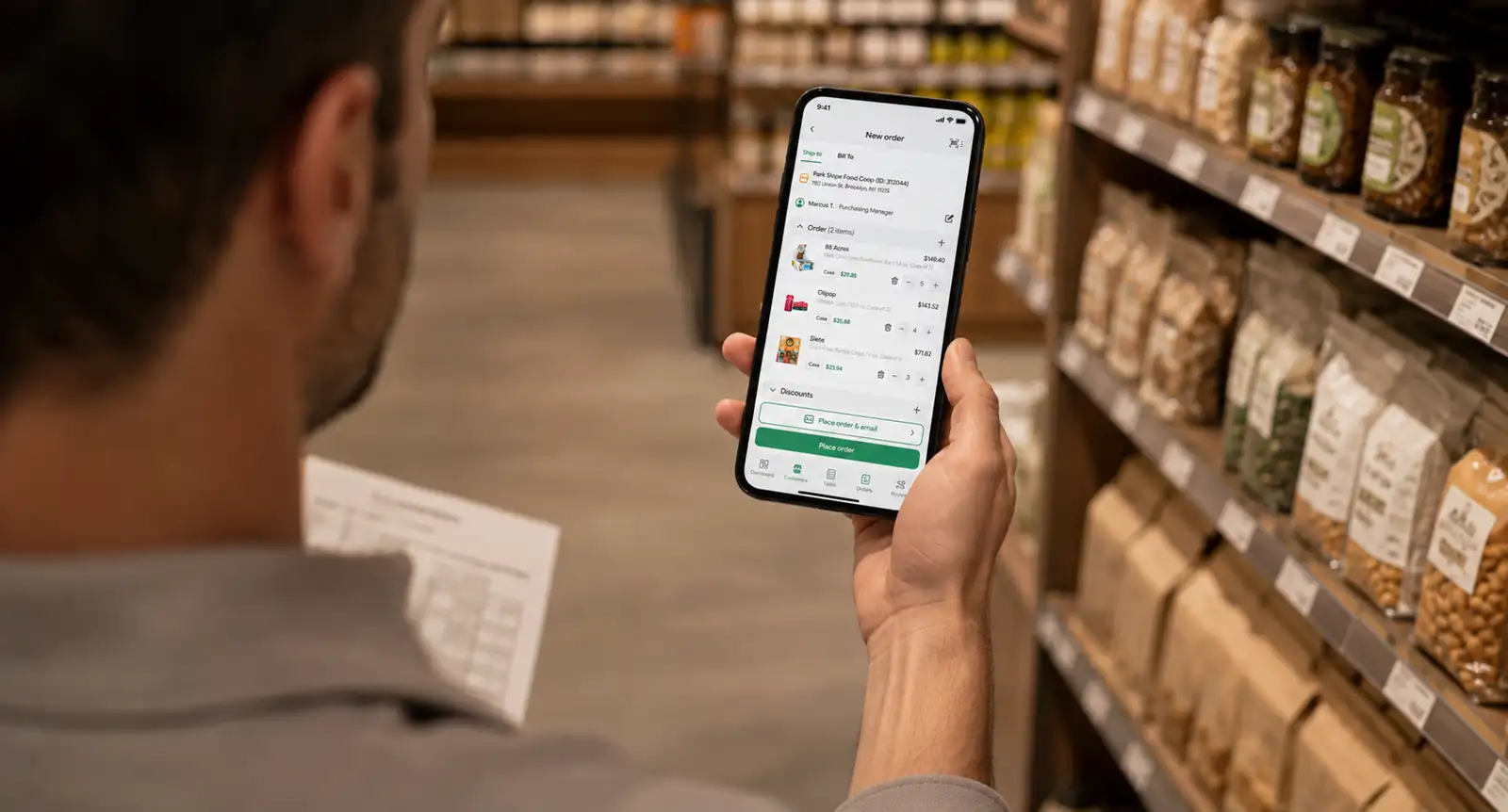
Guided Selling: How It Works for B2B Sales Teams


📌 Key takeaways
- Guided selling is decision support, not just product recommendations. It helps determine what should be shown, discussed, reordered, substituted, or prioritized.
- Rules should come before recommendations. Availability, pricing, account eligibility, territory, and promotions determine what can be offered before any system decides what is most relevant.
- B2B guided selling works across rep-led and self-service sales. The same account context can help a field rep during a visit or help a retailer ordering online.
- The best systems support human judgment instead of trying to replace it. Reps still understand account relationships, store conditions, objections, and opportunities that data may miss.
A sales rep walks into a store carrying a catalog with 800 SKUs.
The buyer normally orders 12.
Three products are out of stock. Two promotions are active. The retailer has never ordered one of the brand’s fastest-growing SKUs, and the rep has 20 minutes before the next stop.
The problem is not access to information. It is knowing what matters right now.
That is where guided selling comes in.
Guided selling uses customer, product, order, and business data to help sales reps or buyers narrow a large number of possible choices into a smaller set of relevant actions or products.
For distributors and CPG brands, that could mean identifying an assortment gap, suggesting an appropriate substitute, surfacing a promotion, reminding a rep about a reorder opportunity, or helping a retailer find the right products in a self-service storefront.
And the need for that type of guidance is growing. Gartner found that 61% of B2B buyers prefer an overall rep-free buying experience, while 69% report inconsistencies between information on supplier websites and what sales reps tell them. That creates a clear challenge: buyers want flexibility, but they also need consistent, useful guidance wherever they buy. (Gartner)
What Is Guided Selling?
Guided selling is a sales approach that uses customer context and business data to help a seller or buyer choose the most relevant product, offer, or next action.
A traditional catalog answers:
“What can I buy?”
Guided selling answers:
“What makes sense for this customer right now?”
That distinction matters in B2B distribution because the “best” product is rarely determined by product features alone.
A recommendation may depend on what the account already carries, its negotiated price, available inventory, previous orders, retailer type, territory, an active promotion, or even what happened during the last store visit.
The purpose is not to remove choice. It is to remove irrelevant choice.
That makes guided selling a natural extension of field sales software and sales enablement: the rep already has access to account information, but guidance helps turn that information into a decision.
How Does Guided Selling Work?
For distributors and brands, a useful guided selling process can be understood as five steps:
Customer context → Eligibility → Relevance → Explanation → Action
The order matters.
1. Start With Customer Context
Before recommending anything, the system needs to understand the account.
For an existing retailer, that may include purchase history, store type, current assortment, reorder patterns, customer-specific pricing, promotions, territory, and previous sales activity.
Consider two stores that both buy the same sparkling water.
One is a small convenience store with limited cooler space. The other is a specialty grocery store already carrying most of the brand’s range.
Recommending the same next SKU to both accounts simply because they purchased the same product ignores the reality of the account.
Good guidance starts with context.
2. Determine What the Customer Is Actually Eligible to Buy
This is where many recommendation systems get the logic backwards.
Before asking which product should rank first, first ask which products should not appear at all.
A SKU may be unavailable. The customer may have a different price list. A promotion might apply only to certain accounts. A product could be discontinued, restricted to another territory, or inappropriate for that retail channel.
A recommendation that cannot actually be ordered is worse than no recommendation because it teaches the sales team not to trust the system.
The underlying principle is simple:
Eligibility decides what can be recommended. Relevance decides what should be recommended first.
This is especially important in distribution, where pricing, inventory, assortments, and commercial terms are often customer-specific.
3. Rank the Most Relevant Opportunities
Once invalid options are removed, the remaining products or actions can be prioritized.
This is where order history, account similarity, product relationships, seasonality, assortment gaps, promotions, and sales velocity become useful.
Imagine a retailer carrying nine products from a brand’s ten-SKU core assortment.
The tenth SKU sells well in similar accounts and is currently available.
That is a much stronger sales signal than simply recommending the company’s highest-margin product.
The same principle applies to replenishment. If an account normally orders a product every three weeks and six weeks have passed since its last order, the timing itself becomes useful sales context.
Guided selling works best when the system asks:
“What is most relevant to this account?”
—not—
“What do we most want to sell?”
4. Explain Why the Recommendation Appeared
A recommendation becomes far more useful when the rep understands the reason behind it.
Compare these two prompts:
Recommended: Product B
versus:
This account buys four of the five products in this range and has never ordered Product B.
The second gives the rep something they can use.
A good explanation might show that the account purchased the product previously, similar stores carry it, the item is commonly ordered with another SKU, the retailer qualifies for a promotion, or the product is an appropriate replacement for something unavailable.
That transparency also allows the salesperson to recognize when the recommendation is wrong.
The rep might know that the buyer rejected the SKU last month, has no shelf space, sources an equivalent product elsewhere, or plans to change the category entirely.
Guided selling should make salespeople better informed—not turn them into operators following unexplained instructions.
💡 Pro Tip
If your reps cannot explain why a recommendation appears, buyers probably will not find it convincing either. Give the rep a sales reason, not just a score.
5. Put the Recommendation Where the Decision Happens
Timing is part of relevance.
A recommendation discovered in a Monday morning analytics dashboard may be forgotten by the time the rep reaches the store on Thursday.
Guidance is more useful when it appears during the actual workflow: while reviewing the customer before a visit, building an order, checking previous purchases, applying a promotion, or responding to an unavailable product.
That is why guided selling is closely related to sales execution software.
The information and the action should live close together.
If a rep sees a recommendation and then has to open another app, search the catalog, check inventory, find the right customer price, and return to the original order, the system has provided insight but not much guidance.
What Does B2B Guided Selling Look Like in Distribution?
The concept becomes clearer when applied to everyday distributor workflows.
Reorders With an Assortment Opportunity
A beverage rep visits an independent retailer that routinely orders six core SKUs.
The normal reorder items are already visible, but the account is also missing one product carried by most comparable stores in the territory.
Instead of making the rep search through the full catalog, the sales workflow highlights that assortment gap while the order is being created.
The rep can decide whether it makes sense for the store.
This is guided selling at its most practical: not replacing the existing order, but adding useful context to it.
Out-of-Stock Substitutions
A retailer asks for a product that is unavailable.
The worst experience is simply telling the buyer it is out of stock.
A better workflow can surface a suitable alternative based on brand, category, pack size, flavor, or previous purchasing behavior.
The important distinction is that the suggestion responds to an existing customer need.
It is not an arbitrary upsell.
Promotions
Distributors frequently run discounts or promotions that only apply to certain products, customers, quantities, or periods.
A rep should not have to remember every rule.
Guided selling can surface a relevant promotion when the customer and order meet the appropriate conditions.
That helps prevent both missed opportunities and irrelevant pitches.
New Product Launches
New-product distribution is another strong use case.
A brand launching a new SKU could ask every rep to pitch every account.
Or it could prioritize accounts based on their current assortment, retailer type, category performance, location, and history with similar launches.
That fits naturally into a broader CPG go-to-market strategy: winning the listing is only the first step; brands still need to identify where the product has the best chance of selling through.
Self-Service B2B Ordering
Guided selling does not require a field rep.
A retailer using a B2B storefront can receive the same kind of assistance through relevant reorders, substitutes, complementary items, or account-specific recommendations.
This matters because digital B2B ordering creates an interesting trade-off.
Buyers want self-service, but self-service can also remove the account knowledge an experienced salesperson normally brings to the purchase.
Good B2B guided selling helps put some of that context back into the digital experience.
That is also one reason the underlying B2B ecommerce workflow matters. Recommendations are only useful when product information, pricing, inventory, and ordering logic are reliable.
Is Guided Selling the Same as Upselling or Cross-Selling?
No.
Upselling and cross-selling can be outcomes of guided selling, but they are narrower concepts.
Upselling usually means encouraging the buyer to purchase a higher-value version or larger quantity. Cross-selling means recommending an additional related product.
Guided selling asks a broader question:
What is the best next decision for this account?
That answer might be a cross-sell.
It could also be a reorder, substitute, promotion, new-product recommendation, or no recommendation at all.
That final option is important.
If every customer always receives five “opportunities,” salespeople quickly learn that the system is generating noise rather than insight.
Guided Selling vs. Product Recommendations vs. CPQ
|
Approach |
Main question it answers |
Typical B2B use |
|---|---|---|
|
Product recommendations |
“What else might this customer buy?” |
Related products, cross-sells, ecommerce suggestions |
|
Guided selling |
“What should this buyer or rep consider next?” |
Reorders, assortment gaps, promotions, substitutions, product selection |
|
CPQ |
“How should this complex solution be configured, priced, and quoted?” |
Configurable products, complex pricing, formal quotes |
The categories can overlap.
A guided selling workflow might eventually feed a CPQ process, and a product recommendation may be one part of guided selling.
But for most distributors carrying finished SKUs, the immediate opportunity is less about configuring complex products and more about helping reps make better account-level decisions.
Does Guided Selling Require AI?
No.
In fact, some of the most important guided selling decisions should not be left to AI.
Inventory eligibility is a rule.
Territory restrictions are rules.
Customer-specific pricing is a rule.
Promotion eligibility is a rule.
A product that has been discontinued should not suddenly become eligible because an algorithm predicts a high probability of purchase.
AI becomes more useful once those hard constraints have been applied.
If ten products are all valid options, a predictive model can help determine which ones are likely to be most relevant based on customer behavior or patterns across similar accounts.
The practical model is:
Business rules → eligible options → relevance ranking → human decision
That hybrid approach is also consistent with the broader direction of B2B selling. Gartner expects AI to remain useful for information gathering and personalization while human sellers remain important at complex or high-stakes decision points. (Gartner)
What Data Does Guided Selling Need?
Guided selling does not become useful because a company has “a lot of data.”
It becomes useful when the right data is connected to the decision.
For distributors and CPG brands, the strongest foundation usually combines customer context, order history, product information, commercial rules, inventory, and field execution data.
That last category is especially important.
An order tells you what the retailer bought.
A store visit may tell you why the next order should be different.
Shelf observations might reveal an out-of-stock. A photo may show a competitor taking more facings. A merchandising audit could show that a newly launched SKU has weak placement.
Merchandisers do not need to own the order for their work to improve guided selling. Their observations can become account context that helps the sales rep make a better decision later.
That connection between what happens on the shelf and what happens in the sales conversation is where retail execution software becomes particularly relevant.
When Is Guided Selling Worth Implementing?
Not every distributor needs a sophisticated recommendation engine.
If you carry 40 products, every rep knows every customer personally, and the assortment changes rarely, adding complex guidance may create more work than value.
The opportunity becomes more compelling when catalogs grow, reps manage many accounts, customer pricing becomes complex, new products are launched frequently, promotions vary by account, or newer reps struggle to develop the same account knowledge as experienced sellers.
A useful signal is repetition.
If managers repeatedly tell reps things like:
“Remember to check whether they carry Product X.”
“Make sure you offer the promo to eligible accounts.”
“If that SKU is unavailable, suggest Product Y.”
“This customer should probably have reordered by now.”
…then part of the sales process is already being guided.
The guidance just lives in people’s heads, Slack messages, spreadsheets, or training documents rather than inside the workflow.
How Should Distributors Implement Guided Selling?
Start with one recurring decision rather than trying to automate the entire sales conversation.
For example:
Which accounts are due to reorder?
or:
Which core SKU is missing from this account’s assortment?
Define what makes an account or product eligible. Then decide what information determines relevance. Put the recommendation inside the workflow where the rep can act on it, and track what happens afterward.
If the rep accepts the recommendation, that is useful feedback.
If they reject it, that is useful too.
The reason for rejection may reveal missing information: no shelf space, buyer declined previously, wrong store format, low local demand, or an equivalent product already sourced elsewhere.
Over time, that feedback loop can make the guidance more accurate.
The goal is not to build the smartest recommendation engine.
The goal is to reduce unnecessary decisions without removing the decisions where human judgment adds value.
How Do You Measure Guided Selling Performance?
Start with recommendation quality rather than revenue alone.
Recommendation acceptance rate tells you whether salespeople or buyers consider the suggestions useful.
SKU penetration can show whether relevant products are expanding across suitable accounts.
New-product adoption is useful when guided selling supports a launch.
Average order value can help measure the effect of appropriate cross-selling and upselling, although it should not become the sole objective. SimplyDepo’s guide to average order value covers that metric in more depth.
Also look at order-entry time and recommendation overrides.
A tool that increases order value slightly but makes every order slower may simply be shifting the cost elsewhere.
And a high override rate should not automatically be blamed on reps. It may mean they know something the model does not.
What Are the Most Common Guided Selling Mistakes?
The biggest mistake is confusing more recommendations with better guidance.
A list of 20 recommended products is another catalog.
The second mistake is optimizing recommendations only for what benefits the seller. If every suggestion prioritizes margin or promotional pressure without considering the retailer’s assortment, the rep eventually loses trust with both the buyer and the system.
Another common mistake is ignoring operational reality. Recommendations need to reflect inventory, pricing, account rules, and fulfillment constraints.
Finally, avoid building guided selling as a separate dashboard that salespeople have to remember to check.
The closer guidance appears to the customer and ordering workflow, the more likely it is to be used.
Where Does SimplyDepo Fit?
Guided selling depends on connected operational context.
Before a system can recommend the right next product or action, it needs reliable information about the customer, their previous orders, products, pricing, promotions, and what is happening in the field.
SimplyDepo brings many of those workflows together for distributors and CPG brands through customer management, mobile field sales, B2B ordering, and retail execution.
That does not mean every sales decision should be automated.
The more useful opportunity is reducing the distance between what your organization knows about an account and what the rep can actually do with that information during a visit or order.
For distributors working toward that kind of connected workflow, CRM for distributors and field sales tools provide the operational foundation that guided selling relies on.
FAQs
Guided selling is a sales approach that uses customer context, product data, business rules, and sometimes predictive models to help sellers or buyers choose the most relevant product, offer, or next action.
It reduces unnecessary choice while keeping the final decision with the salesperson or buyer.
B2B guided selling applies the same approach to business purchasing.
For distributors, recommendations may consider account-specific pricing, order history, inventory, assortments, territories, promotions, retailer type, and other commercial rules that make B2B buying more complex than a typical consumer purchase.
Guided selling software is technology that surfaces recommendations or next-best actions based on customer and product context.
Depending on the use case, it may exist inside a CRM, ecommerce platform, sales enablement system, CPQ tool, or field sales application rather than as a standalone product.
No.
Rules-based guided selling can already solve valuable problems such as promotion eligibility, reorders, substitutions, and assortment gaps.
AI becomes more useful when many valid choices remain and the system needs help ranking them by relevance.
Yes.
Field reps can use guided selling before or during customer visits to identify reorder opportunities, assortment gaps, relevant promotions, substitute products, or new-product opportunities.
The strongest implementations surface that information inside the rep’s existing customer and order workflow.
Yes.
The same account context used by a field rep can support self-service purchasing through account-specific recommendations, reorders, substitutions, and relevant product discovery.
The interface changes, but the underlying objective remains the same: help the buyer make a better decision with less effort.
No.
Sales enablement is broader. It provides sales teams with the training, content, processes, data, and tools needed to sell effectively.
Guided selling is one form of decision support within that broader sales process.
Start with a narrow, repeatable use case that already causes friction for reps.
Reorder identification, assortment gaps, promotion eligibility, and out-of-stock substitutions are usually easier to define and validate than attempting to automate an entire sales conversation.
-
 October 1, 2026
-
 October 1, 2026
-
 October 1, 2026