How to Make Your First Sale: Tips for New B2B and Field Sales Reps


Most advice on making your first sale assumes you run an online store: share the link with friends, run a few ads, fix the checkout. That can work well on Shopify. It helps much less when your first sale has to happen at a store counter.
This guide is for the other kind of first sale, a purchase order from a business that will resell your product. It’s written for two people in particular: the rep in their first weeks with a territory to work, and the founder of a young CPG brand who is still doing the selling in person.
Both walk in without history. The buyer doesn’t know you, your product hasn’t sold in that store, and you don’t yet know which questions are coming. The steps below cover the work before the visit, the visit itself and the weeks after it, where a store that ordered once becomes a customer or doesn’t.
What Counts as a First Sale in the B2B Sales Process and Field Sales
In B2B and field sales, a first sale is the first purchase order from a business that buys to resell, usually a store, a chain or a distributor. The buyer won’t use the product, so the decision rests on margin, how fast it will sell and whether you’ll deliver when you say you will.
That changes what winning means. A store that takes two cases and never reorders has cost you a visit, a sample and a delivery, and has taught the buyer that your product sits on the shelf. The first order opens the relationship, and the reorder shows whether the sale worked.
The two readers of this guide start from different places. A new rep often has an established catalog, a price list and maybe a few inherited accounts, but has no relationships and doesn’t know the territory yet. A founder knows the product inside out and has no track record with buyers, often no distributor and very little spare time.
Know the Margin Math Before You Walk In
A store buyer decides with a calculator, so run the numbers before they do. You need your case price, the units per case, the likely shelf price and the margin the store keeps, plus what changes when a distributor sits in the middle.
The table uses made-up figures for a 12-unit case to show how the pieces fit together. Swap in your own before a visit.
| Line | Selling direct to the store | Selling through a distributor |
|---|---|---|
| Price you charge per case | $24.00 to the store | $18.00 to the distributor |
| Store’s cost per case | $24.00 | $24.00 |
| Store’s cost per unit | $2.00 | $2.00 |
| Shelf price per unit | $3.49 | $3.49 |
| Store’s margin per unit | $1.49, or 42.7% | $1.49, or 42.7% |
| Distributor’s margin per case | None | $6.00, or 25% of $24.00 |
| What you receive per case | $24.00 | $18.00 |
The store sees the same cost either way: $2.00 a unit and $1.49 of margin at a $3.49 shelf price. What changes is what you keep. Going through a distributor costs you $6 a case in this example, in exchange for delivery, invoicing and reach you’d otherwise handle yourself. Distributors often bill promotions, free fills and new-item fees on top, so ask for their fee schedule before you set your price.
Know which number the buyer is likely to push on. If the category needs a higher store margin than your price allows, you’ll hear “too expensive,” and the fix is a pricing decision, not a better pitch. Work the chain up from your own cost with one consistent wholesale pricing formula before the meeting, so you can answer a margin question on the spot instead of promising to get back to them.
Pick Stores That Can Say Yes Today
Your first sale is most likely at a store where the product fits the shelf, the person you meet can decide, and a small opening order is normal. For most new reps and founders, that means independent stores before chains.
An independent grocer, deli, café or specialty shop often has an owner or manager who can approve a new item that day. The right first-store target is a qualified sales lead: a potential customer that already sells the category, understands the product type, and can afford to bring it in. A chain usually routes new items through a category review on a set calendar, which is worth pursuing later, just not as your first order.
A record of reorders from independents is also what a chain buyer will want to see later, which is why starting with independent retailers can be the quicker way into big retail.
Build your short list from stores clustered in one part of the territory, so a morning of visits doesn’t turn into a morning of driving.
Before you add a store, check with a quick walk-through or on its website to identify prospects and quality leads that fit the shelf, shopper, and price point before spending time on a visit. This also helps you reach decision makers instead of the wrong contact. Then plan to visit at a quiet hour, since a buyer on a busy Saturday won’t have long to talk.
Prepare a Sell Sheet and a Sample Plan
A sell sheet is the one page the buyer keeps after you leave, and it’s often what the buyer reaches for later, when checking with the owner or looking at the shelf plan. Fill it with the facts a buyer needs to say yes rather than your brand story.
Here’s what a first-visit sell sheet should carry.
- The product name, flavors or sizes, and a clear photo of the package
- The UPC, case pack and case dimensions
- Case cost, suggested shelf price and the store’s margin at that price
- Shelf life and storage needs, such as refrigerated or shelf-stable
- Minimum order, delivery days and lead time
- Which distributors carry you, or a note that you deliver direct
- Payment terms and how to place a reorder
- One proof point using social proof, such as nearby stores that already stock it, testimonials, or early sell-through evidence
- Your name, phone number and email
Samples need a plan too. Decide before the visit who gets one, how much to leave and when you’ll follow up, then write the follow-up date on the sell sheet so the buyer knows it’s coming, and make the product’s value easy to scan later when the buyer reviews it. A sample left with no date attached is easy to forget once you’ve driven away.
How to Make Your First Sale on a Store Visit
A first store visit works best as a short, prepared conversation: look before you talk, ask before you pitch, propose something small and specific, and ask for the order plainly. Each step below takes a few minutes.
Walk the Store Before You Ask for Anyone
Find your category first. Note what’s on the shelf, the price points, any gaps and anything dusty or overstocked, and take a photo if the store allows it. Those details give you an opening that isn’t about you.
Open with What You Noticed
Ask for the person who orders your category, then start with the store rather than the product. “I noticed you carry three cold brews and the two cheaper ones were empty” shows you looked, and it earns more attention than a rehearsed opener.
Ask More Than You Pitch
Active listening is key to building trust in early sales interactions. Itani, Goad and Jaramillo pooled 24 empirical studies, covering about 20 years of research on salesperson listening, in a 2019 meta-analysis for the Journal of Business Research. They concluded that listening is just as important as adaptive selling in lifting a salesperson’s performance.
Good first-visit questions are simple. Ask what sells best in the category, what shoppers ask for that the store doesn’t carry, how often it orders and who else signs off on new items. These questions help uncover pain points, identify the prospect’s pain points more clearly, and clarify the prospect’s role in approving or influencing the order. The answers tell you whether to pitch now, which item to lead with and what order size makes sense.
That diagnosis-first habit is consultative selling compressed into a short store visit, and it often gets the buyer to describe the gap your product could fill before new reps try to prove what they know instead of learning what matters most to the buyer.
Propose a Small, Specific First Order
Make the first order easy to approve as part of a repeatable sales process: one or two items, a case or two of each, with a clear spot on the shelf. “Two cases of the original and one of the ginger, next to the cold brew where shoppers already look” is easier to say yes to than “try our line” because the proposal can focus on the store’s best customers and the specific shelf opportunity you observed.
If the buyer worries about risk, offer something concrete, such as a demo day or a guaranteed-sale window, which is a promise to credit unsold units after a set period. You can also offer an approved, budgeted early-bird incentive for the first order, like a small introductory discount. Offer it only if your company has approved it, or, if you’re the founder, only if you’ve budgeted for the credits. It’s not an option for beer, wine or spirits, where federal rules bar selling with the privilege of return.
Ask for the Order Out Loud
It’s easy to leave a friendly conversation without asking, but after a good discussion you should ask for the order with confidence. Close with a direct question, such as “Can I write that up for Thursday’s delivery?”, then stop talking and wait for the answer. Good handling objections starts before the buyer raises them, by being ready to answer likely questions about price, margin, delivery, or fit.
When the First Answer Is No
A no on a first visit is often a not yet and one of the normal stages before closing deals, so leave with a reason and a next step. Ask what would need to be true for the store to try the product: a different price point, a distributor it already buys from, proof from nearby stores or a different season.
Write the answer down and set a follow-up date that matches it. Persistence matters because 80% of sales require at least 5 follow-ups. If the buyer says the shelf resets in March, a visit in February with your sell sheet and the names of two nearby stores that now carry you beats a call next week.
Between visits, a short email that quotes the buyer’s own concern keeps you in mind without pressure, and a set of follow-up email templates written for field reps saves you from a blank screen after a long day on the road. Those follow-up emails should be categorized by purpose and add value each time, whether that means answering a concern, sharing proof, or confirming timing, so your consistency leads to more deals.
Stop following up when the buyer rules out the category for good, or when two or three honest attempts get no reply. The goal is to avoid missed opportunities without chasing stores that are clearly unqualified, because your time is better spent on the next store on your list and the deals most likely to move.
Write the First Order So It Arrives Right
A first order has to arrive exactly as written, because the buyer has no track record with you to excuse a mistake. Before you leave, confirm the items, case counts, price, delivery day, receiving hours and who signs for the delivery.
Pack size and price are where first orders go wrong. If you write “two” and the warehouse reads two units instead of two cases, or the invoice shows a price the buyer never agreed to, the reorder conversation starts with a credit memo.
Three checks prevent the most avoidable first-order mistakes in a simple process that reduces avoidable errors before they affect customers: write quantities in cases with the case pack shown (2 cases of 12), confirm the price against what the buyer agreed to, and confirm stock before you promise a delivery day.
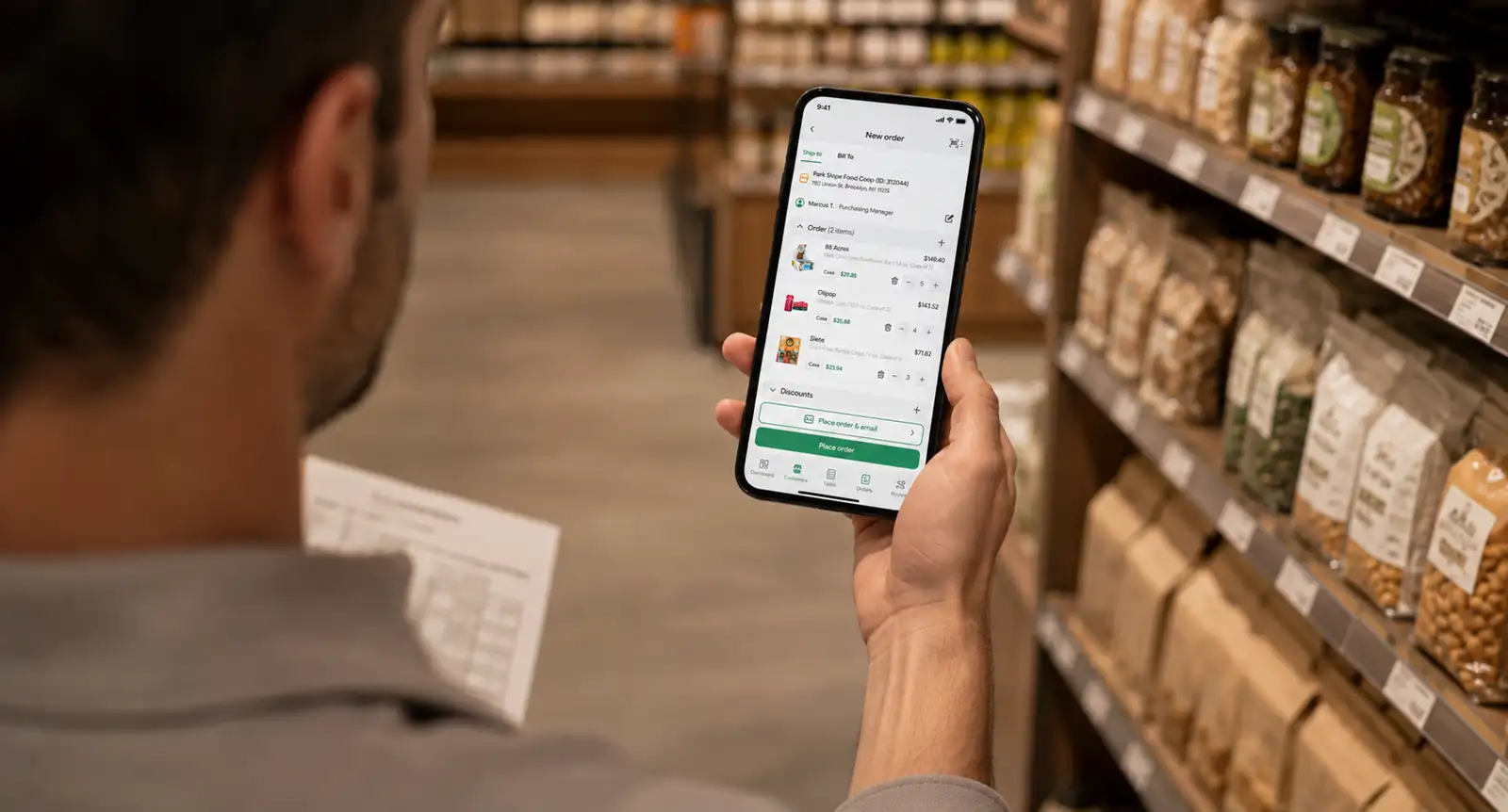
Ola Mate, a New York City yerba mate brand whose reps visit stores daily and take orders on the spot, moved that order entry into SimplyDepo’s mobile app. Its order correction rate then fell from 25% to 5%, and new store onboarding shrank from 7 to 10 days to 2 to 3 days, according to the Ola Mate case study. Many sales teams now use tools for order accuracy and support, and 19% of B2B sales forces already use GenAI for sales support. Its reps now use tools to place and edit orders in the store.
Turn the First Order Into a Second
The second order is where a first sale becomes a customer, and getting it right is key to long term success, not just a one-time win. Plan those weeks before the product arrives.
The table below is a starting schedule for a newly opened account. Tighten it for short-dated or fast-moving products and stretch it for slow categories.
| When | What to do | Why it matters |
|---|---|---|
| Before you leave the store | Confirm delivery day, receiving hours, who signs and where the product will sit | A missed receiving window can cancel the order before it lands |
| Delivery day | Check the order arrived complete and made it to the shelf | Cases left in the back room don’t sell |
| End of week one | Visit or call to fix placement, price tags and facings | Early placement problems are the easiest to correct |
| End of week two | Count what sold, talk to the staff who stock the shelf, and propose the reorder if stock is running low | Sell-through is the evidence for your next proposal |
| Weeks three to four | Write the reorder if you haven’t already and set the account’s regular visit rhythm | The second order confirms the store is a customer |
Handled well, early buyers can become clients who give positive feedback and referrals, which helps turn early customers into advocates and sources of referrals.
Base the reorder on what sold, not on what you hope to sell. If the store sold 18 units in two weeks and has 6 left, it’s selling about 9 a week and will run out within days, so write the reorder on that visit instead of waiting. Twelve more units covers the next two weeks at that pace with nothing to spare, which is one 12-unit case.
If delivery takes a few days or the buyer wants a cushion, a second case is the honest ask, and saying the math out loud lets the buyer check it.
SimplyDepo’s B2B ordering app is built for both the first order and this one. The rep sees the seller’s live stock by SKU before proposing a quantity, each account opens with its own price list, and the buyer signs on the device, with payment by cash, check, or card via Stripe.
Keep every conversation, photo and promise from these weeks in one place. The next visit may be a month away, and it may be made by someone else, so one record also helps with future customer interactions and relationship building across the account.
Common Sales Mistakes New Reps Make
Most of the common sales mistakes below come from nerves and hurry rather than a lack of product knowledge. Watch for them in your first months.
- Pitching before you’ve looked at the shelf
- Talking over the buyer’s answers instead of listening to them
- Missing body language or visible hesitation from the buyer, which can derail sales interactions
- Pushing a big first order to look good, then watching it sit
- Promising a delivery day or a price your company hasn’t approved
- Offering a discount before the buyer has raised price
- Spending the visit with someone who can’t place an order
- Criticizing the competitor sitting on the buyer’s shelf
- Leaving without asking for the order or a next step
- Skipping the visit notes until the end of the day, when half of it is forgotten
A written pre-visit routine and a short review at the end of each day catch several of these. The best salespeople improve faster when salespeople review mistakes in a measurable way instead of trying to fix everything at once.
Sales Tips for Beginners in the First 90 Days
The most useful sales strategies for beginners are about learning fast: get clear on what a good visit looks like, ask colleagues and buyers plenty of questions, and keep a record you can learn from to support long-term growth and success.
Research on new employees backs the first two. Bauer and colleagues’ meta-analysis of 70 samples of newcomers, published in the Journal of Applied Psychology in 2007, found support for a model in which newcomers’ role clarity, self-efficacy and social acceptance carried the effects of a company’s onboarding tactics, and of newcomers’ own information seeking, through to job performance, satisfaction and turnover.
For a new rep, these habits turn that finding into a routine, and a structured course or onboarding plan can help new salespeople ramp faster in their first 90 days.
- Ask your manager to describe a good visit and a good week in writing.
- Ride along with a strong rep for a few days before working alone.
- Learn your top ten SKUs and their case packs until you can quote them without looking.
- Ask every buyer one question about how they order, even when they don’t buy.
- Log each visit the same day, including the ones that went nowhere.
- Review your week every Friday, use data from your visit logs to see what is working, and pick one thing to change so you can refine your strategies over time.
The last two habits depend on a record you can search. A field sales CRM that keeps each store’s notes, photos, orders and contacts on the rep’s phone lets a new rep see what the last person promised before walking in, helps build pipeline, gives sales leaders real visits to coach from, and lets reps draw on past notes instead of starting cold each visit.
What Changes When You’re the Founder Doing the Selling
For a founder, how to make your first sale follows the same steps with three differences: nobody recognizes the brand yet, you may not have a distributor yet, and every hour spent selling is an hour away from running the company, so focus on the market you can win first instead of trying to sell everywhere.
Turn being unknown into an advantage. Buyers at independent stores often like meeting the person who made the product, so give the short version of why it exists and who buys it, then move to the numbers.
Settle the distributor question before you pitch, because some stores only add items their existing distributors carry. Have an answer ready: you deliver direct in this area, you’re in talks with a named distributor, or you’ll use your first stores’ sales to win one. Buyers, distributors, and other businesses weigh the same things, and founders need to position the product clearly against competitors without attacking competing items: sell-through, margin and reliability. The way to pitch a retail buyer or a distributor is to lead with those three.
Protect your time as the list grows. Track which visits produce orders, and once a group of stores reorders without you, hand them to a rep or a distributor and go open the next ones, which frees up efforts for new accounts that can generate more money and revenue. The notes you keep now are what you’ll be handing over.
Count the Second Order, Not the First
Knowing how to make your first sale is mostly preparation: know the margin math, choose stores that can say yes, walk in with a sell sheet and a question, and ask for a small, specific order; the repeatable process behind it creates a more solid foundation for future orders. Whether it was worth it shows up afterward, in the delivery, the first shelf check and a reorder proposed from real sell-through.
That follow-through is easier when every visit, note, and order for a new account sits in one place that a manager and the next rep can see, helping reps stay consistent across accounts and support continued success. With sales management software like SimplyDepo, CPG brands and distributors can keep that information accessible to reps from their phones, so everyone has the context they need before the next visit. If you’d like to see how that could work for your team, you can book a demo.
Frequently Asked Questions
It depends on the territory more than the rep. A rep who inherits active accounts may write an order in the first week, while a rep opening new stores should identify decision makers early so they are not spending time on people who cannot move the purchase forward and may need several visits per store before one says yes. A founder selling a new brand should expect a longer path, since the buyer has no sales history to go on.
Walk the shelf before you talk to anyone, ask more than you pitch, propose a small and specific first order, and ask for it directly; these sales techniques work because they keep the rep focused on prospects and their needs rather than on a scripted pitch. Log every visit the same day and review your week on Fridays. Ride along with a strong rep early, since watching a good visit teaches more than a script does.
The ones to watch for are pitching before looking at the shelf, missing budget constraints before pushing for an order, talking over the buyer, pushing an oversized first order, promising terms your company hasn’t approved and leaving without asking for the order. Criticizing a competitor on the buyer’s own shelf is another, because the buyer chose to stock that product.
Small enough that the store can sell most of it before you propose the reorder, and large enough to fill a proper facing. For many independent stores, that means one or two items and a case or two of each. Base the second order on what actually sold, so neither you nor the buyer is guessing.
Selling direct keeps more of the case price and gives you closer contact with each store, but you handle delivery, invoicing and collections yourself. A distributor takes a margin and gives you reach and logistics. One workable path is to sell direct in one area to build a sales record, then use that record to win a distributor for wider coverage, while a new brand can also use micro-influencers and early retail wins to support advertising and attract more qualified store interest before wider distribution.
-
 October 1, 2026
-
 October 1, 2026
-
 October 1, 2026