AI-Powered Sales Forecasting for SMBs: Boost Accuracy and Grow

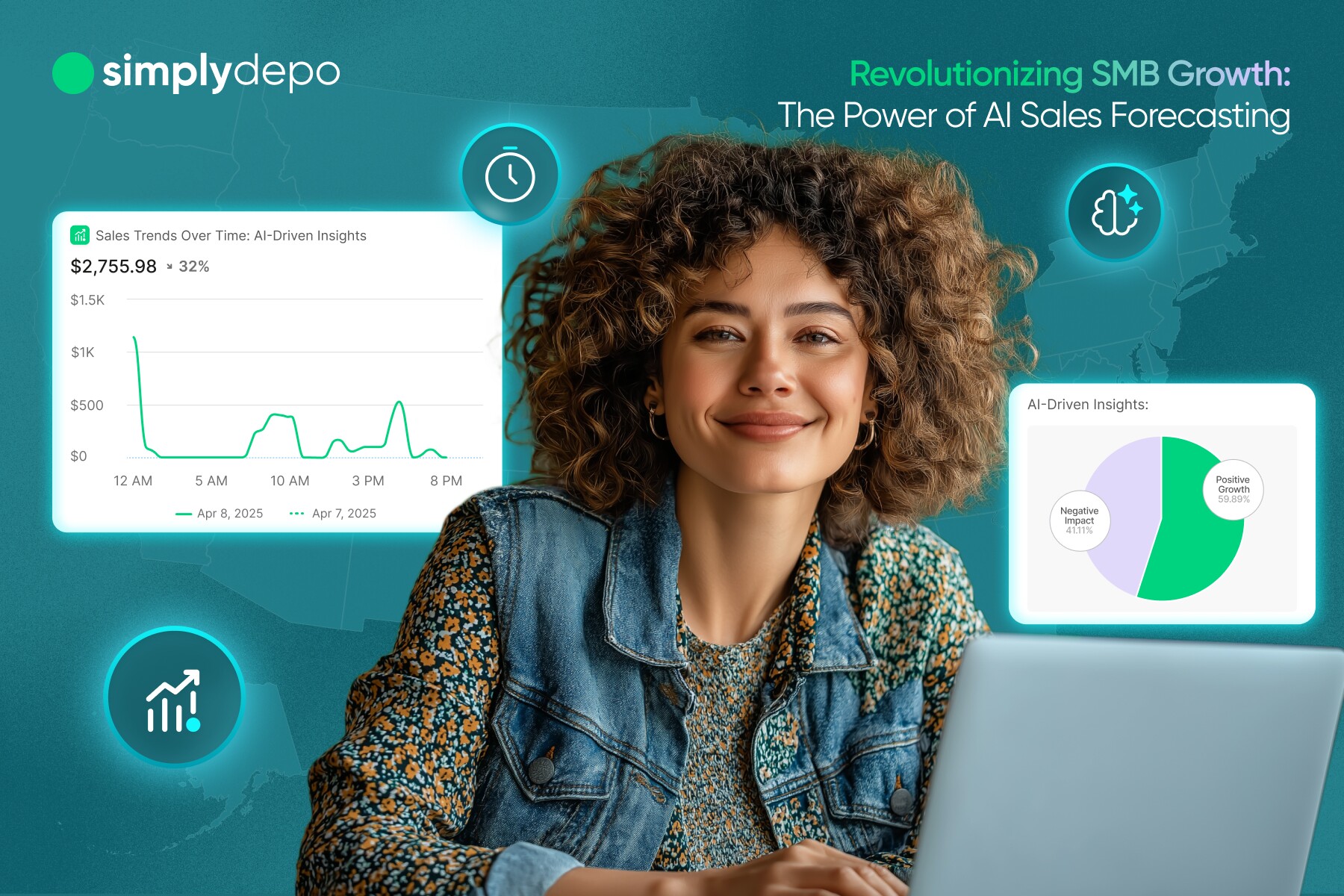
For small and mid-sized businesses (SMBs), every decision counts, and few decisions are more important than forecasting sales. But traditional sales forecasting methods fall short, leaving companies with too much inventory or not enough.
That’s where AI-powered sales forecasting comes in.
By using artificial intelligence and machine learning, even smaller businesses can now get predictive insights that were previously only available to large enterprises with data science teams. AI makes forecasting smarter, faster, and more accurate.
Let’s dive into how AI-driven sales forecasting works, how it helps SMBs, and how tools like SimplyDepo help distributors and brands make data-driven decisions.

What Is Sales Forecasting?
Sales forecasting is the process of predicting future sales based on historical data, current market trends, and predictive models. Accurate forecasting helps businesses plan inventory, allocate resources, and set realistic growth targets.
Traditional forecasting relies on:
- Past sales data
- Seasonality
- Sales rep input
- Spreadsheet modeling
While helpful, this manual approach is:
- Time consuming
- Prone to human error
- Blind to real-time changes in market behavior
AI changes that.
How AI Changes Sales Forecasting
AI-powered forecasting uses algorithms to analyze massive amounts of data, find patterns, and make predictions with incredible accuracy.
Here’s how AI improves forecasting:
1. Data Enrichment and Automation
AI tools pull data from multiple sources: POS systems, CRM, ERP, inventory logs, seasonal calendars, promotions, weather data, and more.
Instead of relying on past averages, the algorithm builds a dynamic understanding of what drives your sales.
2. Pattern Recognition
Machine learning can detect complex correlations and nonlinear trends that humans can miss, like how weather affects beverage sales or how pricing impacts repeat orders.
3. Real-Time Adaptation
AI models adjust in real-time based on new data, so if a top client suddenly reduces orders, your forecasts adjust accordingly.
4. Scenario Planning
AI lets you simulate multiple scenarios (e.g., promo impact, market slowdown, competitor entry) and forecast outcomes before you commit.
📊 According to McKinsey, AI-powered forecasting can reduce supply chain errors by 20–50% and increase sales by up to 6%.## Why SMBs Need AI Sales Forecasting (Not Just Enterprises)
Many SMBs think advanced forecasting tools are only for big corporations. But in reality, SMBs benefit the most.
✅ Better Inventory Planning
Overstock ties up cash flow. Stockouts lose sales. AI helps you find the sweet spot between demand and availability.
✅ Lower Operational Costs
Less overproduction, better warehouse efficiency, fewer emergency shipments. Forecasting reduces waste and reactive costs.
✅ Smarter Purchasing Decisions
You can order just enough raw materials or products to match actual demand—no guesswork.
✅ Enhanced Customer Service
Forecasting ensures the right products are available at the right time, boosts fulfillment rates, and customer satisfaction.
✅ Faster Scaling
With AI models in place, you can expand into new territories or product lines with data-driven confidence.

Case Study: How SimplyDepo Helps Distributors Forecast Smarter
SimplyDepo is a mobile-first platform that helps SMB distributors and brands simplify field sales, inventory, and route operations. And now, AI-powered forecasting is making it even more powerful.
📍 Example: HC Foods
HC Foods, a regional distributor of ethnic grocery products, used SimplyDepo to move from manual Excel-based forecasting to AI-driven demand planning.
Results after 3 months:
- Stockouts reduced by 40%
- Order fill rates increased by 20%
- Warehouse waste decreased by 18%
📍 Example: Brickyard Brands
Brickyard Brands, managing multiple beverage SKUs, needed seasonal forecasting to prep for Q3 promotions. SimplyDepo’s forecasting tools analyzed previous years’ data alongside promotion calendars and territory-level trends.
Outcome:
- They cut down on last-minute procurement by 70%
- Reduced underperformance in low-volume areas by reallocating stock
- Hit 97% availability rate during peak months
What to Look for in a Sales Forecasting Tool
When choosing an AI-powered forecasting solution, especially for SMBs, look for: FeatureWhy It MattersMulti-Source Data IntegrationCombines CRM, inventory, sales history, and external dataUser-Friendly InterfaceNo data science team required—your ops manager can use itDynamic ForecastingModels adjust as new data flows inCollaboration FeaturesSales and supply teams can align in one platformScenario SimulationTest the impact of promotions, price changes, or holidays
🎯 SimplyDepo’s forecasting engine is embedded in the same platform where SMBs manage orders, stock, and field teams—so there’s no need to switch tools or migrate data.
How AI Forecasting Works in Practice (Step-by-Step)
Let’s walk through how a typical SMB distributor might use AI forecasting through SimplyDepo or similar platforms.
Step 1: Collect and Sync Data
Import historical order volumes, product SKUs, sales routes, customer reordering behavior, promotions, and inventory levels.
Step 2: Define Forecast Periods and Goals
Set parameters—monthly, quarterly, or for specific promotions.
Step 3: Run Forecast Models
Let the AI run simulations and output forecasts by product, route, or customer.
Step 4: Review Scenarios
Adjust based on assumptions (e.g., “What if we run a 10% promo?”).
Step 5: Align Teams
Use the forecasting dashboard to share forecasts with purchasing, sales and warehouse teams.
Step 6: Execute and Monitor
As actual sales happen, AI learns and improves the model continuously.
What to Watch Out For
AI forecasting isn’t a magic bullet—it requires clean data, alignment, and understanding of your business model.
Common pitfalls:
- Relying on outdated or incomplete data
- Overcomplicating the model with too many variables
- Ignoring human feedback from field teams
That’s why tools like SimplyDepo combine AI forecasting with intuitive mobile tools for field teams, so your sales reps can give input directly during visits.
SimplyDepo: Making Sales Forecasting Simple for Distributors
What sets SimplyDepo apart is its ability to merge sales forecasting with real-world execution.
You’re not just getting predictions—you’re getting a live, operational workflow:
- Accurate Demand Forecasting. SimplyDepo uses AI to analyze historical and real-time data to give you precise forecasts to optimize inventory and avoid stockouts or overstocking.
- Visit & Route Planning. Sales teams can plan routes based on accurate demand forecasts to save time and see more customers.
- Instant Ordering. Sales reps can order on the go to ensure inventory is replenished in real-time based on demand forecasts.
- Real-Time Stock Tracking. Track inventory in real-time and adjust stock and supply chain operations as needed to ensure products are always in stock.
- Real-Time Adaptation. SimplyDepo allows you to adjust forecasts and operational plans as new data comes in so you can make decisions based on the latest information.
- Mobile-First. With a mobile-first design, SimplyDepo ensures all teams – from sales reps to warehouse staff – are aligned in real-time to increase collaboration and decision-making efficiency.
The Business Benefits
SimplyDepo increases efficiency, sales, and reduces costs by giving you accurate forecasts, optimizing routes, and real-time data. Scalable for SMBs to grow while staying efficient and cost-effective.
Forecast Your Way to Growth
In 2025, sales forecasting isn’t optional—it’s your competitive advantage. With AI, SMBs can forecast like Fortune 500s without a data science team.
The result? Better decisions. Fewer surprises. More profit.
Don’t just guess what’s coming. Know it—and act on it.
👉 Book a demo here to see how SimplyDepo can work for you
FAQs: AI Sales Forecasting
What is AI sales forecasting?
AI forecasting uses machine learning to predict future sales based on patterns in historical and real-time data. It’s faster and more accurate than spreadsheet-based methods.
Is AI sales forecasting only for big companies?
No. SimplyDepo makes AI forecasting available and affordable for SMBs—especially distributors and B2B brands.
What kind of data do I need to use AI forecasting?
You’ll need past sales data, customer order history, product information and optionally data like promotions or external factors (e.g. weather, seasonality).
Can AI replace human judgment in forecasting?
No, but it can supercharge it. The best systems combine AI-driven insights with real-world knowledge from your sales and operations teams.
How long does it take to see results?
Many SMBs see improvements in accuracy and inventory efficiency within 1-3 months of implementation.
Can AI sales forecasting help reduce inventory costs for SMBs?
Yes. AI-driven forecasting helps optimize inventory levels by predicting demand more accurately. This reduces overstocking, which ties up cash flow, and stockouts, which result in lost sales. Better inventory planning ultimately reduces storage and operational costs.
How does AI handle unpredictable events like market changes or customer behavior shifts?
AI-powered forecasting tools adapt to real-time data, meaning they can adjust when unpredictable events occur. For example, if a market downturn or an unexpected customer behavior shift happens, AI can quickly incorporate these changes into the model, allowing businesses to adjust their strategies accordingly.
Is AI sales forecasting scalable for growing businesses?
Absolutely. AI forecasting solutions can scale alongside your business, handling larger datasets and more complex forecasting scenarios as your business expands. As new products, markets, or locations are added, AI can adjust to ensure forecasts remain accurate.

 Rated 4.7 on G2
Stop leaving revenue on the table between territories.

-
 September 16, 2026
 -
 September 15, 2026
 -
September 15, 2026
