
📌 Key Takeaways
- Match the follow-up email template to the scenario. A post-visit follow-up needs a different tone than a reorder nudge or a breakup email. The 8 follow-up email templates in this guide cover the most common field sales situations.
- Keep it short, specific, and mention one ask at a time. Reference a specific detail from your previous conversation and include one clear call to action.
- Time your follow-up sequence to the buyer’s calendar, not yours. A follow-up email after no response lands better when it hits just before the account’s purchasing window, not a few days after your visit.
- Don’t let follow-ups die between routes. Templates give you the right words, but SimplyDepo makes sure they actually get sent by tying reminders, visit notes, and order history directly to each account.
You pitch. The buyer seems interested, and you leave the store feeling good about it. Then nothing.
No reply to your email, no returned call. And no order.
This is the part of field sales nobody talks about enough. The visit is only half the job. What happens after the visit, how quickly you follow up, how well you pick up the context, and how clearly you move the account forward determine whether the deal progresses.
The problem is that most follow-up advice is built for cold email outreach, not for reps who’ve already stood in front of the buyer and shaken hands. The dynamic is different, the templates should be too.
In this guide, I’ll share 8 templates for follow up email after no response, built around real field sales scenarios: post-visit, post-quote, trade show, reorder nudge, and more. Each one is ready to use and easy to personalize.
Why Do Buyers Go Silent?
Before getting to the templates, let’s understand why buyers go quiet in the first place. The reason shapes the message. And in field sales, sending the wrong type of follow-up to the wrong situation is almost as bad as sending nothing at all.
Their inbox is overwhelming
Your follow-up email is competing with invoices, supplier notifications, promotional blasts, and internal threads. Business owners and buyers at retail and wholesale accounts are not sitting at a desk waiting to reply. They’re on the floor, managing staff, and putting out fires. Your email gets seen, mentally flagged as “I’ll get to this later,” and buried.
According to Microsoft’s research, an employee receives 117 emails daily. For a buyer managing a store or distribution operation, anything that isn’t urgent gets pushed down the list.
Lack of relevant outreach
A Gartner survey found that 73% of buyers actively avoid suppliers who send irrelevant outreach. At the same time, another Gartner report highlights that 72% of B2B transactions still close through a sales rep-led channel rather than a self-service one.
The takeaway: buyers still need human touchpoints to get deals done, they just have zero patience for generic ones.
They’re waiting on internal approval
In B2B sales, the person you pitch to is often not the person who signs off on the order. A store manager may love your product but need owner approval. A purchasing coordinator may need to clear shelf space or run it past a category manager first.
It’s one of the most common reasons a warm prospect goes quiet. They’re not ignoring you; the decision is sitting in someone else’s inbox.
The timing is off
Buying decisions in retail and wholesale distribution are tied to seasons and budget cycles.
A buyer who went cold after your October visit may be genuinely interested but locked into existing supplier contracts until Q1. A well-timed follow-up later can reopen a conversation that felt dead.
You reached the wrong contact
Not every buyer you meet in the field has purchasing authority.
If follow-ups to the same person keep going unanswered, ask directly whether someone else handles supplier decisions, or find that contact through LinkedIn or a second visit.
💡 Also Read:
8 Follow-Up Email Templates for Field Sales Reps
85% of emails are read in under 15 seconds, according to Microsoft’s research. Your message needs to be short and interesting to pique the buyer’s interest and secure a response.
Template 1: After a first in-person visit (no response)
Use this 48 to 72 hours after meeting a new prospect for the first time.
Subject: Following up from my visit on [day]
Hi [First Name],
It was good stopping by [store/location] on [day]. I wanted to follow up on what we discussed about [product/range].
[One sentence summarizing the key benefit or opportunity you talked about.]
Happy to answer any questions or drop off samples on my next route through your area. Would [day] or [day] work for a quick call?
[Your Name]
Template 2: After sending a quote or catalog (no response)
Use this 3 to 4 days after sending a quote or product catalog with no reply.
Subject: Re: [Product/Quote] for [Store Name]
Hi [First Name],
I sent over the quote for [product/SKU] on [date] and wanted to check in. Did you get a chance to look it over?
If anything needs adjusting on pricing, pack sizes, or minimum order quantities, I’m happy to work through that with you. Respond here, and we can figure it out.
[Your Name]
Template 3: After a trade show or distributor event (no response)
Use this within 48 hours of the event, or up to five days after.
Subject: Good meeting you at [Event Name]
Hi [First Name],
It was great connecting at [event name] last [day/week]. I wanted to follow up on [product/detail] we talked about.
[One to two sentences on the product and why it fits their business.]
Are you open to a 15-minute call this week to go over pricing and next steps?
[Your Name]
Template 4: Reorder nudge for an existing account
Use this when a regular buyer hasn’t placed a reorder within their usual window.
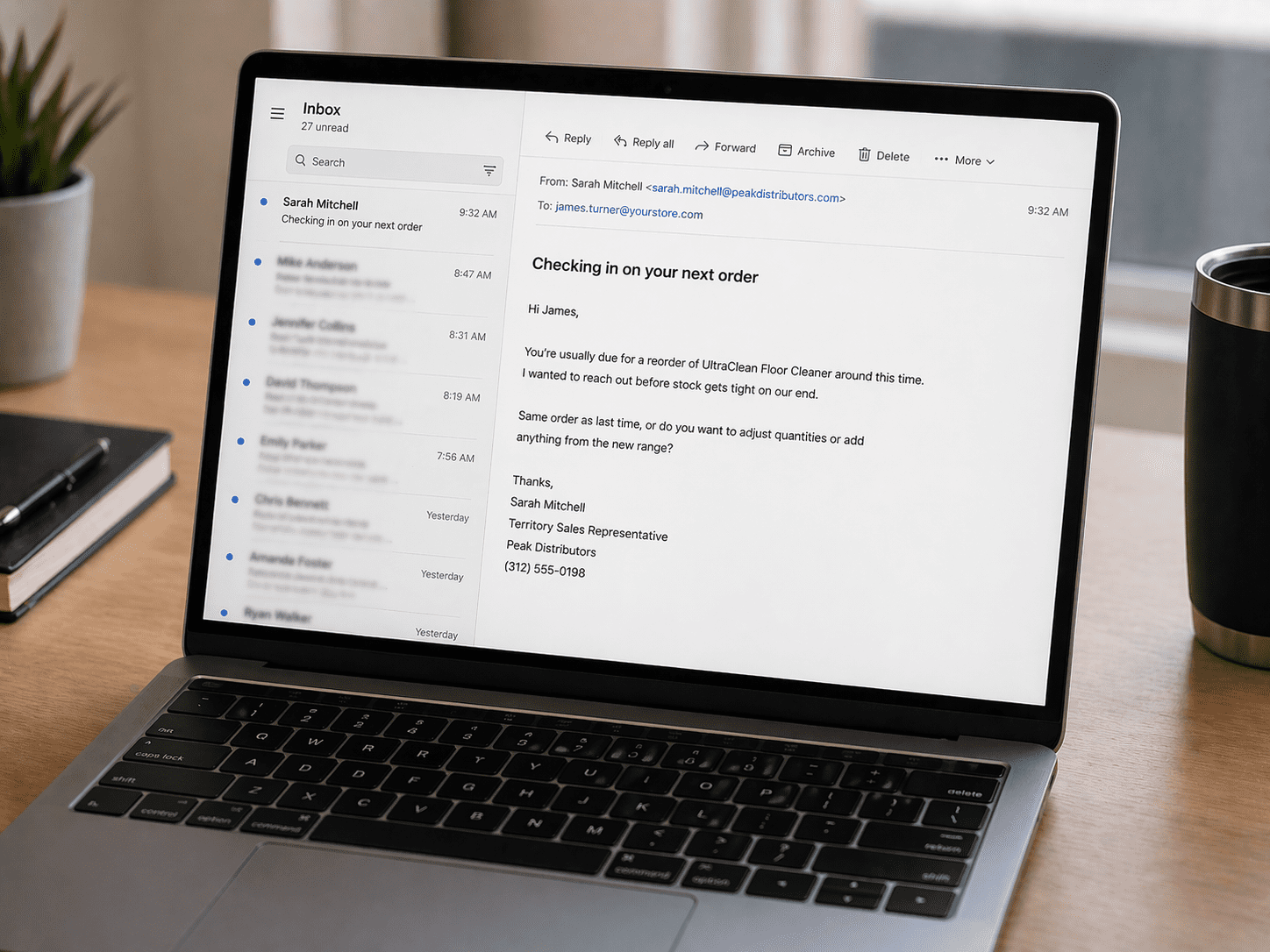
Subject: Checking in on your next order
Hi [First Name],
You’re usually due for a reorder of [product] around this time. I wanted to reach out before stock gets tight on our end.
Same order as last time, or do you want to adjust quantities or add anything from the new range?
[Your Name]
💡 Pro Tip:
Sync follow-ups to the buyer’s restock calendar, not your visit schedule. A follow-up sent three days after your visit means nothing if the buyer isn’t ordering for another month. Map each account’s typical purchasing window and time your sequence to land just before it. That’s when your email actually has a reason to get opened.
Pro Tip: Sync follow-ups to the buyer’s restock calendar, not your visit schedule
A follow-up sent three days after your visit means nothing if the buyer isn’t ordering for another month. Map each account’s typical purchasing window and time your sequence to land just before it. That’s when your email actually has a reason to get opened.
Template 5: After leaving a voicemail (no response)
Use this within an hour or two of the missed call.
Subject: I tried calling earlier, [First Name]
Hi [First Name],
I tried reaching you a little while ago, but couldn’t get through. I’ll keep this short.
[One sentence on what you wanted to discuss.]
If email works better for you, feel free to reply here. Otherwise, let me know a good time to connect and I’ll call you then.
[Your Name]
Template 6: New SKU or product launch (no response)
Use this 3 to 5 days after sending product details for a new line with no reply.
Subject: Quick question about [New Product Name]
Hi [First Name],
I sent over details on [new product] last week and wanted to see if you had a chance to review them.
[One sentence on what makes it relevant to their store or customer base.]
I can bring samples on my next visit if that makes it easier to evaluate. Would that be useful?
[Your Name]
Template 7: After a positive meeting where the buyer said, “I’ll get back to you.”
Use these 7 to 10 days after a meeting when the buyer committed to following up but hasn’t.
Subject: Regarding our conversation on [date]
Hi [First Name],
I wanted to circle back on our conversation from [date]. You mentioned you’d have a better idea of timing by [rough timeframe]. Checking in to see where things stand.
No pressure at all. If the timing has shifted, happy to reconnect when it makes more sense on your end.
[Your Name]
Template 8: The breakup email
Use this as your final follow-up after 2 or 3 unanswered attempts.
Subject: Should I close your file?
Hi [First Name],
I’ve reached out a couple of times and haven’t heard back, so I’ll assume the timing isn’t right.
I’ll stop following up for now, but if [product/offer] becomes relevant down the line, my details are below. The door is open whenever you’re ready.
Thanks for your time.
[Your Name]
Best Practices for Follow-Up Emails in Field Sales
1. Time it right
Send your first follow-up within 48 to 72 hours of the visit or initial outreach. This keeps the conversation fresh without feeling rushed. If you don’t hear back, a second follow-up in another 4 to 5 days is reasonable. After that, space subsequent attempts further apart.
Timing within the day matters too. According to HubSpot’s research, emails sent between 9 am and 12 pm tend to generate the highest engagement or response rates in B2B dealings.
2. Add value with every touch
A follow-up that only says “just checking in” gives the buyer no reason to reply. Each email should bring something new to the table: a product detail they asked about during the visit, a relevant case study, a limited reorder window, or a question that’s easy to answer.
The goal is to make replying feel worthwhile, not obligatory.
3. Stay in the same thread
Reply to your original email rather than starting a new one. It gives the buyer immediate context and removes the need to search their inbox. It also signals continuity rather than a fresh cold pitch.
4. One ask per email
Every follow-up should have a single call to action. It could be a call, a reply, or a confirmed order quantity. Two asks create hesitation. One ask gets answered.
5. Know when to stop
A study by Rain Group found that 43% of buyers say it’s acceptable for sellers to attempt contact 5 or more times. But to be on the safe side, for cold outreach, around 4 to 5 follow-up attempts are a reasonable ceiling before moving on.
For warm accounts you’ve visited in person, you can use your relationship history as a guide.
A final breakup email that closes the loop gracefully often gets a response when nothing else did, because it creates a sense of finality that prompts action.
💡 Pro Tip:
Rank your pending follow-ups by revenue potential and work on the top ones first. A big account going cold for a week hurts more than a small one taking two weeks to reply.
Never Lose a Follow-Up Between Visits Again
Templates give you the right words. However, they won’t remind you to send the email three days after a store visit when you’re already halfway through the next route.
That’s where follow-ups slip. The visit goes well, the rep makes a mental note, and by the time the day ends, there are six accounts to log and two more to prep for tomorrow. The follow-up never gets sent.
Multiply that across a full territory, and you have a serious pipeline problem.
That’s where a tool like SimplyDepo can help.

SimplyDepo is a field sales software built for CPG brands, distributors, and wholesale teams that manage outside sales, customer visits, B2B orders, and route execution. It gives reps and managers one mobile platform to plan sales routes, capture activity, and track follow-ups across every territory.
Here’s how SimplyDepo supports field teams and managers before, during, and after the visit:
Before the visit

Reps go into every account with full context. Customer history, previous orders, outstanding follow-up tasks, and visit notes from prior stops are all accessible from the mobile app before a rep walks through the door.
No more scrambling to remember what was discussed last time, and no showing up unprepared to a warm account.
Reps can:
- View account history and past interactions
- See outstanding follow-up tasks tied to each customer
- Check pricing, inventory, and product catalog before the visit
During the visit

Reps capture everything on the spot without switching between apps or scribbling notes to transfer later. Orders are taken directly in the platform, online or offline, with pricing and inventory already synced.
Sales reps can:
- Capture orders on the spot
- Log visit notes and next steps in real time
- Set follow-up reminders tied directly to the account
- Take photos and attach them to the account record
After the visit

Managers get a live view of what’s happening across the territory without waiting for end-of-day check-ins. Sales rep productivity metrics, visit coverage, order status, and follow-up tasks are all visible in one place. Everything syncs automatically once the device reconnects, so even visits in low-signal areas get logged accurately.
SimplyDepo enables managers with:
- Real-time visibility into rep activity and territory coverage
- Performance and route analytics across the whole team
- Full order and visit history per account
- Automatic sync when connectivity is restored
Email follow-ups don’t close deals on their own. But a system that makes sure they actually get sent, is a good place to start.
Follow Up Consistently. Close More Accounts.
Silence from a buyer is not a closed door. It’s a timing problem, an inbox problem, or an internal process problem, and a well-written follow-up email is how you reopen the conversation.
The templates for follow up email after no response I shared in this guide cover the scenarios field sales reps run into every day. Use them as a starting point and personalize them to the account. Remember to be consistent, because the reps who follow up are the ones who close.
And if keeping track of who needs a follow-up, when, and why is the harder problem to solve, that’s what SimplyDepo is built for. Book a free demo today!
FAQs
How many follow ups should I send before giving up?
There’s no universal rule, but for cold outreach, 4 to 5 attempts is a reasonable ceiling. For warm accounts where you’ve had a previous interaction in person, your relationship history gives you more room. A well crafted follow up at the end of your follow up sequence, like a breakup email, often gets a response when nothing else did because it signals finality and leaves the door open without pressure.
What's the best subject line for a follow up email after no response?
Keep it short, specific, and tied to your previous conversation. Reference something concrete from the visit or quote rather than using generic phrases like “just a quick reminder” or “hope you’re doing well.” For example, “Re: [Product/Quote] for [Store Name]” works because it connects to a previous email and gives the buyer instant context. Personalizing the subject line to the account can make all the difference in whether your message gets opened.
How long should I wait before sending my first follow up email?
Send your first follow up within 48 to 72 hours of the visit or initial email. That window keeps you fresh in the buyer’s memory without coming across as pushy. If that gets no reply, wait another 4 to 5 business days before your second follow up. After that, space your attempts further apart. Timing your follow up to land just before the buyer’s purchasing window, not just a few days after your visit, tends to improve your response rate significantly.
Should I write follow up emails from scratch every time or use follow up email templates?
Start with a few templates like the ones in this guide, then personalize them for every account. Drop in a specific detail from your last interaction, reference a specific benefit you discussed, or mention a relevant topic for their store. Templates save time and keep your follow up strategy consistent across a full territory, but a personal touch, like referencing something the buyer said during your last conversation, is what separates a quick check-in that gets a reply from a generic one that gets ignored.
What should I include in a follow up email to move the conversation forward?
Every follow up should bring something new: a quick recap of what you discussed, a relevant success story, updated pricing, or a clear call to action like booking a quick call or confirming an order quantity. Avoid sending the same message twice or writing a gentle reminder email that gives the buyer no reason to reply. One ask per email keeps things focused. If you’re nudging a potential client toward a decision, offer a free demo or suggest dropping off samples on your next route, something that makes responding easy rather than obligatory.
How do I keep track of follow ups across a full territory without letting accounts slip?
The perfect moment to send a follow up rarely lines up with when you actually remember to do it. You finish a route, mentally flag three accounts that need a gentle nudge, and by the time you’re prepping for tomorrow’s stops, those follow ups simply forget themselves. Multiply that across 30 or 40 accounts and you have a pipeline leak that no email template can fix. SimplyDepo solves this by letting reps set follow-up reminders as notes tied directly to each account right after a visit. Previous discussion notes, order history, and pricing context are all accessible from the mobile app before the next touchpoint, so you can follow up with the right person at the right time with the right message.


Your reps are in the field. Do you know what's happening?


Your reps are in the field. Do you know what's happening?

Boost Sales.
Cut Manual Work.
Streamline ordering, routing and retail execution — while giving every rep the tools to grow accounts faster.
-
+15h
Save weekly
per rep -
93%
Increase
buyer retention -
24%
Increase
in retail sales
