Top CPG Brands in 2026: Who’s Winning Shelf Space & How

📌 Key takeaways
- Legacy brands are paying premium prices for the shelf-space momentum that challengers have built: PepsiCo bought Poppi for $1.95 billion; Unilever paid close to a billion dollars for Nutrafol.
- Store brands are the fastest-growing force in CPG. Private label hit $283 billion in 2025, with household products losing the most ground to retailers’ own brands.
- Retail buyers care about two things: velocity data that proves your product moves and store-level execution that keeps it on the shelf.
- You don’t need a massive team to win retail placement. Ritual, AG1, and Dr. Squatch all scaled from niche DTC brands to national shelf presence by owning one category and executing well.
Every few years, a CPG brand that nobody saw coming takes shelf space from a company that’s held it for decades. It happened with Dollar Shave Club in razors. It’s happening now with Olipop in soft drinks and Ritual in supplements.
What’s different in 2026 is the speed. The window between emerging brand and acquisition target has collapsed. Legacy CPG companies have stopped waiting for challengers to become real threats. They’re acquiring them early before they become real threats.
This article looks at which CPG brands are winning shelf space across major categories right now and what’s driving those wins.
What are CPG brands?
Consumer packaged goods (CPG) are products with high demand, relatively low cost, and short shelf life compared to durable goods like appliances or electronics.
CPG items include everything from soft drinks and frozen meals to paper towels and wellness products.
They are sold through supermarkets, pharmacies, convenience stores, and online retailers, and consumers purchase them weekly or monthly without much deliberation.
Is CPG different from FMCG?
The subtle differences between consumer packaged goods CPG and fast-moving consumer goods (FMCG) come down to geography more than substance.
CPG is the standard term in North America, while FMCG is used more commonly in Europe and Asia. Both describe the same category of consumer products: branded, packaged, sold at high volume, and replenished regularly.
Two types of players define the CPG landscape: legacy multinationals with massive brand portfolios spanning dozens of categories, and challenger brands that focus on one or two categories where they can move faster than incumbents. Both compete for the same shelf space, retail relationships, and consumer attention.
Top CPG brands by category in 2026
The CPG industry covers a wide range of product categories. Here are the leading CPG companies and the iconic brands driving revenue in each.
1. Food and beverage
This is the largest CPG category by revenue and the one where shelf space battles are most visible right now.
Nestlé leads globally with brands like Nescafé and KitKat. PepsiCo dominates snacks and beverages through Frito-Lay and Gatorade. Coca-Cola maintains global leadership in soft drinks.
But the biggest shift in this category is the functional beverage takeover.
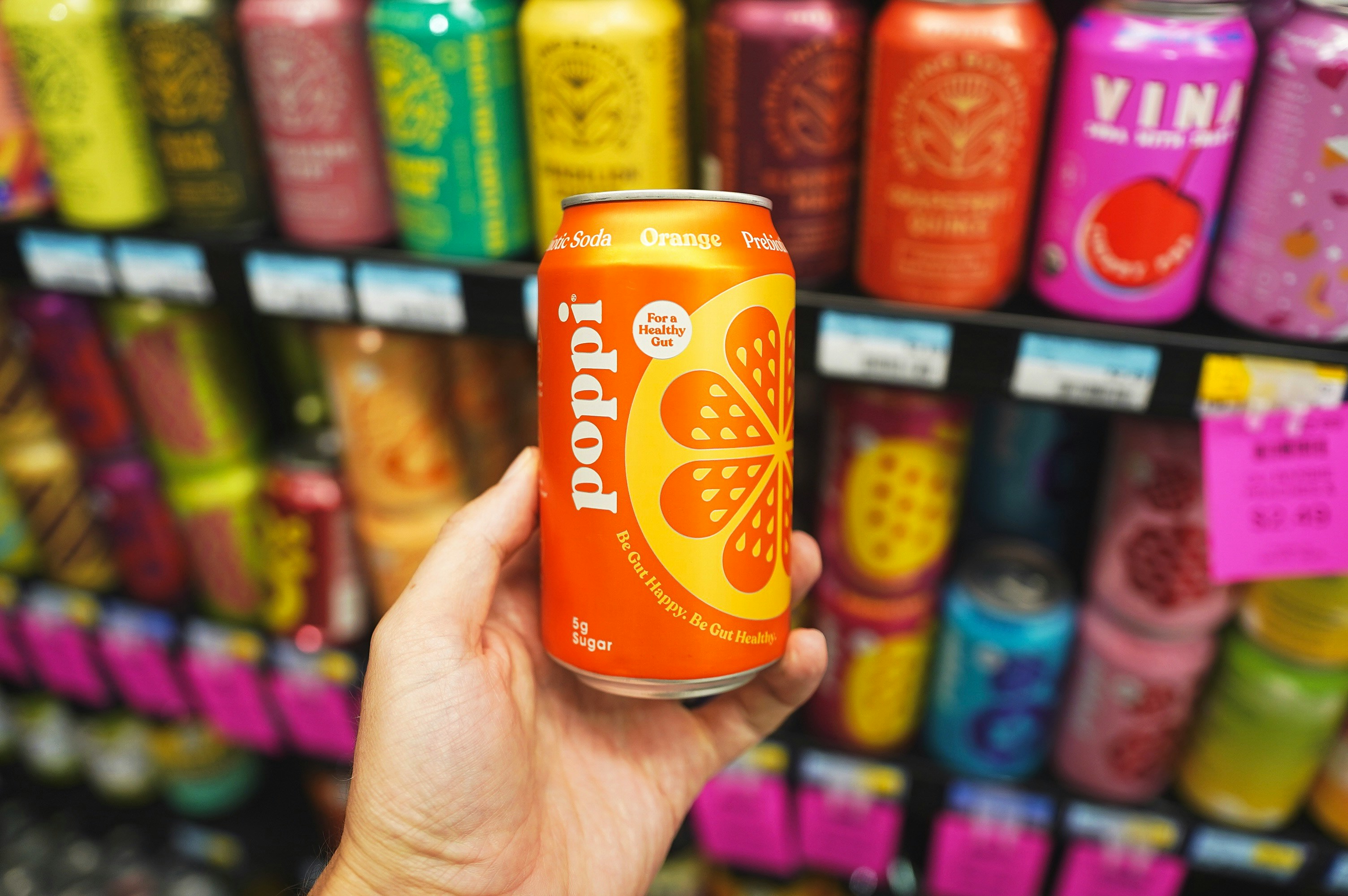
PepsiCo’s $1.95 billion acquisition of Poppi in 2025 signaled that legacy giants are now buying their way into the better-for-you space rather than building from scratch.
Coca-Cola has launched Simply Pop, its own prebiotic soda line.
Meanwhile, Olipop continues to prove that challenger brands with strong velocity data can command shelf space that legacy products held for decades.
The takeaway for smaller CPG brands is: high sales velocity in a growing subcategory is the fastest path to winning retail placement.
2. Personal care and beauty
P&G (Olay, Pantene, Gillette) and Unilever (Dove, Axe, Vaseline) still hold dominant positions in personal care. L’Oréal maintains strength across both mass and prestige beauty.
The category’s defining story over the past few years has been DTC brands crossing into retail.
Harry’s and Dr. Squatch both built loyal followings online before expanding onto physical shelves, forcing legacy players to acquire or innovate to hold their position.
Retail buyers in personal care increasingly favor brands that bring their own audience to the store rather than relying solely on category foot traffic. The brands winning shelf space here combine strong digital engagement with visually distinctive packaging that stands out on a crowded aisle.
3. Household products
P&G (Tide, Dawn, Swiffer) and Reckitt (Lysol, Finish) lead in cleaning products and household essentials.
But this is the category where private label pressure is hitting hardest. Private label sales hit a record $283 billion in 2025 according to PLMA, growing nearly three times faster than national brands. Store brands now hold over 21% dollar share across US retail, with retailers offering comparable quality at lower price points.
For established CPG brands, defending shelf space here requires consistent innovation in formulation and format alongside trade promotions that show category growth to retail buyers.
Sustainability has also become a competitive differentiator. Plant-based and concentrated formulas are gaining traction among consumers who are willing to switch from national brands when they see a credible alternative.
4. Health and wellness
Johnson & Johnson, GSK, and Abbott lead among legacy players. But challenger brands are closing the distance fast in this category.
Brands like Ritual, AG1 (Athletic Greens), and OLLY have built massive followings by leading with transparency and clinical backing.
AG1 reached unicorn status after bootstrapping to $150 million in revenue through a DTC-only model powered by podcast sponsorships and influencer partnerships, before eventually expanding into retail.
Unilever’s nearly a billion-dollar acquisition of Nutrafol further confirms that legacy CPG companies are willing to pay premium prices for wellness brands with proven loyalty.
What makes this category different from others is switching behavior. Once a consumer finds a supplement or functional product that works for them, they’re less likely to try alternatives.
That loyalty gives emerging brands with strong efficacy data a durable advantage. According to NIQ’s 2025 Global Health & Wellness survey, 82% of consumers say labels on health and wellness products need to be more transparent and easier to understand. Brands that meet that standard are winning shelf space.
How top CPG brands win and keep shelf space
1. Build a data-backed category story for retail buyers
Shelf space allocation starts in the buyer’s office, not on the shop floor.
CPG brands that secure and expand their position present retailers with category growth data, velocity metrics, and consumer demand signals that prove their products will perform. This sell-in capability is the core of a strong CPG go-to-market strategy. Without it, even a great product struggles to get listed.
2. Execute consistently at the store level
A listing means nothing if the product isn’t stocked at the store. Top CPG companies invest in field sales software that gives reps real-time access to account data, route plans, and task lists during store visits.
That level of execution discipline ensures that every visit translates into maintained shelf presence and accurate product availability, which is what retailers ultimately care about.
3. Monitor shelf compliance and product availability
Shelf space won is shelf space that must be defended. Planogram drift, out-of-stocks, and competitor encroachment erode position over time. Leading brands use retail execution software to capture shelf photos, verify compliance, and flag issues before they turn into lost sales.
In an industry where a single missed out-of-stock event during high demand periods can cost thousands in revenue, you need real-time visibility into what’s happening at the shelf.
4. Invest in supply chain reliability
Retail buyers penalize brands that can’t deliver consistently. On-time delivery and order accuracy are table stakes for maintaining distribution. A reliable CPG supply chain network is the operational foundation that lets everything else, like product marketing, promotions, and new launches, work smoothly.
When a supply chain breaks down, it doesn’t just affect one order; it damages the retailer relationship and opens the door for competitors to take that shelf space permanently.
5. Treat field reps as strategic partners
The best CPG businesses arm their field teams with competitive insights and the authority to solve problems on the spot.
When a rep can show a store manager velocity data or suggest a shelf reset backed by category performance, they become a partner in the retailer’s success. It’s a great way to build the kind of long-term retailer relationships that protect shelf position through category reviews and seasonal resets.
💡 Pro tip
Before any buyer meeting, prepare a “category contribution snapshot”: your share of category sales growth and your velocity versus the category average. Buyers don’t care about your brand story. But they do care about what your product does for their category numbers. Frame every ask in those terms.
How can emerging CPG brands compete with industry giants?
Competing against companies with billions in revenue and decades of brand recognition may seem impossible. But emerging CPG brands have structural advantages that larger CPG companies cannot easily replicate.
1. Category specialization beats portfolio breadth
Challenger brands win by owning a niche rather than competing across 20 categories.
Focused brands can respond to CPG industry trends faster than conglomerates managing hundreds of products. A functional beverage company built around gut health or a cleaning brand specializing in plant-based formulas can adapt its product and retail strategy while demand is still growing.
The focused approach creates category authority with retail buyers and strong customer loyalty within a well-defined consumer segment.
2. Velocity over volume
Small brands don’t need to match P&G’s total shelf footage. They need to prove high sales velocity in the space they occupy. Strong velocity data, captured through consistent field sales reporting, is the strongest argument for expanded distribution.
Retailers care about revenue per linear foot. A small brand that sells through its allocation faster than a legacy competitor is making the retailer more money per shelf inch.
3. Start with independent retailers, then scale
Many successful emerging CPG brands build their sell-through data in independent stores before approaching regional and national chains. It de-risks the pitch to bigger buyers and provides real performance proof from actual purchases.
The progression from indie stores to regional chains to national retail is a well-established path that reduces the cash flow risk of scaling too quickly.
4. Use technology to compete above your weight
A 5-person brand team with the right CPG software can cover the same number of stores that larger competitors need 20 people to manage.
Route optimization, order management, retail execution tracking, and live inventory visibility all sit on a single platform instead of being scattered across spreadsheets and standalone tools.
Your reps spend less time on logistics and more time in stores, and every visit generates data that sharpens the next decision. That’s how a lean team can close the operational distance between itself and an enterprise sales team.
💡 Pro tip:
Track your “rate of sale” (units sold per store per week) from your very first retail accounts. That’s the most persuasive number in any buyer conversation. When you can show a regional chain buyer that your product sells 3x the category average across 15 independent stores, you’ve made the case for distribution better than any pitch deck could.
Staying competitive in the CPG industry
The CPG industry right now is shaped by both legacy giants with global distribution and fast-moving challenger brands that are rewriting category norms.
88% of organizations use AI in at least one business function, signaling that technology and data are now central to how the industry operates, from demand forecasting to trade promotion optimization.
What separates the brands that win shelf space from the ones that lose it comes down to execution: getting the product on the shelf, keeping it there, and proving its performance with data.
That operational discipline applies whether you’re a co-founder building a beverage brand from scratch or a category manager at a Fortune 500 manufacturer.
SimplyDepo is a retail execution platform that helps CPG brands manage field sales, retail execution, route planning, and order capture under one roof. If your team is ready to scale store coverage and win more shelf space, book a demo and see how SimplyDepo can help you.
FAQs
Many CPG brands now use the direct-to-consumer route as a testing ground before pitching to retail buyers. Launching a new flavor or formula online first lets you build velocity data and customer reviews without the risk of a failed retail launch.
It also creates a built-in audience that retailers value, since buyers are more likely to list a product that already has proven demand. Brands like AG1 and Dr. Squatch used this exact path to go from online-only to national shelf presence.
Brand recognition alone doesn’t protect shelf position anymore. Retailers evaluate products on velocity per linear foot, category contribution, and margin. A trusted brand that underperforms on these metrics will lose facings to a smaller competitor that moves faster in the same space.
Consistent store-level execution also matters. If a product is frequently out of stock or misplaced on the shelf, buyers notice. Tools like SimplyDepo help brands monitor shelf compliance and flag issues before they cost facings in the next category review.
Focus on the first 90 days after getting listed. Run targeted trade promotions, make sure your field team visits every account weekly to check placement and stock levels, and collect sell-through data from day one. That early velocity data becomes your strongest argument for expanded distribution.
SimplyDepo gives field teams real-time visibility into store-level performance so they can act on slow accounts before the retailer pulls the product.
Extremely. Energy drinks are one of the fastest-growing segments within food and beverage products, but the category is dominated by Red Bull, Monster, and Celsius, with deep retail relationships and massive marketing budgets.
New entrants usually succeed by targeting a specific niche or a specific demographic, rather than going head-to-head on the mainstream shelf.
Proving strong rate-of-sale in independent stores before approaching chains is critical here.
For low-consideration everyday products, brand loyalty is built through consistent availability and repeat purchase convenience rather than emotional connection. If your product is on the shelf every time a shopper reaches for it, that habit becomes loyalty over time.
The biggest threat to that cycle is an out-of-stock event: one missed purchase is often enough for a consumer to try a competitor or switch to private label permanently. That’s why field execution and inventory accuracy are crucial in these categories.

 Rated 4.7 on G2
Margins are tight. Visibility shouldn't be.

-
 September 16, 2026
 -
 September 15, 2026
 -
September 15, 2026
