Types of Retail Displays: A Complete Guide for CPG Brands

📌 Key takeaways:
- Choose displays around the shopper moment. Entryway displays build early awareness, end caps capture attention before shoppers enter an aisle, and checkout displays encourage last-second purchases.
- Consider both impact and upkeep. High-visibility formats such as end caps can deliver stronger results, but they cost more and require closer attention than shelf signage or dump bins.
- Execution determines whether the display performs. Teams must launch each display on time, follow the planogram, keep products stocked, and maintain the setup throughout the promotional period.
On a single trip through a grocery store, one shopper can encounter your product in four different places.
It can:
- Stop them at the door before their basket has anything in it
- Sit quietly on an aisle shelf, waiting to be noticed
- Catch them at the end of a run of shelving, right where they turn
- Grab them at the register while they wait to pay
Each placement meets the shopper at a different point in the trip and serves a different purpose.
The shopper you’re trying to reach is behaving differently than a few years ago. Circana’s research found that people are making more shopping trips, up 8.9%, but buying fewer items on each one, with baskets shrinking by as much as 11%.
More trips create more chances to win attention, but smaller baskets make every display work harder for its place in the cart.
Brands often choose displays by appearance alone: a larger sign or a more polished fixture. The stronger decision starts with when you want to reach the shopper and what action you want to prompt.
In this guide, I’ll organize retail display types by where they sit in the store and their roles, so you can choose the right fit.
What is a retail display?
A retail display is anything in a store that houses or promotes your product, from a two-sided shelving unit to a small printed card clipped to a shelf edge.
It’s the physical marketing layer of the store, and often the first point of contact between a product and a shopper.
Each display type plays a different role.
Point-of-purchase (POP) displays scattered through the floor do a different job than a card at eye level on the aisle shelf, and both differ from the unit that greets people at store entrances.
CPG displays also differ from apparel merchandising. The product is small, bought repeatedly, and highly sensitive to impulse, so much of the work is about visibility, facings, and catching attention in crowded product categories rather than styling a look.
In the next few sections, I’ll walk you through the store the way a shopper does: the entrance and windows, the secondary placements out on the floor, the primary aisle, and the checkout, and the signage layer that rides on top of all of them.
Which displays greet shoppers at the entrance and windows?
The first displays a shopper meets are working before anyone has walked through the door. Window displays attract passersby and draw them into stores, and a well-designed window display can be the deciding factor in whether someone enters at all.
Effective window displays showcase seasonal products and brand uniqueness. The strongest ones tell a story using props and lighting rather than simply lining up stock.
Mannequins are often used in window displays to bring seasonal fashion collections to life, though for CPG the same storytelling instinct applies to a hero product staged to create visual interest.
Just inside, the entryway display picks up where the window left off.
Entryway displays encourage impulse buys from customers who are entering ready to spend, and they are effective for showcasing new products and trade promotions before shoppers reach a single competitor.
Because they are flexible to design, you can build them around a launch, a holiday, or a headline promotion, and they are ideal for high traffic areas for maximum visibility.
What are POP displays and the standalone display family?
Point of purchase is the umbrella term for displays placed out on the sales floor to draw attention to a product, separate from its home on the aisle shelf.
You’ll often find these standalone displays in high-traffic areas, and their real value is secondary placement: incremental facings and a second chance to be seen, somewhere the shopper wasn’t expecting you.
That second chance pays off. In Grocery TV’s 2026 shopper survey, 37% of shoppers said in-store advertising helped them discover a product they wouldn’t have noticed otherwise, and 62% had bought something directly after seeing it advertised on an in-store screen.
1. Freestanding displays
You can place freestanding displays anywhere in the store and are ideal for new product launches or promotions.
As they stand alone in open floor space, they allow 360-degree customer interaction, and they can be interacted with from all angles as shoppers move around them.
These displays can feature bespoke artwork and marketing messaging, and they’re often made from cardboard for easy customization, which makes them a natural home for printed graphics that carry a campaign look.
2. Dump bins
Dump bins are effective for promoting impulse buys. They are commonly filled with individually packaged products and convey a sense of urgency and bargain, which is why they work so well for small, discounted SKUs.
You can position them wherever traffic is heaviest and are often made from cardboard for easy setup, so a field team can ship them flat and build them in minutes. The whole format invites shoppers to grab loose products on the way past.
3. Banner stands
Banner stands are inexpensive and mobile, which makes them useful for directing attention or announcing a promotion across different parts of the store. Along with pull up signs, you can reposition them quickly and move to wherever the campaign needs a voice.
How do end caps and gondolas work on the aisle?
The aisle holds the two most valuable fixtures in CPG merchandising, and understanding how each one earns its place is where a lot of shelf strategy lives.
1. End cap displays
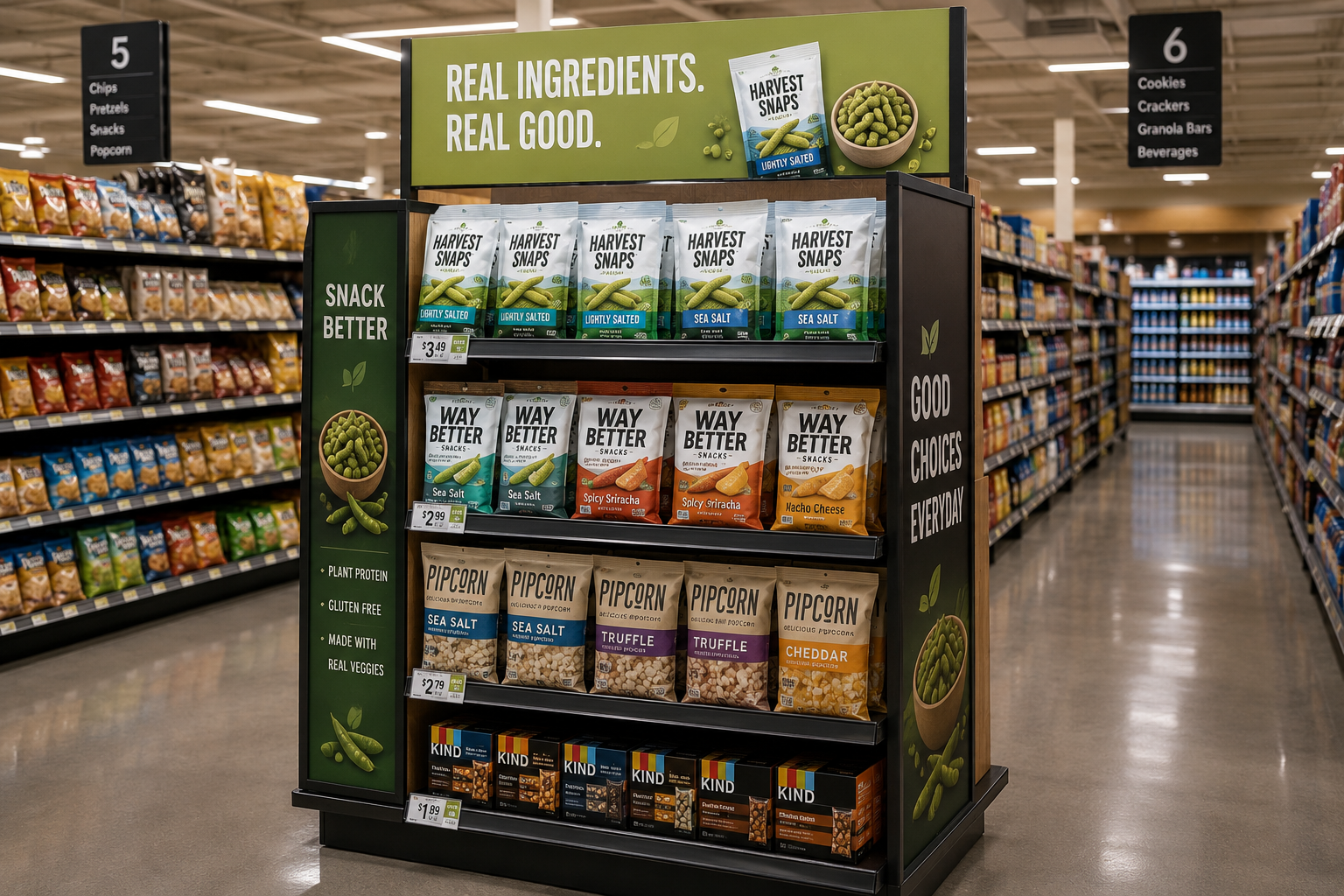
End cap displays are located at the end of aisles, facing the main traffic that runs across the store.
That position is what makes them work: shoppers see the product before they enter the category, which gives the featured item high visibility and a major advantage over anything sitting mid-aisle.
End caps drive impulse purchases. They can showcase top-selling items effectively, and you can creatively design them to pull the eye from a distance.
Since endcaps are prime, time-bound placements, teams must set promotions correctly and on schedule.
2. Gondola displays
Gondola displays are two-sided, standalone shelving units, the everyday workhorse that forms the aisles shoppers walk through.
They have adjustable shelves for different sized products, which lets a category flex as SKUs change, and being double-sided gives them maximum visibility from both walking directions.
Gondola displays fit in almost every retail location, and while they anchor the core range, they are also useful for seasonal items and limited promotions.
The eye-level shelf is the most valuable vertical space on the unit, and placement there usually follows the retailer’s planogram.
Which displays live at the shelf edge and checkout?
Not every display is a fixture. A whole layer of low-cost signage rides along the aisle shelves, and then there is the register itself.
1. Shelf talkers, header cards, and clip strips
Shelf talkers, also known as hang-tags, are the small signs that stick out perpendicular to aisle shelves. They help products stand out in crowded aisles and can highlight promotions or sales.
Using colors similar to product packaging enhances shelf talkers’ effectiveness by making the sign and the product read as one. At their best, shelf talkers improve customer understanding of products right at the point of decision.
Header cards sit at the top of a display or shelf section to frame what is below and reinforce the brand. Clip strips hang vertically with hooks for small items and are ideal for cross merchandising, letting you place a snack next to its natural partner elsewhere in the store.
2. POS and checkout displays
The register zone is built for impulse. Point-of-purchase displays near checkouts encourage impulse buying, capturing the small add-on while a shopper waits to pay. A counter display or countertop display of small SKUs turns idle queue time into sales.
This is where the POP vs. POS distinction becomes clear: POP displays work throughout the store as secondary placement, while point of sale displays sit at the register and exist almost entirely to prompt that last-second grab.
How do you choose the right retail display type?
The right display is a match between three things: the shopper moment you want to own, the product’s price and impulse profile, and what your team can realistically maintain.
A display that looks incredible on day one but sits half-empty by week two is worse than a simpler one kept full.
The table below weighs the common display types against the factors that decide the choice.
| Display type | Where it sits | Best for | Relative cost | Effort to maintain | Impact |
|---|---|---|---|---|---|
| Window/entryway | Perimeter/entry | Launches, seasonal, promotions | Medium/High | Medium | High (drives traffic) |
| Freestanding | Secondary floor | Promotions, incremental facings | Medium | Medium | High |
| Dump bin | Secondary floor | Impulse, small SKUs | Low | Low | Medium |
| End cap | Aisle terminus | Featured and promoted SKUs | High (leased) | High | Very high |
| Gondola | Primary aisle | Core range, everyday | Low (fixture) | Medium | Steady/foundational |
| Shelf signage | Shelf edge | Differentiation, promo call-outs | Low | Low | Low–Medium |
| POS/checkout | Register | Impulse add-ons | Low | Low | Medium |
💡 Pro tip:
Test a new display format in a small group of representative stores before rolling it out widely. Compare the sales lift against the work required to keep each display stocked and correctly set up.
Read it as a menu of trade-offs rather than a ranking.
An end cap can deliver the biggest lift in the store, but it is expensive and demanding to keep to standard. A dump bin costs almost nothing and asks little, but its ceiling is lower.
The best choice depends on whether the team can execute the display and keep it up once it is live.
Why display type only pays off with execution
Every display in this guide is a promise, and the promise only pays out if someone sets it correctly, keeps it stocked, and holds it to standard through the whole promotional window.
An end cap that launches three days late, or a freestanding unit that runs empty by the weekend, returns nothing on your investment.
Choosing the retail display type is the easy half. The harder half is the field work: confirming the team assembled the unit correctly, followed the planogram, kept the facings full, and maintained the promotion according to plan.
Put simply, display strategy and field execution are the same problem seen from two ends. A modest display with strong execution will outperform a brilliant one with poor execution, which is why successful brands treat display strategy and field execution as one job.
Turn display strategy into shelf reality
The framework holds up across the store: match the display type to the shopper moment, weigh its cost and upkeep against its likely impact, and remember that the fixture is only as good as the execution behind it.
That last part is where retail execution software earns its place. Tools in this category give field teams a way to verify that displays are set, stocked, and compliant across every location, replacing the guesswork of “we think the end caps went up” with real evidence from the store.
SimplyDepo is built for exactly that work.
Field reps check in with GPS-verified visits tied to each store’s address.They capture time-stamped shelf photos and add them directly to the visit log. Brand-specific audit forms prevent reps from skipping required steps such as planogram compliance and POS material checks.
Those visits, photos, and compliance scores roll up into client-ready reports, so a brand can see whether the display it paid for actually showed up the way it was planned. It is how a good display type becomes a display that performs.
Want to improve field execution? Book a demo with SimplyDepo today!
FAQs on types of retail displays
POP (point of purchase) displays are placed throughout the store as secondary placement, drawing attention to a product away from its home shelf. POS (point of sale) displays sit at the register and exist to prompt last-second impulse buys while shoppers wait to pay. POP is about visibility across the floor; POS is about the checkout grab.
Visual merchandising combines product placement, layout, lighting, and signage to guide shoppers and drive sales, and displays are where that strategy becomes physical. A strong visual merchandising strategy matches each display type to a shopper moment, uses seasonal and themed displays to create excitement, and places high-margin items at eye level. The display is the tool; visual merchandising is the plan behind it.
An end cap display sits at the end of an aisle, facing the store’s main traffic. It works because shoppers see the featured product before they enter the category, giving it high visibility and a strong edge over mid-aisle placement. End caps are usually leased and time-bound, so they demand correct, on-time setup.
A gondola is a two-sided, freestanding shelving unit that forms the aisles shoppers walk through. It has adjustable shelves to fit different product sizes and offers visibility from both directions. Gondolas anchor a store’s core range, and eye-level placement on them is the most valuable position for a product.
A dump bin is a standalone bin, often made from cardboard, filled with individually packaged products. It is built to promote impulse buys of small, discounted SKUs and conveys a sense of urgency and bargain. Placed in high-traffic areas, dump bins support high-volume sales with very little setup effort.
Match the display to three things: the shopper moment you want to own, the product’s price and impulse profile, and what your team can realistically keep stocked and compliant. A high-impact end cap suits a featured promotion; while a low-effort dump bin suits small impulse SKUs.
Setup usually falls to field merchandisers and sales reps, or to the retailer’s own staff, working from the retailer’s planogram. Because compliance and restocking decide whether a display actually performs, many CPG brands track execution with photos and visit records to confirm the display was set and maintained to standard.
Permanent displays, such as gondolas and shelving units, are built to last and hold a product’s core range for months or years. Temporary displays, like cardboard freestanding units and dump bins, are designed for a specific promotion or season and are removed once the campaign ends. Temporary displays cost less and go up fast, while permanent displays anchor everyday placement.

 Rated 4.7 on G2
Blind spots on the shelf are costing you sales.

-
 September 16, 2026
 -
 September 15, 2026
 -
September 15, 2026
