7 Best DSD Software for Route Sales Teams (2026)

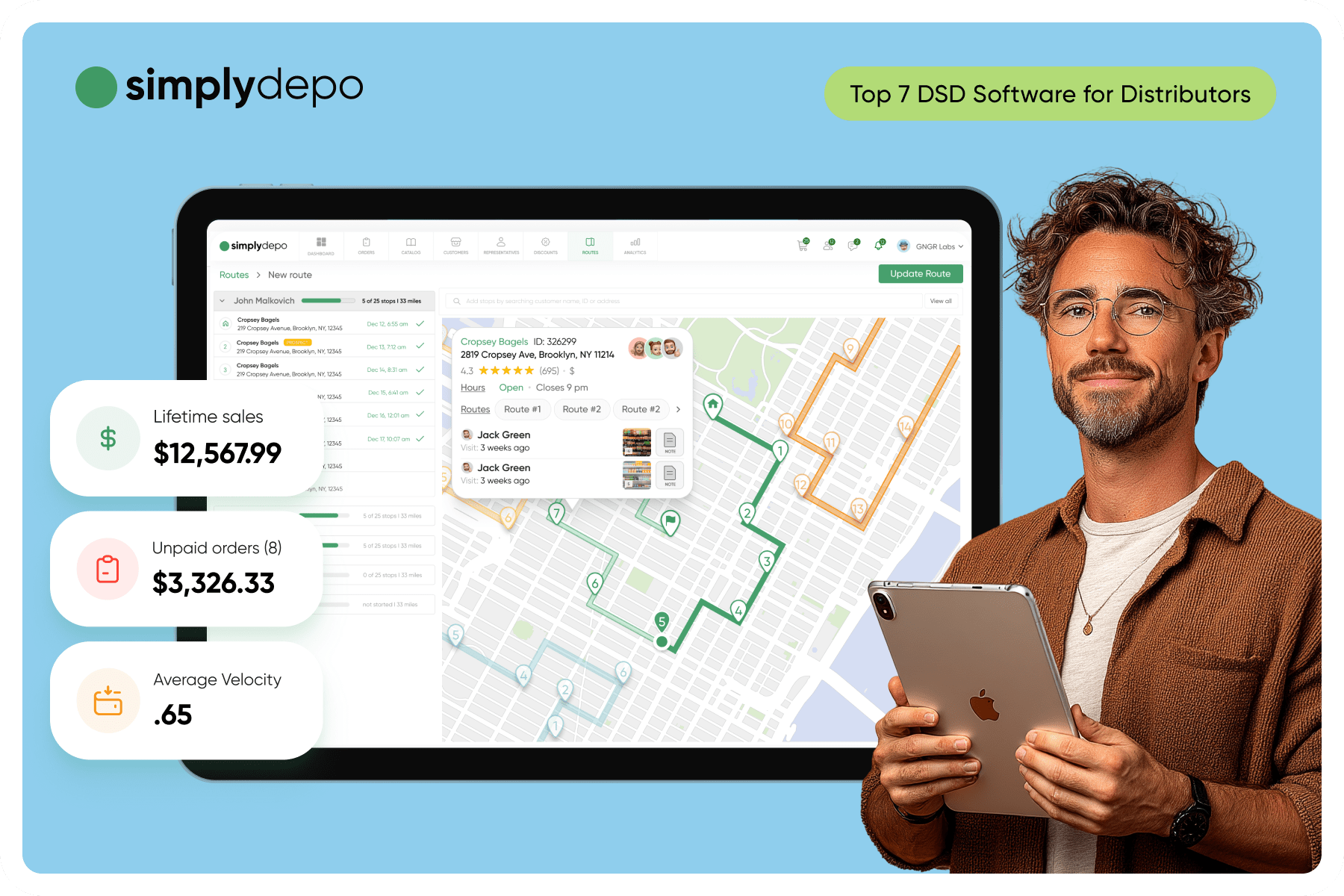
Choosing the right DSD software is about more than route planning. Today’s distributors need one platform to manage mobile ordering, route optimization, inventory, CRM, retail execution, analytics, and accounting integrations—without relying on multiple disconnected systems.
According to the Forrester US Tech Forecast 2026, retailers continue to increase technology investments to improve operational efficiency, real-time visibility, and customer experience—driving rapid adoption of modern cloud-based DSD software.
In this guide, we compare the seven best DSD software solutions for distributors in 2026 based on features, pricing, integrations, scalability, ease of implementation, and overall value to help you choose the best platform for your business.
At a Glance
- Best Overall: SimplyDepo
- Best for Small Distributors: inSitu Sales
- Best Enterprise Solution: SAP Direct Store Delivery
- Best for Retail Execution: StayinFront
- Best for Van Sales: Pepperi
- Best Value: SimplyDepo
- Best Free Trial: SimplyDepo (30 Days)
What does DSD mean?
DSD stands for Direct Store Delivery — a distribution model where suppliers deliver products directly to retail stores instead of routing them through a retailer’s central warehouse first.
In a DSD setup, the same team that delivers the product also handles merchandising, shelf restocking, returns, and order taking — all at the store level. It compresses three roles into one efficient route.
DSD is most common in categories where products move fast or need frequent attention:
- Beverages (soda, beer, energy drinks, water)
- Snacks and chips
- Bakery and tortillas
- Dairy and ice cream
- Newspapers and magazines
- Candy and confectionery
- Tobacco
According to GS1 industry data, DSD accounts for roughly 24% of supermarket dollar sales in the U.S. — driven almost entirely by these high-velocity categories.
DSD vs warehouse distribution
The two models solve different problems. Here’s the side-by-side:
| Factor | Direct Store Delivery (DSD) | Warehouse Distribution |
|---|---|---|
| Path to shelf | Supplier → store | Supplier → retailer DC → store |
| Who stocks the shelf | Supplier rep | Store associate |
| Order frequency | Daily to weekly | Weekly to monthly |
| Best for | Perishables, fast-movers, fragile goods | Stable, slow-moving, packaged goods |
| Inventory ownership | Often supplier-owned until scan | Retailer-owned at receiving |
| Margin pressure | Higher logistics cost, better availability | Lower logistics cost, more stockouts |
| Data visibility | Store-level real-time | Aggregated at DC level |
The shorthand: if a category needs to be on the shelf within 24-72 hours of leaving the producer, DSD wins. If shelf life is measured in months, warehouse distribution wins.
How DSD works (step by step)
- Pre-route planning — the system optimizes the day’s stops based on geography, store priority, and delivery windows
- Truck loading — pickers load product to match the route’s projected orders, often using mobile picking lists
- Store arrival & check-in — rep checks in at the back door, often with a digital signature
- Shelf check & merchandising — rep audits planogram compliance, rotates stock, removes expired product
- Order entry — rep takes the next order on a mobile device, often suggesting volume based on sell-through data
- Invoice & payment — invoice is generated and signed on-device; payment may be collected immediately for cash routes
- Sync to ERP — at the end of the route (or in real time, on cloud platforms), all data flows back to accounting and inventory systems
DSD examples — companies using this model
DSD is the backbone for some of the world’s largest CPG brands:
- Coca-Cola runs one of the largest DSD networks globally, with bottlers handling delivery, merchandising, and equipment service
- PepsiCo (Frito-Lay, Pepsi Beverages) delivers daily to most U.S. supermarkets and convenience stores
- Bimbo Bakeries uses DSD for tortillas, bread, and snack cakes across the Americas
- Anheuser-Busch and Molson Coors rely on independent beer distributors for the three-tier alcohol DSD system
- Red Bull built its category through aggressive DSD-led merchandising in convenience and grocery
- Snyder’s-Lance, Utz, and other regional snack brands depend on DSD to keep shelf presence in supermarkets
Smaller and mid-size CPG brands often outsource to independent DSD distributors or run hybrid DSD + 3PL models.
What is a DSD driver?
A DSD driver isn’t just a delivery driver. They’re a hybrid sales rep, merchandiser, and logistics operator. On a typical day, a DSD driver:
- Drives a route of 15–40 stops
- Carries pre-loaded product matched to expected demand
- Checks inventory and rotates stock at every stop
- Takes new orders directly on a mobile device
- Removes damaged or expired product
- Often handles invoicing and payment on the spot
DSD drivers are the highest-value frontline role in CPG distribution — which is why software that lifts their productivity has such a clear ROI.
What does Walmart DSD mean?
At Walmart, DSD refers to the suppliers approved to deliver and stock product directly in stores instead of routing through a Walmart distribution center. Walmart’s DSD program is one of the largest retailer DSD operations in the U.S., covering categories like soft drinks, salty snacks, bread, dairy, magazines, and greeting cards. Suppliers in Walmart’s DSD program are subject to strict scan-based trading, EDI compliance, and on-shelf availability standards.
Why distributors are upgrading their DSD systems in 2026
The shift away from legacy handheld systems is happening fast. Here’s what’s driving it:
1. From single-purpose apps to connected platforms. Buyers don’t want a delivery app, a route planner, an inventory tool, and an invoicing system that don’t talk to each other. The 2026 default is a single platform that handles ordering, pricing, inventory, merchandising, payments, and reporting in one login.
2. Cloud-first deployment as the default. Real-time sync between the truck, the warehouse, and the back office replaces end-of-day uploads. Sales managers see what’s happening in the field as it happens, not 12 hours later.
3. AI-assisted ordering and routing. Deloitte’s 2026 retail outlook found that 7 in 10 retail executives expect AI capabilities deployed within the year. In DSD specifically, that means: suggested order quantities based on historical sell-through, dynamic price recommendations, demand forecasting per SKU per store, and route re-optimization mid-day.
4. Mobile-first field execution. Photo proof of delivery, planogram compliance scoring, digital signatures, and visit-level analytics are now table stakes — not premium features.
5. Native ERP and accounting integrations. QuickBooks, NetSuite, and SAP integrations need to be live out of the box. Custom API work for basic accounting sync is a 2018 problem.
6. Omnichannel order capture. DSD reps still drive the route, but customers also want to reorder via B2B portals, mobile apps, and EDI. The platform has to handle all three channels with shared inventory and pricing.
7. Compliance-ready by default. SOC 2, GDPR, and food traceability standards (FSMA 204) are now requirements buyers ask about on the first call.
💡 Pro Tip:
Audit your DSD platform’s security and compliance posture every quarter. The cost of a compliance gap during a retailer audit dwarfs the cost of switching.
How We Evaluated These DSD Software Platforms
Not every distributor has the same requirements, so we evaluated each DSD software platform using the criteria that matter most to food & beverage brands, wholesalers, and route sales teams. Our comparison considers features, ease of use, mobile capabilities, route planning, retail execution, integrations, scalability, pricing, customer support, and overall value for different business sizes.
Whether you’re a small distributor replacing spreadsheets or a growing CPG brand looking to streamline field sales and retail execution, this guide highlights where each platform performs best.
Which are the top 7 DSD software for distributors in 2026?
So, here are the best sales distribution software solutions helping distributors simplify operations, boost sales, and deliver better customer experiences in 2026. But, before we dive deep into each platform in details, here’s a quick side-by-side look at how the top options stack up.
| Software | Best For | Free Trial | Starting Price | Mobile App | Retail Execution | Route Planning | CRM | QuickBooks | AI Features | Offline Mode |
|---|---|---|---|---|---|---|---|---|---|---|
| SimplyDepo | Brands & Distributors | ✅ 30 Days | From $69 | ✅ | ✅ | ✅ | ✅ | Native | ✅ | ✅ |
| Pepperi | Mid-Market | Demo | From $500 | ✅ | Partial | ✅ | ✅ | Native | Partial | ✅ |
| bMobile | Small Distributors | ✅ | Custom | ✅ | Limited | ✅ | Limited | Native | No | ✅ |
| Skynamo | Sales Teams | Demo | Custom | ✅ | Limited | Partial | ✅ | Native | No | ✅ |
| SAP DSD | Enterprise | Demo | Custom | ✅ | Partial | ✅ | Partial | Connector | Partial | ✅ |
| StayinFront | Retail Execution | Demo | Custom | ✅ | ✅ | Partial | Partial | Connector | Partial | ✅ |
| inSitu Sales | Small Teams | 14 Days | From $200 | ✅ | Limited | ✅ | Limited | Connector | No | ✅ |
Now that you’ve seen the big picture, let’s take a closer look at what makes each platform shine.
Best DSD Software by Use Case
| Use Case | Recommended Software | Why |
|---|---|---|
| Best Overall DSD Software | SimplyDepo | Best balance of features, ease of use, integrations, and value |
| Best for Small Distributors | inSitu Sales | Affordable entry point for small route sales teams |
| Best for Mid-Market Distributors | SimplyDepo | Strong scalability with CRM, retail execution, and QuickBooks integration |
| Best for Enterprise | SAP Direct Store Delivery | Built for large organizations with complex ERP requirements |
| Best for Retail Execution | StayinFront | Strong merchandising and shelf compliance capabilities |
| Best for Van Sales | Pepperi | Mature van sales and offline workflows |
| Best Value | SimplyDepo | Comprehensive feature set with transparent pricing and a 30-day free trial |
1. SimplyDepo

SimplyDepo is an all-in-one field sales and distribution platform built for CPG brands, distributors, and merchandising teams that want one system instead of five.
Best for: CPG brands and distributors (1–100 reps)
Starting price: $69/month per user
Free trial: 30-day free trial
Top integrations: QuickBooks, Shopify, HubSpot, Stripe, ShipStation, Zapier
What SimplyDepo does well
- Unified order management, route planning, retail execution, and CRM in one mobile-first platform
- 30-day free trial — the longest in the category
- AI-powered order suggestions and demand insights
- White-glove onboarding with 24/7 customer support
- Native integrations with the accounting and e-commerce stack most CPG brands already run
Where SimplyDepo may not be the right fit
- Enterprise-only features (advanced TPM, complex tax engines) require custom configuration
- Best suited to North American operations; international localization is on the roadmap
Bottom line: SimplyDepo is a fit for distributors and CPG brands that want a modern, mobile-first DSD platform without the implementation timeline of legacy enterprise tools. The free trial is long enough to validate against real route data before committing.
2. Pepperi
Pepperi is a B2B sales and DSD platform with strong van-sales and offline capabilities, popular with distributors that need deep ERP integration.
Best for: Mid-market and enterprise CPG / beverage / food distributors with SAP or NetSuite
Starting price: From $500/month
Free trial: Demo on request
Top integrations: SAP, NetSuite, QuickBooks, Zoho, custom ERP
What Pepperi does well
- Reliable offline mode for routes in low-connectivity areas
- Geo-tracking and visit verification
- Configurable van sales workflows (load, sell, settle)
- B2B e-commerce portal alongside the field app
Where Pepperi may not be the right fit
- Higher starting price than most alternatives
- Implementation can be longer for distributors without an existing ERP
Bottom line: Pepperi is a strong fit for established mid-market and enterprise distributors with an ERP backbone, especially those running heavy van sales operations.
3. bMobile DSD
bMobile DSD is a route accounting and direct store delivery platform with a long track record in the food and beverage distribution space.
Best for: Small to mid-market food and beverage distributors
Starting price: Custom (positioned as affordable)
Free trial: Yes
Top integrations: SAP, NetSuite, QuickBooks, Zoho, custom ERP
What bMobile DSD does well
- Route planning and order capture in one mobile app
- Real-time inventory updates from truck to back office
- Transparent, all-in pricing model
- Works well for distributors transitioning off paper or legacy handhelds
Where bMobile DSD may not be the right fit
- UI feels more utilitarian than newer cloud-native competitors
- Less depth on retail execution (planograms, photo audits) compared to specialist tools
Bottom line: bMobile DSD is a practical choice for small and mid-market distributors who want core DSD functionality without enterprise pricing.
4. Skynamo
Skynamo is a field sales and CRM platform with DSD capabilities, designed for sales-led distribution teams.
Best for: Distributors prioritizing rep productivity and pipeline visibility
Starting price: Custom
Free trial: Demo on request
Top integrations: SAP, NetSuite, QuickBooks, Zoho, custom ERP
What Skynamo does well
- Clean, modern mobile UX for reps
- Real-time visibility for managers (live route map, visit history)
- Strong activity tracking and call planning
- ERP-friendly integrations
Where Skynamo may not be the right fit
- More sales-CRM than pure DSD route accounting — distributors with heavy van sales workflows may find gaps
- Pricing isn’t published publicly
Bottom line: Skynamo suits distributors who care most about rep activity, sales performance, and field visibility, rather than pure delivery and inventory mechanics.
5. SAP Direct Store Delivery
SAP Direct Store Delivery is the enterprise-grade DSD solution for organizations already running SAP S/4HANA or SAP ERP.
Best for: Enterprise CPG, beverage, and food companies with SAP infrastructure
Starting price: Custom / Enterprise
Free trial: Demo on request
Top integrations: SAP ERP, SAP CRM, NetSuite, QuickBooks, Zoho
What SAP Direct Store Delivery does well
- Deep, native integration across SAP modules (finance, inventory, CRM, supply chain)
- Comprehensive enterprise features: complex tax handling, multi-country compliance, advanced TPM
- Reliable offline mode for global field operations
- Backed by SAP’s enterprise support model
Where SAP Direct Store Delivery may not be the right fit
- Implementation timelines and TCO are aimed at enterprise budgets
- Overkill for distributors under ~50 reps
Bottom line: SAP DSD is the right answer for large, multi-country enterprises already invested in the SAP ecosystem. Smaller distributors will find faster ROI with cloud-native alternatives.
6. StayinFront
StayinFront is a retail execution and DSD platform with deep merchandising and field intelligence capabilities.
Best for: CPG brands focused on retail execution excellence
Starting price: Custom
Free trial: Demo on request
Top integrations: SAP, NetSuite, QuickBooks, Zoho, custom ERP
What StayinFront does well
- Strong mobile order entry and route optimization
- Image recognition for shelf compliance and planogram audits
- Configurable workflows for complex CPG retail programs
- ERP-friendly architecture
Where StayinFront may not be the right fit
- More retail execution-focused than pure delivery management
- Configuration and onboarding are typically longer than cloud-native peers
Bottom line: StayinFront fits CPG brands and distributors that prioritize retail execution analytics — shelf share, planogram compliance, photo audits — alongside DSD operations.
7. inSitu Sales
inSitu Sales is a mobile-first DSD and route accounting platform aimed at small and mid-market distributors.
Best for: Small distributors (3–25 reps) and route sales teams getting off paper
Starting price: From $200/month for 3 users
Free trial: 14-day free trial
Top integrations: SAP, NetSuite, QuickBooks, Zoho, custom ERP
What inSitu Sales does well
- Lowest published entry price in the category
- iOS and Android native apps with offline mode
- Mobile invoicing, proof of delivery, and flexible payment capture
- Real-time GPS tracking
Where inSitu Sales may not be the right fit
- Less feature depth at higher rep counts
- Reporting and analytics are more basic than enterprise alternatives
Bottom line: inSitu Sales is a strong starter platform for small distributors and a good entry point for teams replacing paper or spreadsheets
Frequently Asked Questions
DSD software helps distributors plan routes, take orders, manage inventory, capture payments, and track retail execution from one mobile platform — replacing paper, handhelds, and disconnected apps.
CPG brands, beverage and food distributors, ice cream and frozen food companies, bakery and tortilla suppliers, and any wholesaler whose reps deliver and merchandise directly at retail stores.
Route accounting software focuses on the financial side — invoices, payments, settlements. DSD software covers the full workflow: routing, sales, merchandising, and route accounting. Most modern DSD platforms include route accounting as one module.
Yes. Most modern platforms cache data on the device and sync when the rep regains connectivity, so routes don’t break in dead zones or remote stops.
Through native connectors, most DSD platforms push invoices, payments, and inventory adjustments to QuickBooks Online or QuickBooks Desktop in real time, removing manual data entry.
Yes — van sales (also called “route settle”) is a core DSD workflow. The system tracks truck inventory, lets the rep sell from on-hand stock, and reconciles at end of route.
Customers commonly report fewer stockouts, faster invoicing, lower order errors, and 10–20% productivity gains per rep. Specific ROI depends on the team’s starting point — distributors moving off paper see the biggest gains.
Yes — beverage distribution was one of the original DSD use cases. Most platforms support keg deposits, multi-pack pricing, three-tier compliance for alcohol, and route loadout for beverage trucks.
For brands with 1–10 reps, SimplyDepo (30 day trial), inSitu Sales (from $200/month), and bMobile DSD are the most accessible options. The best fit depends on how heavily you sell vs. merchandise.

-
 October 8, 2026
 -
 October 8, 2026
 -
 October 7, 2026
