
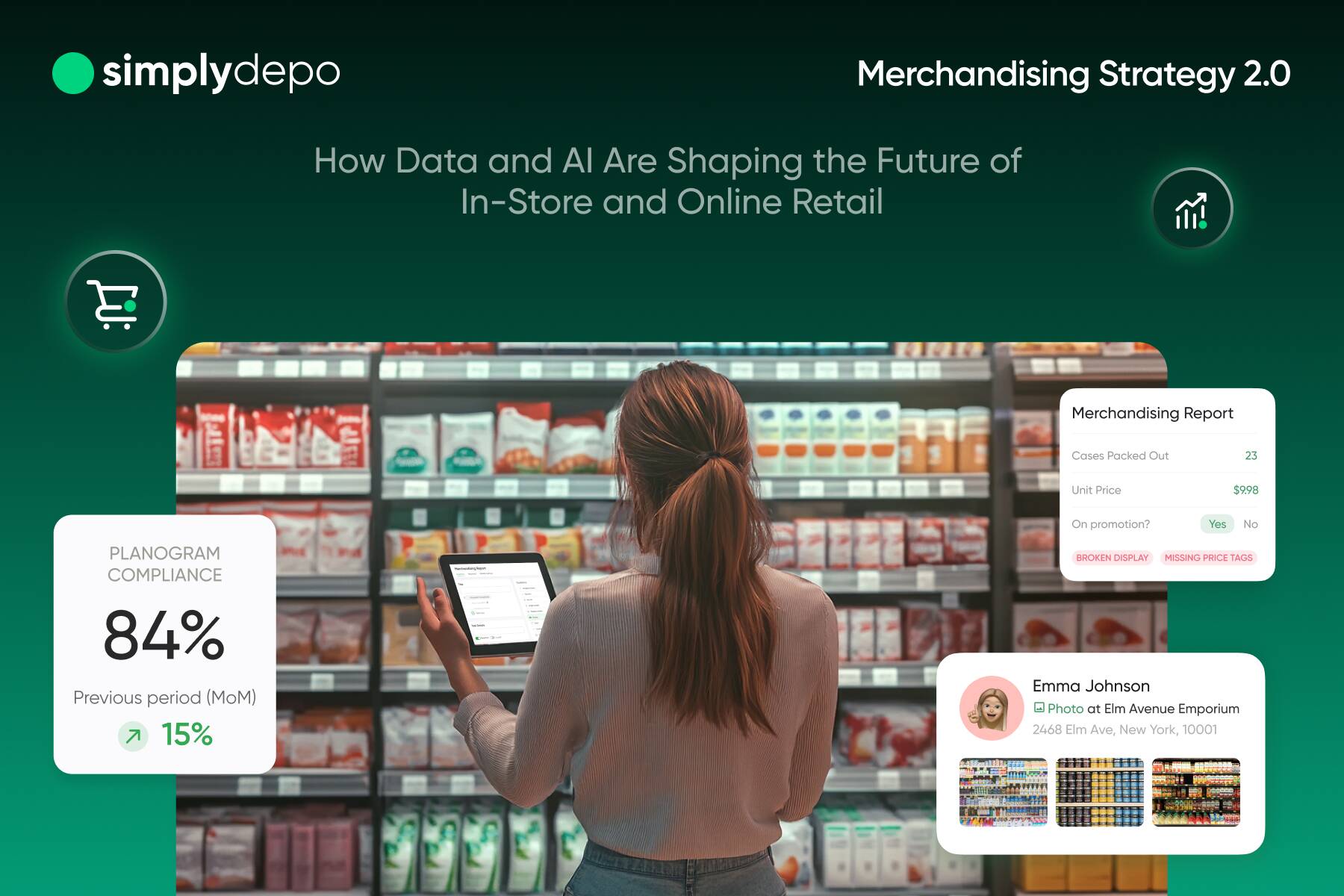
The merchandising world is changing. What used to be based on gut instinct and visual appeal is now powered by data, AI, and automation. And it’s changing how brands and retailers approach product placement, pricing, and promotions – online and on the shelf.
This is Merchandising Strategy 2.0 – a smarter, faster, and more responsive approach for the hybrid retail world.
If you’re still making merchandising decisions based on past sales and anecdotal field reports, you’re leaving opportunity on the table. Let’s explore how AI and real-time data are transforming merchandising and what your team needs to be competitive in 2025 and beyond.

The Old Playbook Is Broken
Traditional merchandising strategies have always been about one core goal: putting the right product in front of the right customer at the right time. But until recently, most of those decisions were based on static rules and reactive feedback.
Common challenges in traditional merchandising include:
- Delayed data: Field reports or sales trends come too late.
- Manual execution: Merchandising plans are printed, emailed, or scribbled on paper.
- Lack of visibility: Brands can’t see if their planograms are being followed.
- Online/offline disconnect: Physical store strategies don’t sync with digital product pages.
Retail is too fast and too competitive for that now.

Enter: Merchandising Strategy 2.0
What defines this new wave of merchandising isn’t just smarter tech – it’s a complete shift in how teams work, measure success, and adapt in real time.
Merchandising Strategy 2.0 is:
- Data-led, not guesswork-based
- AI-enhanced, not manually reactive
- Unified across channels, not siloed by teams
- Execution-focused, not just planning-heavy
What has changed?
| Feature | Old Merchandising | Merchandising 2.0 |
| Decision-making | Based on past sales | Based on real-time AI insights |
| Execution speed | Weeks or months | Hours or days |
| Compliance tracking | Manual reports | Automated photo analysis |
And it starts with a mindset shift: merchandising is no longer a once-per-season planning task. It’s a continuous, dynamic cycle that adapts with consumer behaviour and retail conditions.
Online Meets Offline: One Strategy, Two Worlds
Modern merchandising lives across two planes: the physical shelf and the digital storefront. And both are equally important – but often misaligned.
In-Store Retail Shoppers still go to physical stores for immediate needs, sensory experiences, and brand discovery. But planogram compliance, shelf visibility, and correct pricing are ongoing struggles, especially for brands with third-party reps.
Online Retail
Here, product images, descriptions, reviews, and stock availability define success. And yet many product detail pages are outdated, inconsistent, or disconnected from store-level strategy.
The fix: Unify your merchandising strategy across platforms using centralised data, shared KPIs, and AI-powered insights.
Real-World Impact: How Brands Are Implementing Merchandising with SimplyDepo
Let’s talk results. Here’s how SimplyDepo clients are using modern merchandising strategies:
📍 Brickyard Brands: Reps with Real-Time Shelf Insights
Brickyard’s reps now use SimplyDepo’s app to upload shelf images and report planogram compliance instantly. AI flags issues like missing SKUs or pricing errors.
Results:
- Reduced stockouts in key SKUs by 28%
- Cut planogram deviation reporting time by 75%
- Increased promotional ROI by 32% through faster in-store corrections
📍 iCalm: Digital Merchandising Meets Field Execution
iCalm aligned their online and offline strategies by syncing inventory visibility, promo calendars, and product content updates via SimplyDepo. Store visits are now synced with e-commerce analytics, resulting in consistent experiences across all customer touchpoints.

What Data-Driven Merchandising Looks Like (In Practice)
Here’s what modern merchandising strategy includes:
🛠 Live Planogram Compliance
Shelf photos are analysed with AI. Non-compliant stores are flagged for follow-up. You no longer rely on weekly reports.
📈 SKU-Level Sales Velocity
Forget category-level views. Real-time sales data helps you decide which SKUs to prioritise, phase out, or promote.
📦 Out-of-Stock Detection
With SimplyDepo’s app, field reps log missing items on the spot. The backend recommends replenishment actions immediately.
🎯 Online and In-Store KPI Matching
See how a promo performs in-store and online in one dashboard. React quickly if it underperforms in either channel.
Why AI Is the Merchandiser’s New Best Friend
AI in merchandising isn’t about replacing human decisions – it’s about elevating them.### AI Features:
- Image recognition: Automatically detects shelf layout issues from photos.
- Predictive analytics: Know what products will underperform—before they do.
- Recommendation engines: Suggest the best next move for each store, product or rep.
- Anomaly detection: Flag inconsistencies in pricing, display setup, or product facings.
The result? Less data crunching. More action.
The Merchandising Stack: What You Need
You don’t need 5 tools. You need one system that connects strategy, execution, and performance.
Here’s what’s in your merchandising toolbox:
Must-HavePurposeField appCapture photos, report compliance, log inventoryDashboard with sales + visual dataConnect shelf data with performanceAI AI alerts, Flag issues or opportunities at store levelPromo & content calendarAlign field visits with online campaignsCross-channel reporting in-store + e-commerce data together
SimplyDepo combines all of this into one field execution platform, designed for merchandising agencies and growing brands.
Building a Merchandising Team for 2025
Your tools only work if your team is aligned. That’s why Merchandising Strategy 2.0 also redefines how teams work together.
Roles in a modern merchandising team:
- Field Reps: Equipped with mobile tools to collect real-time data
- Data Analysts: Interpreting patterns, not just aggregating reports
- Digital Merchandisers: Updating product content across marketplaces
- Trade Marketing Leads: Coordinating online + in-store activations
The magic happens when these teams share the same dashboard, data sources, and KPIs.

Don’t Just Plan—Execute, Track, and Improve
Planning is only half of merchandising. Execution is where the magic happens.
3 Questions Every Brand Should Ask:
- Are our in-store displays compliant?
- Do our digital product pages match our in-store messaging?
- Can we see performance changes within days, not months?
With data and AI-powered execution tools, the answer to all 3 can be: yes.
Key Takeaways: Merchandising Strategy 2.0
Merchandising Strategy 2.0 is a data-driven, AI-enhanced approach that unites in-store and online retail operations, enabling real-time compliance tracking, faster decision-making, and unified performance measurement.
Core Benefits
- Faster execution: Move from weeks to hours for planogram and promo adjustments.
- Higher ROI: Brands using AI merchandising report up to 30%+ improvement in promotional returns.
- Reduced stockouts: Real-time alerts help prevent lost sales opportunities.
- Unified strategies: Ensure store shelves and digital product pages match for a seamless customer experience.
Key Features of AI-Driven Merchandising
- Image recognition: Detects missing SKUs, pricing errors, and planogram deviations from photos.
- Predictive analytics: Forecasts SKU performance before sales drop.
- Anomaly detection: Flags pricing and display inconsistencies instantly.
- Recommendation engine: Suggests the best next step for each store or product.
Best Practices for Implementation
- Equip field reps with mobile tools for real-time shelf data capture.
- Use a central dashboard to align online and offline merchandising KPIs.
- Automate compliance tracking and reporting to free up team time.
- Foster cross-functional collaboration between field reps, analysts, and digital merchandisers.
Getting Started
- Digitize execution workflows.
- Centralize retail and e-commerce data.
- Deploy an all-in-one merchandising platform like SimplyDepo to connect strategy, execution, and reporting.
Merchandising Strategy 2.0 isn’t a trend – it’s the new normal.
📲 Ready to modernize how your team plans, executes, and tracks merchandising? Learn how SimplyDepo can help

FAQ: Merchandiasing Strategy in the Age of AI
What is merchandising strategy 2.0?
It’s a data and AI-driven approach to merchandising that connects physical and digital channels, automates compliance tracking, and enables real-time performance management.
Can Merchandising Strategy 2.0 reduce promotional waste?
Yes. By monitoring promo performance across both online and offline channels in real time, brands can adjust strategies quickly—reducing wasted spend on underperforming promotions.
How does AI work in merchandising?AI recognises shelf layout issues from photos, forecasts SKU performance, detects anomalies, and recommends in-store actions—automating once manual tasks.
What makes a modern merchandising team?Cross-functional collaboration, shared dashboards, mobile execution tools, and fast adaptation.
Who should be part of a merchandising team?
A modern merchandising team typically includes field reps with mobile tools, data analysts to interpret trends, digital merchandisers managing online product content, and trade marketing leads to coordinate promotions across channels.
Is SimplyDepo only for field teams?No. While it’s designed for reps in the field, it also connects digital merchandising, inventory tracking, and sales analytics in one system.
How do I get started with modernising my merchandising process?
Start by digitising your execution: equip field reps with mobile tools, centralise your data, and use AI to guide actions. Platforms like SimplyDepo can help you do it all from day one.
How does real-time planogram compliance work?
Field reps capture shelf images using a mobile app, AI analyzes the photos instantly, and non-compliant stores are flagged for immediate corrective action—eliminating delays from manual reporting.


-
 NewsG2 Winter 2026 Breakdown: Why Field Sales & Retail Execution Teams Choose SimplyDepoDecember 6, 2025
 -

-

Boost Sales.
Cut Manual Work.
Streamline ordering, routing, and retail execution — while giving every rep the tools to grow accounts faster.
-
+15h
Save weekly
per rep -
93%
Increase
buyer retention -
24%
Increase
in retail sales
