What Is Consultative Selling? A Practical Guide for Reps


📌 Key takeaways:
- Consultative selling means diagnosing what the customer is trying to fix before recommending anything, and it has been measurable since 1982, when Saxe and Weitz built a scale for it.
- The companion idea is adaptive selling: changing your approach during the conversation based on what you learn, which research ties to knowing customer types well enough to recognize which one you are facing.
- On a route, the whole consultative process may have to fit into the few minutes a busy owner can spare, so the diagnosis happens by reading the shelf before you say hello.
- The technique fails for a boring reason far more often than a skills reason, which is that nobody wrote down what the buyer said last time.
Almost everything written about consultative selling assumes you have an hour. The advice describes discovery calls, stakeholder mapping, tailored proposals and follow-up decks, all of which are real activities in a long enterprise cycle.
None of it survives contact with a store visit. A rep selling beverages into independent retail gets a few minutes with an owner who is signing for a delivery and watching the register, and will get those minutes again in two weeks, and again two weeks after that.
That constraint does not make the approach irrelevant. It makes it more valuable, because the alternative in short visits is an order-taking habit that never grows an account. This guide covers what the approach is, what the research actually supports, and how the technique compresses into the time a field rep really has.
What Is Consultative Selling?
Consultative selling is an approach where the seller works to understand the buyer’s situation and problems first, then recommends a solution based on what they found, rather than presenting a fixed pitch and handling whatever objections come back.
The definition is easy to state and hard to practice, because the pull toward talking about your own product is strong when you have a target. The distinguishing test is simple: in a consultative conversation, the seller could conclude that the customer should buy less, buy later, or buy something else, and would say so.
That willingness is not altruism. It is what makes the recommendation credible the next time, which in a repeat-purchase category is the only thing that compounds.
Consultative Selling vs. Transactional Selling
The contrast with transactional selling is the clearest way to see what changes. Both are legitimate; they suit different situations.
| Dimension | Transactional selling | Consultative selling |
|---|---|---|
| Opening move | Present the product or the promotion | Ask about the buyer’s situation |
| Information flow | Mostly seller to buyer | Mostly buyer to seller, early on |
| What success looks like | This order is written | The account grows across orders |
| Handling a bad fit | Push through the objection | Say so, and protect the relationship |
| Time required per contact | Short | Longer at first, shorter later |
| Best suited to | Commodity items, price-led categories, one-off purchases | Repeat categories, considered purchases, anything where the buyer carries risk |
The last row is the practical guide. If a buyer is committing shelf space, working capital or their own credibility, they carry risk, and a consultative approach earns its extra minutes. If they are reordering a staple at a known price, a fast transaction respects their time more than a discovery question does.
Most field territories contain both situations, often inside the same store, which is why treating this as a personality choice rather than a situational one is a mistake. Reps who never make the switch tend to describe the result as one of the more stubborn field sales challenges, when it is really a decision nobody made explicitly.
The Research That Backs It
The approach is often presented as received wisdom. It has better support than that.
In 1982, Robert Saxe and Barton Weitz published the SOCO scale in the Journal of Marketing Research, defining customer orientation in salespeople and building an instrument to measure how much a given seller practiced it. Their validity test found that customer-oriented selling “is related to the ability of the salespeople to help their customers and the quality of the customer-salesperson relationship.”
Two things in that sentence are worth noticing. The finding is about the seller’s ability to help and about relationship quality, not about hitting quota this month. And the construct is a spectrum, not a binary: the scale measures selling orientation at one end and customer orientation at the other, and real sellers sit somewhere between.
That matters for how you coach it. Nobody converts from transactional to consultative in a training session. What moves is the balance, and it moves through the questions a rep habitually asks.
Adaptive Selling Is the Other Half
The complementary idea arrived four years later. In the Journal of Marketing in 1986, Barton Weitz, Harish Sujan and Mita Sujan set out a framework for adaptive selling, proposing that a seller’s ability to change approach mid-conversation depends on their knowledge of customer types and sales strategies, and on their motivation to alter direction.
The knowledge condition is the part usually skipped. Adapting is not improvisation. A rep can only recognize “this is a price-driven owner who will not care about the brand story” if they have met enough owners to have categories. Which is why a new rep asking good questions still adapts badly: they collect the answers and have nowhere to put them.
Two practical consequences follow. New reps need patterns handed to them rather than being told to listen, and the patterns need to come from the accounts your team actually calls on, not from a generic training deck.
Consultative Selling on a Route
Here is the version of the approach nobody publishes. A field rep working a route may get only a few minutes at a stop, and much of that is physical work: checking stock, facing product, counting what moved, writing the order.
The diagnosis therefore happens before the conversation, not during it. By the time the rep says hello, they should already know what sold since the last visit, what is out of stock, whether the display survived, and what the store ordered last time compared with the time before.
That is a consultative position reached without asking a single question, and it changes what the one question you do get to ask can be. “How’s it going?” wastes the opening. “You went through the twelve-count faster than last time, do you want to go to two cases or add the other flavor?” is a recommendation grounded in evidence, offered in one sentence.
Practically, this makes account history the binding constraint on the whole approach in the field. A rep who cannot see the last three visits before walking in is not able to be consultative, however good their instincts are, which is the specific gap a field sales CRM is built to close.
Techniques That Fit a Short Visit
The published technique lists run long and assume a meeting. These four survive compression.
Read the shelf as your discovery
Out-of-stocks, facings lost to a competitor, dusty stock at the back and a display that has been dismantled are all answers to questions you did not have to ask. Note them before you speak.
Ask one question, not five
A short visit supports a single good question. Make it open, make it about their business rather than your product, and then stop talking. “What’s moving well for you in the cooler right now?” outperforms any question containing your brand name.
Recommend against your own interest at least occasionally
If a slow SKU is not working in their store, say so and pull it. The next recommendation you make will be believed, and buyers remember who told them the truth about a dud.
Close the loop out loud
End by stating what you will do before the next visit and then do it. A rep who says “I’ll bring the shelf strips next Tuesday” and arrives with shelf strips has built more trust than any pitch delivers.
Each of the four is a habit rather than a script, which is deliberate. Scripts break under time pressure and habits survive it, which is also why the reps who run the tightest visits are usually the ones placing faster reorders rather than the ones talking longest.
Questions That Open a Real Conversation
Question quality is where the method either happens or does not. These work in a short retail visit because they are answerable in a sentence.
- What’s selling well for you in this category right now?
- Which of my items would you drop if you had to drop one?
- Who else has been in this week trying to get shelf space?
- What’s the biggest hassle with deliveries at the moment?
- If I could fix one thing about working with us, what would it be?
The second and fifth are uncomfortable to ask, which is exactly why they produce information the competitor does not have. A buyer who tells you which SKU they would cut has handed you the problem to solve before it becomes a delisting.
The answers are only worth collecting if they survive the drive to the next stop. Writing them against the account while you are still standing there is the difference between a question that compounds and one that evaporates, and it is the single behavior any retail CRM has to make effortless or reps will not do it.
Consultative Selling Examples
Three short scenarios show the difference in practice.
The declining account. A store’s orders have dropped for three cycles. The transactional response is a promotion. The consultative response is to ask what changed, which surfaces that a new competing brand took two facings and the owner is watching which one turns faster. The useful move is a display placement, not a discount.
The over-ordering account. An enthusiastic owner wants ten cases of a new flavor. The consultative response is to point out that the store sells four cases of the established flavor in a month, recommend three, and protect them from a stale-dated write-off that would sour them on the whole brand.
The new account with the wrong assortment. A buyer wants the full range. Their store’s demographics and cooler space support two items. Selling two, proving they move, and coming back for a third is slower on paper and produces an account that lasts.
In each case, the consultative move costs revenue this visit and protects it over the year. That is the trade, and it is only worth making in categories where you will be back.
Notice that all three depend on knowing the account’s own sell-through history rather than on charm. That is the practical reason shortlists of the best CRM for sales reps matter more to this technique than any training curriculum.
What Actually Stops Reps Being Consultative
The obstacle is rarely skill. In small brands and distributors, the approach fails for a mundane reason: the information from the last conversation is gone.
iCalm Health, a New York CPG brand founded in early 2024 by sisters Daniela and Michelle, described the problem plainly on its case study page. Working across more than 200 target locations, the team tracked stores in Excel and on paper, and key data including store descriptions, the contact person to speak to, prospects, calls and visits was frequently undocumented.
The consequence they name is the one that kills the technique: lost leads, missed follow-ups, and incomplete records of customer preferences. A rep who cannot recall what a buyer told them six weeks ago has no choice but to open with a generic pitch.
Fixing that is unglamorous. It means capturing a handful of fields at every visit, in the moment, and having them retrievable at the next one.
None of that is a training problem, which is why brands often spend on coaching when the binding constraint is a notebook.
Making the Last Visit Visible
The test for any system meant to support this approach is narrower than a feature list. Can a rep retrieve the last conversation in under ten seconds, standing up, on a phone, in a stockroom with no signal.
SimplyDepo handles it as customer profiles that carry orders, notes, tasks, photos and contacts against each account, so the previous visit is on screen before the rep walks in. Purchase history and the last few conversations arrive together, which is the combination that lets a rep open with a recommendation instead of a question.
Worth knowing before you shortlist it: the platform is sold only in the US and Canada, it is designed for field forces topping out around a hundred reps, and the sales side of the business stays separate from your accounting system rather than absorbing it.
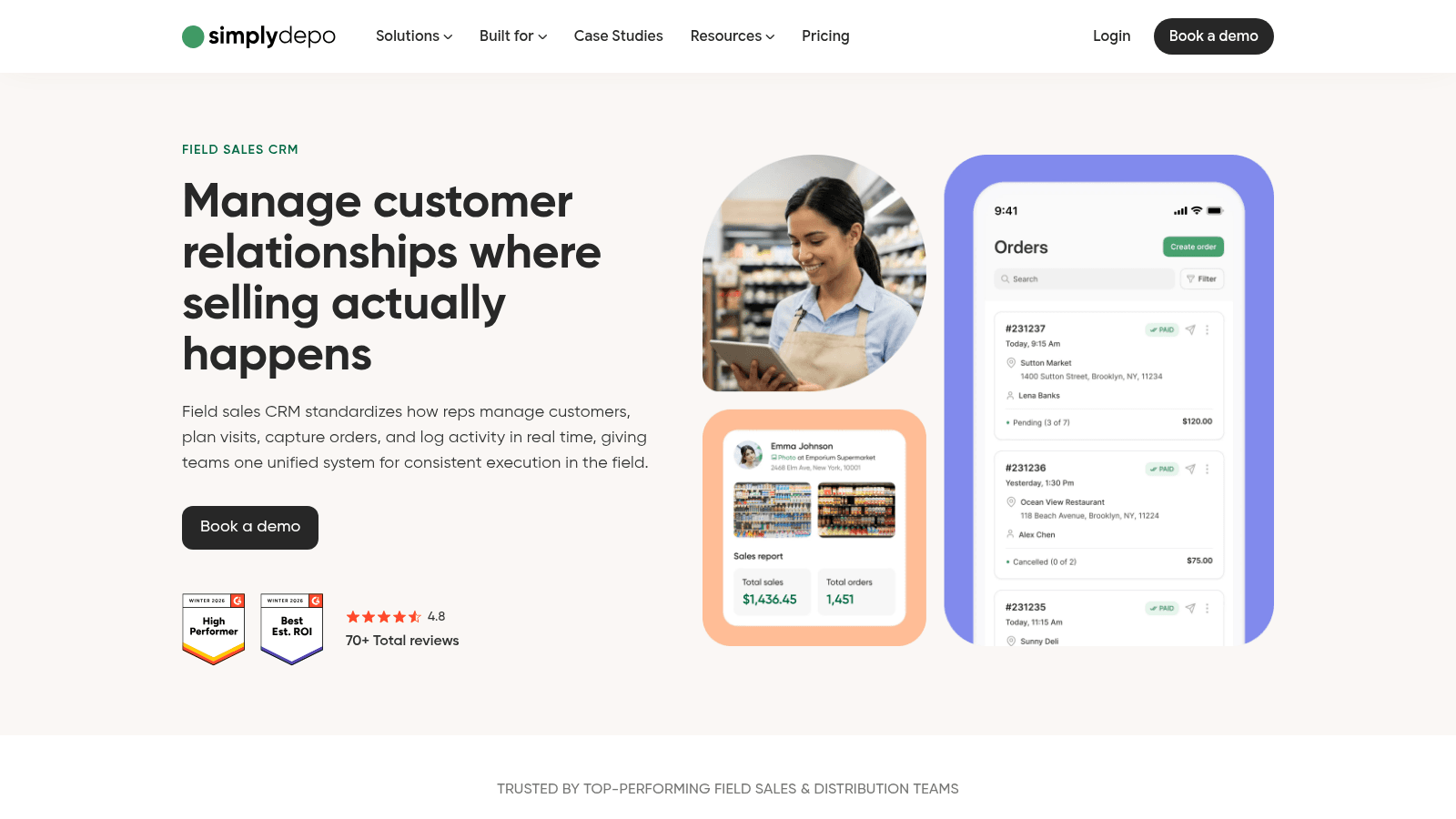
SimplyDepo’s field sales CRM page, simplydepo.com (September 2026).
Whatever a team runs, the buying criterion for account management software in the field is retrieval speed under bad conditions, not the length of the feature list.
Measuring Whether It Is Working
The approach resists measurement because its payoff is delayed. A few indicators track it honestly.
| Signal | What it indicates | Where to find it |
|---|---|---|
| Reorder rate | The recommendation was right, so they came back | Order records by account |
| Average items per account | The relationship is broadening, not just repeating | Order lines over time |
| Notes captured per visit | Reps are collecting information, not just orders | Visit logs |
| Accounts with a named contact and preferences on file | The history exists to be consultative from | Account records |
| Returns and write-offs | Falling means reps stopped over-selling | Credit notes |
The fourth row is the leading indicator and the one teams most often leave untracked. If half your accounts have no recorded contact name, the consultative conversation is starting from zero every visit, whatever your training budget says.
Reviewing your sales rep productivity metrics alongside these signals keeps the picture honest, since activity and effectiveness diverge quickly here. A rep can complete every scheduled visit and still learn nothing about a single account.
Where to Start
Consultative selling is not a personality or a script. It is a sequence: find out what is actually happening, recommend accordingly, and be willing to recommend less. Saxe and Weitz showed it can be measured; Weitz, Sujan and Sujan showed that adapting well depends on knowing your customer types rather than simply intending to listen.
For a field team, the first move is not training. It is making the last visit visible before the next one starts, because a rep holding the account’s history becomes consultative without being taught, and a rep without it cannot.
SimplyDepo gives new teams 30 days to try it, with setup help and training thrown in at no charge, and a booked demo is how you get a look at the account record on a phone.
Frequently Asked Questions
Consultative selling is an approach where you diagnose the customer’s situation before recommending anything, so the recommendation fits the problem rather than your sales target. In practice it means asking about their business first, listening to the answer, and being willing to suggest they buy less or buy nothing if that is the honest conclusion. The payoff is a recommendation the buyer believes next time.
Transactional selling leads with the product or the promotion and works to close the order in front of you. Consultative selling leads with questions about the buyer’s situation and treats the current order as one step in a longer account relationship. Neither is universally better: transactional suits commodity items and one-off purchases, while consultative earns its extra time whenever the buyer is taking on risk, such as committing shelf space or working capital.
Question design, listening without steering, and pattern recognition across customer types. The research on adaptive selling points at that third one specifically, since a rep can only adjust their approach if they have enough experience of different buyers to recognize which type they are dealing with. A fourth, less discussed skill is record discipline, because selling this way across repeat visits depends entirely on remembering what was said last time.
Yes, but the sequence changes. In a visit that short there is no time for open-ended discovery, so the diagnosis has to happen before the conversation by reading the shelf, the last order and the previous visit’s notes. The rep then spends their limited speaking time on one grounded question and one evidence-based recommendation instead of a discovery process.
Telling a store owner to order three cases instead of the ten they asked for, because their sell-through does not support ten and stale stock would damage the brand in that store. Recommending that a slow item be pulled rather than defending it. Responding to a declining account by asking what changed instead of offering a discount.
In each example the seller gives up revenue in the moment to keep the account working over the year.
-
 October 20, 2026
 -
 October 20, 2026
 -
 October 20, 2026