Vendor Onboarding: How Distributors Should Set Up and Manage New Suppliers


📌 Key takeaways:
- Most vendor onboarding advice is written for accounts payable setting up a service vendor. A distributor is onboarding a product line, so the item master is the stage that decides whether the rest works.
- Collect the W-9 before the first payment, not after. Missing or wrong taxpayer information obliges you to withhold 24% of payments and send it to the IRS.
- Bad supplier data does not stay in the back office. A wrong case pack becomes a wrong order, a wrong invoice, and a credit request.
- Onboarding is not finished when the vendor is in your system. It is finished when your reps can sell the line correctly in front of a buyer.
A new supplier signs, everyone shakes hands, and then three weeks disappear. The item list arrives as a spreadsheet with inconsistent unit sizes. Nobody has the certificate of insurance. The first purchase order goes out against a price that was superseded in an email, and the first customer invoice has to be credited.
None of that is a relationship problem. It is a process problem, and it repeats with every new line because the process lives in one buyer’s head.
The vendor onboarding process is the standard set of steps that takes a supplier from “we want to carry this” to “our reps are selling it correctly and the invoices match.” This guide lays out a new vendor onboarding process for wholesale distributors and CPG operators specifically, including the stage that generic onboarding guides skip entirely.
What Vendor Onboarding Means for a Distributor
Vendor onboarding is the process of collecting the information, documents, approvals, and product data needed to trade with a new supplier, and setting all of it up in your systems before the first order.
For most companies, that is a finance exercise. You are hiring a landscaper or a software vendor, so you need a W-9, a contract, banking details, and a record in accounts payable. That is where nearly every published vendor onboarding checklist stops.
A distributor is doing something different. You are not buying a service, you are taking on a product line that will flow through your warehouse, your price lists, your trucks, and your reps’ order screens. The supplier’s data becomes your catalog, and every error in it multiplies across hundreds of downstream orders.
So a distributor’s onboarding has the standard compliance layer plus a product layer: items, pack configurations, barcodes, costs, minimums, lead times, and the sell-in materials your team needs. Skip the second layer and you get a vendor who is technically approved and practically unsellable.
The Vendor Onboarding Process Flow, End to End
A workable vendor onboarding process flow has six stages with a named owner for each. The owner matters more than the tooling, because unowned stages are where the three lost weeks come from.
| Stage | Owner | Typical duration | Output |
|---|---|---|---|
| Intake and qualification | Buyer or category manager | 1 to 3 days | A completed vendor onboarding form and a go or no-go |
| Documents and compliance | Finance, with legal on exceptions | 3 to 7 days | W-9, COI, licenses, signed terms |
| Item master build | Purchasing or data ops | 3 to 10 days | Clean SKUs, packs, barcodes, costs |
| Commercial terms and pricing | Buyer with finance sign-off | 2 to 5 days | Cost table, MOQs, lead times, promo rules |
| Systems setup and first order | Operations | 1 to 3 days | Vendor live, first PO placed |
| Field launch | Sales management | 2 to 5 days | Reps trained, catalog live on the app |
Run those vendor onboarding process steps in parallel where you can. Compliance documents and the item master build have no dependency on each other, and insisting on a strict sequence is what turns a two-week onboarding into a two-month one.
The one hard dependency is that no purchase order should go out before compliance clears. That single rule prevents most of the expensive mistakes.
Stage 1: Intake and the Vendor Onboarding Form
The intake stage exists to answer one question: is this line worth the work of carrying it? Answer it before anyone starts collecting documents.
A vendor onboarding form is how you get comparable answers instead of a series of phone calls. Keep it to a single page and make every field one you will actually use.
Ask for legal entity name and any DBA, the remit-to address, a primary and a backup contact, the product categories and item count, the pack configurations, MOQs and lead times, existing distribution in your territory, whether they hold any exclusivity, their fill-rate history, and how they handle damages and short shipments.
Two of those punch above their weight. Existing distribution in your territory tells you whether you are about to compete with another distributor on the same shelf, which changes the margin math entirely. And the damages policy tells you who eats the cost of a broken case, which is a conversation that goes badly if you have it for the first time after a pallet arrives crushed.
Score the answers against your own criteria rather than sizing up the brand story. Category fit, margin, minimums you can actually hit, and lead times your customers will tolerate will predict the outcome better than enthusiasm will.
Stage 2: Documents and Compliance
Compliance is the stage most likely to be done informally and most likely to cost real money when it is. Collect the documents before the first payment, not before the first audit.
The tax paperwork is not optional. A payer must collect a taxpayer identification number from a U.S. vendor on Form W-9, and if the TIN is missing or the IRS says it is wrong, the payer is required to withhold at a current rate of 24 percent on reportable payments and remit it to the Treasury.
The IRS treats that as the payer’s obligation, not the vendor’s, so an unreturned W-9 becomes your problem at 1099 time.
Beyond the W-9, a distributor typically needs a certificate of insurance naming you as additional insured, a signed supplier agreement covering pricing, returns and damages, resale or exemption certificates where applicable, and any category licenses. Alcohol, tobacco, and regulated food categories each carry their own.
Food and Beverage Adds a Traceability Layer
If you distribute anything on the FDA’s Food Traceability List, supplier onboarding is also where traceability data starts. The rule under Section 204 of the Food Safety Modernization Act requires firms handling listed foods to keep Key Data Elements tied to Critical Tracking Events and to produce those records to the agency within 24 hours of a request.
The timing has moved and is worth stating precisely, because plenty of coverage gets it wrong. The original compliance date was January 20, 2026. The FDA then proposed a 30-month extension to July 20, 2028, and Congress separately directed the agency not to enforce the rule before that same date, which the FDA has said it intends to follow.
That is breathing room rather than a reprieve. Traceability records depend on lot-level data arriving from your suppliers, so the practical move is to add the fields to your onboarding form now and let them fill up as new vendors come on. Our guide to food distribution covers where those records sit in the wider operation.
Stage 3: Building the Item Master
This is the stage generic onboarding guides skip, and it is the one that determines whether the next six months run smoothly. Every downstream error traces back to a field somebody guessed at here.
| Field | Why it matters | What breaks without it |
|---|---|---|
| Selling unit of measure | Defines what a customer is buying, each versus case | Orders arrive at 12 times the intended quantity |
| Case pack and inner pack | Drives pricing, picking, and truck planning | Pick errors and unworkable pallet math |
| GTIN or UPC per level | Lets a rep or picker scan the item | Barcode scanning fails, manual entry returns |
| Item dimensions and weight | Feeds freight cost and pallet configuration | Freight quotes are wrong, margin evaporates |
| Landed cost, not invoice cost | Includes freight, duty, and allowances | Margin looks healthy on paper and is not |
| Shelf life and storage | Governs rotation and what you can promise | Short-dated stock nobody flagged |
| Minimum order quantity | Sets the reorder point you can actually use | Purchase orders rejected by the supplier |
| Product images and descriptions | What the rep and the customer see | Reps sell from memory and describe it wrong |
Insist on one file, in your format, before you build anything. Suppliers will send a PDF sell sheet or a spreadsheet with merged cells and three different ways of writing a case pack, and accepting it as-is guarantees that someone retypes it under time pressure.
Validate a sample before loading everything. Take ten items, load them, and put a test order through end to end: catalog to order to invoice. Ten items will surface a unit-of-measure mismatch in an hour, where 400 items will surface it in a customer complaint.
Consistent SKU management rules are what make this repeatable across suppliers. Decide your naming convention once, then apply it to every vendor rather than inheriting each supplier’s internal codes.
Stage 4: Commercial Terms and Price Lists
Terms are the part everyone thinks they agreed to. Write them down in the system rather than the thread.
Capture the cost table with effective dates, payment terms, freight terms and any free-freight threshold, volume or growth rebates, promotional allowances and how they are claimed, return and damage policy, and the price change notice period. That last one is worth negotiating hard, because 30 days of notice is the difference between repricing calmly and eating a quarter of margin.
Set the minimum order quantity against your own turn rate, not the supplier’s preference. A minimum that forces you to hold 90 days of a slow SKU is a working capital decision disguised as a shipping term.
Then load customer-facing prices as a price list rather than as a note. Distributors typically run different pricing by customer group, and if those rules live anywhere other than the system that generates the order, a rep will eventually quote last year’s number in good faith.
SimplyDepo handles this with per-customer price lists that apply automatically at order entry, plus volume promotions defined as rules rather than as reminders: free case, percentage discount, dollar amount, or quantity break. The rep sees the right price for the account in front of them, which removes the most common source of a credit request on a new line.
Stage 5: Systems Setup and the First Order
Systems setup is mechanical, and it goes fast when the previous stages were done properly. Create the vendor record, load the items and price lists, set the reorder points, and connect the accounting sync so purchase orders and payments post without re-entry.
A note on accounting scope: SimplyDepo syncs orders, payments, and back-office workflows with QuickBooks Online, and it is not an ERP or an accounting system. It does not replace your general ledger, and QuickBooks Desktop is not supported, which is worth confirming early if your finance team still runs Desktop.
Then place a deliberate first order and treat it as a test. Order a small quantity across several pack types, and check five things when it lands.
- The quantity received matches the unit of measure you configured, not what the supplier assumed.
- Every barcode scans on the first try against your catalog.
- The invoice price matches the cost table, line by line, including freight terms.
- The actual lead time matched the one you loaded into the reorder point.
- The paperwork carries the lot codes and any traceability data you are required to keep.
Fix any mismatch before order two. A first order that arrives wrong and gets quietly corrected by hand teaches everyone that the system’s data is unreliable, and after that people stop trusting it and start calling the buyer.
Stage 6: Getting the New Line Into the Field
Onboarding is not complete when the vendor is live in the back office. It is complete when a rep can sell the line correctly in front of a buyer, and that is a separate piece of work.
Reps need the item list with images, the price list that applies to the account in front of them, the promo rules, the story behind the brand, and the answers to the three questions every buyer asks: what does it replace on my shelf, what is the margin, and how fast can you restock it.
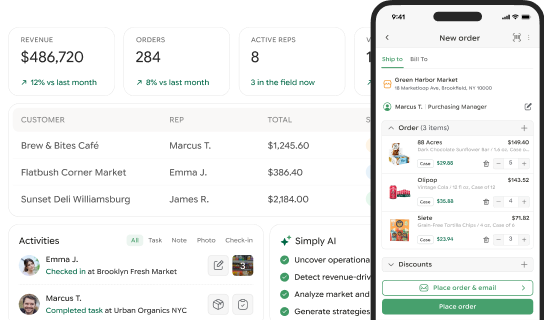
This is where a mobile catalog earns its keep. In SimplyDepo, the new items and their customer-specific pricing appear in the rep’s app as soon as they are loaded, so a rep taking an order sees the correct price for that account instead of working from a printed sheet.
The barcode scanner finds the item in the catalog at the shelf, which only works because the GTINs were captured properly in stage three.
Set a launch target and measure it. Something like “listed in 40 accounts within 60 days” gives the line a definition of success, and it tells you quickly whether a slow start is a product problem or a distribution problem.
How Long Vendor Onboarding Should Take
A well-run distributor onboarding runs about two to three weeks from signed agreement to first order, with the field launch a week behind that.
The variance is almost never in the paperwork. It is in the item master, because the supplier sends incomplete data and the back-and-forth happens over email in fragments.
Track cycle time from intake to first order, and track it per stage. If the average sits at six weeks, the stage-level numbers will show you exactly which handoff is failing, and it is usually the one with no named owner.
Set different targets by tier. A supplier bringing 400 SKUs and cold-chain requirements is not the same job as one bringing eight shelf-stable items, and holding both to one standard makes the metric useless.
Vendor Onboarding Automation, and What Not to Automate
Automation helps most at the collection and validation stages, where the work is repetitive and the errors are mechanical.
Worth automating: a web intake form that writes directly into your vendor record instead of arriving as an email attachment, document expiry reminders for COIs and licenses, validation rules that reject an item row with a missing GTIN or an impossible case pack, approval routing so a request cannot sit unowned, and the accounting sync so vendor and item records are created once.
Not worth automating: the qualification decision, the terms negotiation, and the first-order inspection. Those need judgment, and a workflow that auto-approves a vendor because the form was complete has automated the paperwork while removing the thinking.
There is a sequencing trap here. Automating a process you have not standardized just produces errors faster. Write the six stages down, run three vendors through them manually, fix what breaks, and then automate the parts that proved repetitive.
Managing Suppliers After Onboarding
The relationship starts, rather than ends, at the first order. Review it on a schedule against numbers you agreed to up front.
Fill rate is the number that matters most for a distributor, because a supplier who consistently ships less than you ordered is quietly setting your out-of-stock rate for you. Track it alongside on-time delivery, invoice accuracy, damage rate, and lead-time reliability measured as variance rather than average.
Run a quarterly review with your top suppliers and an annual one with the rest, and bring the data rather than impressions. A supplier shown their own fill rate against your other vendors will usually fix it.
Re-verify compliance documents on the same cadence. Certificates of insurance expire quietly, and the day you discover an expired COI should not be the day of a claim. Tools like vendor management software and a maintained catalog management system keep these records and the item data in one place rather than in a folder someone owns personally.
Clean supplier data pays off directly in order accuracy. Tenace, a beverage distributor, cut order corrections by 70% and reached 100% invoice accuracy after moving off manual processes, which is the same defect class that a sloppy item master creates at the source. You can read that in the Tenace case study.
Making the Process Survive Its Author
The difference between distributors who onboard a line in two weeks and those who take two months is rarely software. It is whether the vendor onboarding process steps exist in writing with named owners, or whether they live in the head of one buyer who is currently on vacation.
Write the flow down, build the intake form, define the item fields you will not accept a vendor without, and put a name against each stage. Then run the next supplier through it and fix what breaks.
For a broader view of how supplier data connects to the rest of the operation, see our guides to distribution management and vendor managed inventory, or book a demo to see how the catalog, price lists, and order flow fit together in one system.
Frequently Asked Questions
For a distributor, there are six: intake and qualification, documents and compliance, item master build, commercial terms and pricing, systems setup and first order, and field launch. Generic checklists cover the first two and the fifth, because they are written for accounts payable setting up a service vendor.
The item master build and the field launch are the distributor-specific stages, and they are where most of the delay and nearly all of the downstream order errors originate.
Keep it to one page and only ask for fields you will use. The core set is legal entity name and DBA, remit-to address, primary and backup contacts, product categories and item count, pack configurations, minimum order quantities, lead times, existing distribution in your territory, fill-rate history, and the damages and shortages policy.
For food categories, add lot-code and traceability fields now so the data is there when you need it. Anything you would otherwise have to chase by phone belongs on the form.
Two to three weeks from signed agreement to first order is realistic for a distributor, with the field launch about a week later. Compliance paperwork is rarely the bottleneck; the item master is, because suppliers send incomplete or inconsistent product data and the corrections happen over email.
Track cycle time per stage rather than end to end, set separate targets for a large complex supplier and a small simple one, and expect the slowest stage to be the one with no named owner.
Automation is worth applying to collection and validation: a web intake form that writes straight into the vendor record, document expiry reminders, validation rules that reject item rows missing a GTIN or carrying an impossible case pack, approval routing, and the accounting sync.
Automation is not worth applying to qualification decisions, terms negotiation, or the first-order inspection, all of which need judgment. Standardize the process manually across a few suppliers before automating it, because automating an undefined process just produces errors faster.
Measure the things you agreed to at onboarding: fill rate, on-time delivery, invoice accuracy, damage rate, and lead-time variance rather than lead-time average. Fill rate deserves the most attention, because short shipments from one supplier turn directly into empty shelves at your customers.
Review quarterly with major suppliers and annually with the rest, bring their own numbers to the conversation, and re-verify insurance certificates and licenses on the same schedule so nothing expires unnoticed.
 Rated 4.7 on G2
You shouldn't need 5 tools to run distribution.
-
 September 16, 2026
 -
 September 15, 2026
 -
 September 15, 2026