Customer Lifetime Value: Why it Matters and How to Improve It


📌 Key takeaways:
- Customer lifetime value estimates how much revenue or gross profit an account generates across the entire relationship.
- Distributors should calculate CLV using account-level reorder cadence and servicing costs, since high sales volume does not always mean high profitability.
- Increasing CLV starts with easier reordering and early action when an account’s usual buying cycle begins to slow down.
Every distributor rep has a favorite stop on their route. The one where the owner already knows what they want to order before the rep even parks, and the visit takes just a couple of minutes because nothing needs explaining twice.
A relationship like that rarely shows up in a sales report. The report tracks this month’s total revenue and this week’s new customers. It doesn’t ask how much value that one bodega will bring over the next five years, or ten.
Customer lifetime value is built to close that blind spot. It is not a metric for the transaction in front of you. Instead, it measures value across the entire customer lifecycle: the reorders that have not happened yet and the loyal customers who will still be on the route long after this quarter ends.
Understanding customer lifetime value changes how you prioritize visits, price deals, and decide which existing customer deserves the next hour of a rep’s day.
What is customer lifetime value?
Customer lifetime value (CLV) is the total value a customer brings to a business across the entire relationship, not just one purchase.
Some teams use the term lifetime value or the acronym LTV instead. CLV and LTV are often used interchangeably, though CLV is more common in marketing contexts, while LTV is used in financial reports.
There are two ways to think about it:
- Historic customer lifetime value looks backward at how much an existing customer has already spent
- Predictive customer lifetime value looks forward, using statistical methods to forecast future customer behavior
Historical CLV uses past customer behavior to calculate value, which is useful for understanding what already happened. Predictive CLV points toward future revenue instead, which is why it carries more weight when deciding where to invest next.
Knowing which one you are looking at changes how you use the number. Historic CLV is safe to report to a manager as a record of what happened. Predictive CLV is the one worth acting on before a pattern fully plays out.
Why is customer lifetime value important?
A new customer is expensive to win. Ads, samples, introductory pricing, and rep hours spent building trust with a first-time buyer all add up before a single case ships.
Retaining existing customers costs far less than chasing new customers, which is why improving customer retention sits at the center of most customer acquisition strategies. A customer who stays longer keeps generating customer revenue without a second acquisition cost attached.
CLV also gives a business a way to spot its most valuable customers before they leave, since a higher CLV often correlates with improved customer retention and purchasing frequency.
Customer engagement metrics can help you identify at-risk accounts before a slowdown in orders becomes a lost account entirely.
How do you calculate customer lifetime value?
A basic customer lifetime value (CLV) calculation uses average purchase value, purchase frequency, and average customer lifespan.
CLV = Average purchase value × Purchase frequency × Average customer lifespan
Calculate the first two figures using:
Average purchase value = Total revenue ÷ Total number of purchases
Purchase frequency = Total number of purchases ÷ Number of unique customers
Customer lifespan is the average length of time someone continues buying from your business. You can estimate it using historical customer data or cohort analysis.
Make sure purchase frequency and customer lifespan use the same unit of time. For example, if purchase frequency is measured per year, lifespan should be measured in years.
Suppose a customer spends an average of $200 per order, places four orders per year, and remains a customer for three years:
CLV = $200 × 4 × 3 = $2,400
Purchase frequency has a strong influence on CLV. Two customers may spend the same amount per order, but the customer who orders more frequently will generate more revenue over the course of the relationship. Retaining customers for longer also creates more opportunities for repeat purchases.
Subscription businesses often use a simplified formula:
CLV = Average revenue per user (ARPU) ÷ Customer churn rate
ARPU and churn must cover the same period, and the churn rate should be written as a decimal. If monthly ARPU is $100 and monthly churn is 5%, the calculation is:
CLV = $100 ÷ 0.05 = $2,000
The subscription formula assumes ARPU and churn remain relatively stable. It does not account for changing retention patterns or the time value of money.
Revenue-based CLV shows how much revenue a customer generates. To estimate the gross profit associated with that customer, include gross margin:
Gross-margin-adjusted CLV = Average purchase value × Purchase frequency × Customer lifespan × Gross margin
For subscription businesses, use:
Gross-margin-adjusted CLV = (ARPU × Gross margin) ÷ Churn rate
Enter gross margin as a decimal. For example, use 0.70 for a 70% margin. Customer acquisition cost is usually assessed separately by subtracting CAC from CLV.
Which CLV formula fits your business?
Customer lifetime value examples across different business types show the same three inputs recur: average order value, purchase frequency, and customer lifespan, even when the specifics behind them differ.
| Business model | Formula | Best for | Watch for |
|---|---|---|---|
| Basic retail or one-time purchase | CLV = Average transaction size x Number of transactions x Retention period | Straightforward repeat-purchase businesses, like a coffee shop or a corner retailer | Doesn’t separate profit from revenue unless gross margin is layered in |
| Subscription or recurring revenue | CLV = (Average Revenue per User x Gross Margin) ÷ Churn Rate | SaaS and membership businesses where revenue recurs automatically | Assumes a stable churn rate, which can shift quickly during growth or a pricing change |
| Wholesale or distributor reorder cycle | CLV = Average order value x Orders per reorder cycle x Account lifespan in cycles | Distributors and CPG brands managing route accounts and reorder patterns | Reorder cadence varies by account, so segment customers by route or channel before averaging |
Which factors influence customer lifetime value?
Average order value and purchase frequency are the most visible drivers of customer lifetime value. Several less obvious factors also influence how much customers spend and how long they continue buying.
Average order value
Higher order values increase CLV, provided they do not reduce purchase frequency. Bundles, relevant cross-sells, and volume-based incentives may encourage customers to spend more per order.
Purchase frequency
Customers who order more often generate greater lifetime value. Reliable stock availability and a convenient order management process can turn occasional buyers into repeat customers.
Customer satisfaction and service
Satisfied customers are more likely to continue buying without reconsidering the relationship after every order. When a problem arises, the speed and quality of the response may determine whether the customer stays or looks elsewhere.
Pricing and customer segmentation
Pricing consistency protects customer confidence. If you offer different price plans or account-specific rates, calculate average revenue for each customer segment. A single blended figure may hide major differences between high- and low-value accounts.
Customer experience and engagement
The wider customer experience influences whether an account places its next order. Engagement data explains what encourages different groups to return. Some customers respond to a broader product catalog, while others prioritize dependable availability.
Account tenure
Long-standing customers often have established buying habits and greater confidence in the relationship. They may be more willing to overlook an occasional service issue than newer customers who are still evaluating your business.
How is customer lifetime value different for B2B distributors?
For a B2B distributor, the customer is usually an account rather than an individual buyer. It might be an independent store, a restaurant, or a regional retail chain. Its lifetime value comes from the orders placed across the entire business relationship.
Repeat purchasing therefore plays a central role. An account may reorder weekly, monthly, or according to seasonal demand. Order frequency may also change with product turnover, stock availability, and the reliability of previous deliveries.
Revenue alone does not reveal an account’s full value. A high-revenue customer may receive substantial discounts or require frequent sales visits. Small deliveries, returns, special handling, and extended payment terms may further reduce profitability.
A simplified formula for distributors is:
Account CLV = (Average gross profit per order × Orders per year × Expected relationship length) − Acquisition and account-servicing costs
Customer concentration also deserves attention. If a small group of accounts produces a large share of revenue or profit, losing one of those relationships may have a noticeable financial impact. Distributors should therefore evaluate accounts by profitability and retention potential, not sales volume alone.
Procurement processes add another consideration. Buyers may reassess prices, service levels, and contract terms throughout the relationship. Maintaining CLV depends on continuing to deliver value through dependable fulfilment and terms that work for both sides.
How can you increase customer lifetime value?
Improving CLV involves strategies for increasing transaction value, frequency, and customer retention all at once, not picking one lever and ignoring the rest. If you run a distribution business, that plays out across four areas.
1. Make reordering effortless
Encourage customers to reorder by removing friction. A rep who can pull up an account’s order history and rebuild a past order in a few taps wins more repeat business than one working from memory.
Self-service options extend that convenience between visits, so a customer who wants to place a repeat order does not have to wait for the next scheduled stop. None of this should require the rep to remember anything; an ordering management software should surface it automatically at the start of the visit.
2. Keep account relationships consistent
A rep who leaves takes years of context along with them unless that context lives somewhere else. An account’s pricing history and preferred order pattern should not depend on one person’s memory.
Centralizing customer data around the account, not the rep, protects customer relationships when sales territories change hands. It also gives a new rep an easy start, which keeps the entire relationship from resetting every time staffing shifts.
A quick handover note logged the moment a territory changes hands costs a manager a few minutes and saves the new rep weeks of guesswork.
Continuity like that is worth the effort: McKinsey’s 2026 Global B2B Pulse Survey found that 53% of B2B buyers are relationship-oriented “adapters” who default to known suppliers and established ways of working. Strong account management is essential for retaining this largest buyer segment.
3. Fix the friction points that cause churn
Customer churn in distribution doesn’t announce itself. An account simply orders less, then less again, until the account is gone.
Order errors, late deliveries, and stockouts at reorder time are the usual causes. Each one chips away at customer satisfaction a little more than the last.
Improving customer service and fixing recurring errors at the source does more to protect customer lifetime value than any loyalty program added on afterward.
Track order accuracy and on-time delivery by account to see exactly which relationships need attention before the account stops ordering altogether.
💡 Pro tip:
Set a reorder due date based on each account’s usual buying cycle. If a store normally orders every 14 days, flag the account when that cycle slips instead of waiting for a standard 30- or 60-day inactivity threshold. Sort overdue accounts by CLV so reps address the most valuable relationships first.
4. Expand the basket, not just the order count
Upselling and cross-selling can significantly boost customer value without adding a single new account to the base. A rep who knows an account’s catalog gaps can suggest the right product at the right visit instead of guessing.
Personalized experiences can enhance customer loyalty and CLV here too.
A pricing tier, a bundle, or a recommendation based on what similar accounts already buy raises average order value gradually, without asking the customer to change how often they order.
The best results come from staying specific to the account rather than pushing the same suggestion across the whole customer base. A rep who suggests a product that an account has never carried risks looking like they are not paying attention.
How do you track customer lifetime value over time?
Customer lifetime value figures shift as buying patterns change, so tracking on a regular cadence is the key.
Segmenting CLV by customer cohort or channel gives you the insight to develop targeted strategies for the segments that move the needle most.
Group accounts by route, by account type, or by the month they came on board, then watch how each customer segment’s customer journey evolves.
Other customer metrics, like customer satisfaction scores and customer feedback, help you explain why a number moved, not just that it did. CLV works alongside these other customer metrics, not in place of them.
A dip in CLV paired with a spike in complaints points somewhere specific. The same dip with no complaints at all might just mean an account slowed down for a season.
A shared view between sales and operations works better here than a report only finance opens once a quarter. Reps often notice a behavioral shift on the ground weeks before the number itself moves.
💡 Pro tip:
For multi-location retailers, calculate CLV at both the parent-account and store levels. A chain may look valuable overall while a few locations reorder infrequently or require disproportionate service time. Looking at both levels stops strong stores from hiding weaker ones.
Manage every account’s lifetime value with a unified platform
None of this works if the information needed to act on CLV lives in a rep’s head or disconnected tools. Sustainable growth in customer lifetime value depends on a business being able to see the entire customer journey for every account.
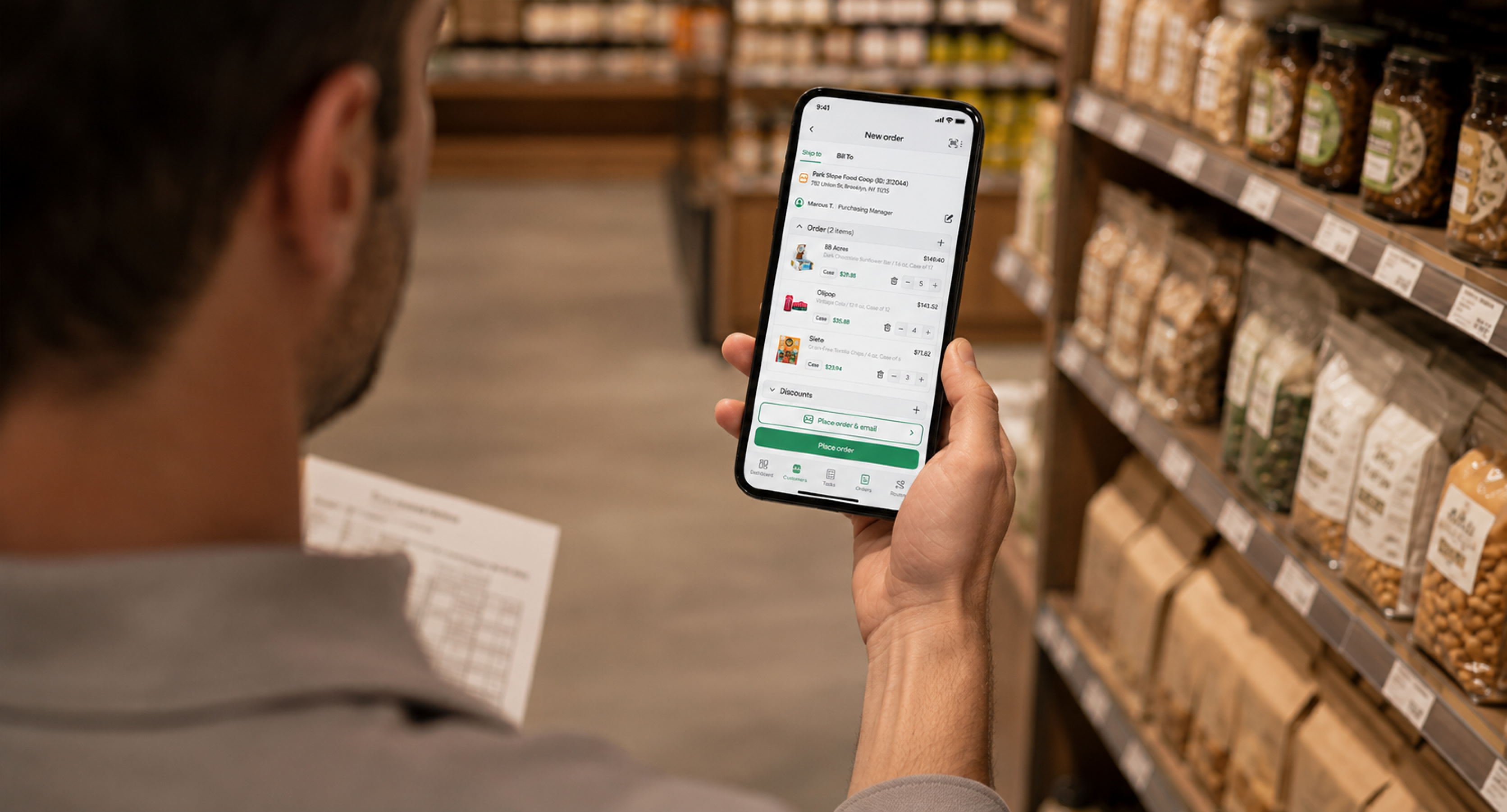
Customer relationship management platform built specifically for distributors earns its place right here. It centralizes customer data, pricing, and order history so a rep walks into every visit already knowing the account.
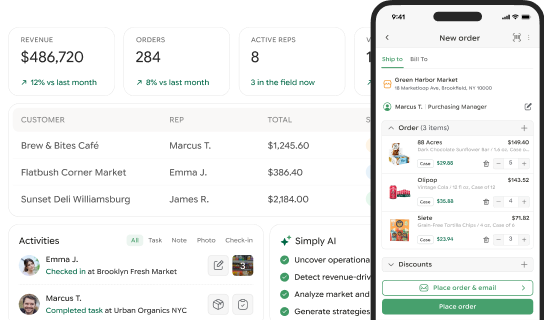
SimplyDepo’s CRM for Distributors does exactly that. It tracks real-time visit activity, orders, and account health so nothing about a relationship depends on one person remembering it.
Alongside it, account management tools keep every account’s pricing, terms, order history, and visit record on one screen, separating the accounts you already serve from the pipeline of new customers you are still chasing.
Book a personalized demo and see how SimplyDepo brings customer activity and order history into one field sales workflow.
FAQs on customer lifetime value
There’s no universal number, since customer lifetime value depends heavily on order size, reorder cadence, and how long accounts stay active. Rather than chasing an industry benchmark, compare CLV across your own customer segments and watch which ones grow relative to what you spend acquiring them.
Customer lifetime value measures what a customer brings in over the entire relationship. Acquisition cost, by contrast, measures what it takes to win that customer in the first place. CLV helps you optimize acquisition spending, since knowing an account’s likely future value shows how much you can reasonably spend to win it.
Recalculate on a cadence that matches your reorder cycle rather than a fixed calendar quarter. A distributor with monthly reorder patterns should review CLV by account or route just as often, since customer lifetime value figures can shift faster than an annual review would catch.
Yes, though the formula needs adjusting. Swap an individual shopper’s purchase frequency for an account’s reorder cadence, and swap a single transaction for the average purchase across a full reorder cycle. The underlying idea, measuring an entire relationship instead of one sale, applies just as well to route accounts as to any other customer base.
B2C customer lifetime value usually averages across a large customer base of individual shoppers. B2B customer lifetime value, especially in distribution, concentrates around a smaller number of high value customers, each managed by a rep and shaped by an ongoing procurement relationship rather than a single purchase decision.
 Rated 4.7 on G2
You shouldn't need 5 tools to run distribution.
-
 September 15, 2026
 -
 September 15, 2026
 -
 September 15, 2026