
📌 Key takeaways:
- Inventory valuation assigns a dollar figure to the stock you still hold, which sets both your balance sheet asset and your cost of goods sold.
- The three methods are FIFO, LIFO, and weighted average cost, and on the same purchase history they produce different profit, different closing inventory, and different tax.
- The entire gap between methods is a timing difference. Whatever FIFO adds to closing inventory it subtracts from cost of goods sold, to the dollar.
- No method fixes a bad count. If your on-hand quantity is wrong, every valuation built on it is wrong by the same proportion.
Ask a distributor what their inventory is worth and you will usually get a confident number. Ask how they arrived at it and the confidence tends to fade, because there is no single correct answer. The same 230 cases sitting on the same rack can legitimately be worth $4,185 or $4,830 depending on which costing method the business elected, and both figures are defensible.
That is not an accounting quirk to be tolerated. It is a decision that changes reported profit, the tax you pay, what a lender sees when you apply for a facility, and whether your margin by item means anything at all.
This guide walks through what inventory valuation is, what belongs in inventory cost, how each of the three methods calculates on one shared set of numbers, what the IRS and international standards actually permit, and why the count feeding the calculation matters more than the choice between methods.
What Is Inventory Valuation?
Inventory valuation is the accounting process of assigning a monetary value to the stock a business holds at the end of a reporting period. That figure lands in two places at once: it is an asset on the balance sheet, and it determines the cost of goods sold on the income statement.
The two are locked together by a simple identity. Opening inventory plus purchases gives you the total cost of goods available for sale, and that total splits into exactly two buckets: what you sold, which becomes cost of goods sold, and what you still hold, which becomes closing inventory. Every dollar you assign to one is a dollar you cannot assign to the other.
Valuation is necessary because you rarely pay the same price twice. Buy the same case of sauce at $18.00 in January and $21.00 in October, sell some of them, and there is no self-evident answer to what the remaining cases cost. A costing method is the rule that settles it.
The calculation itself lives in your accounting system or ERP inventory management platform, not in the warehouse. What the warehouse supplies is the quantity, and the two halves have to agree for the output to mean anything.
Why Valuation of Inventory Matters More Than It Looks
Inventory is often the single largest asset on a distributor’s balance sheet, so the valuation figure is not a rounding item. It drives four decisions that get made about the business, usually by other people.
Reported profit moves first. Because cost of goods sold and closing inventory are two halves of one total, a method that raises one lowers the other, and gross profit follows directly. Two businesses with identical purchases, identical sales, and identical stock on hand can report visibly different profit purely on method.
Tax follows profit. A method that reports higher cost of goods sold reports lower taxable income in that period, which is why the choice is regulated rather than left open.
Borrowing capacity depends on it too. When inventory is pledged as collateral, the lender is looking at the closing inventory figure, and the method that values stock higher presents a stronger balance sheet.
Then there is the operational use, which is the one distributors care about daily: margin by item and by customer. If cost per unit is an estimate, every margin report built on it is an estimate, and pricing decisions inherit the error. Margin by item is only as reliable as the cost data that actually reaches the ledger, a gap that becomes obvious when comparing QuickBooks inventory integrations.
What Goes Into Inventory Cost, and What Does Not
Before choosing a method, settle what number you are applying it to. Inventory cost is not simply the price on the supplier invoice. It is the cost of getting the goods into a sellable condition and location.
| Generally included | Generally excluded |
|---|---|
| Purchase price net of trade discounts | Selling and marketing costs |
| Inbound freight and duty | Distribution to the customer |
| Import and customs handling | General administrative overhead |
| Direct labor to repack or relabel | Abnormal waste and spoilage |
| Storage required as part of production | Ordinary warehousing of finished goods |
The inbound freight line is where small distributors most often understate cost. A container of goods that arrives with meaningful ocean freight, duty, and drayage attached can carry a landed cost well above the invoice price, and if only the invoice price reaches the books, gross margin is overstated on every unit sold from that container.
Getting landed cost onto the receipt is a purchasing discipline before it is an accounting one, which is why the detail belongs in the same workflow as purchase order management rather than being reconstructed at quarter end.
The Three Inventory Valuation Methods
There are three cost flow assumptions in general use, plus specific identification for businesses that can genuinely track individual units. The word assumption matters: these are rules for assigning cost, and they do not have to match the physical movement of goods.
| Method | Assumption | Effect when prices rise |
|---|---|---|
| FIFO | Oldest units are sold first | Lower cost of goods sold, higher closing inventory, higher reported profit |
| LIFO | Newest units are sold first | Higher cost of goods sold, lower closing inventory, lower reported profit |
| Weighted average | All units share one blended cost | Sits between the other two |
| Specific identification | Actual cost of the actual unit | Only practical for serialized or high-value goods |
Specific identification is the most accurate and the least available. It works for a distributor of numbered equipment and not for one moving pallets of interchangeable cases, which is why the remaining three exist at all. For most wholesale operations, then, valuation of inventory comes down to a choice among the first three rows.
A point worth holding onto before the worked examples: none of these methods requires you to physically ship oldest stock first. You should still rotate stock by date for perishability reasons, but that is a warehouse practice, and it is independent of the costing method your accountant elected. Distributors moving onto cloud-based inventory management frequently conflate the two and expect the software to change their tax position, which it does not.
The FIFO Method of Inventory Valuation
FIFO, first in first out, assumes the earliest units you acquired are the first ones sold. Closing inventory is therefore made up of your most recent purchases, valued at the most recent costs.
All three worked examples below use one shared set of numbers, so the methods can be compared without anything else changing. A distributor stocks one sauce SKU over a year in which supplier prices rose:
| Lot | Cases | Cost per case | Total cost |
|---|---|---|---|
| Opening inventory | 200 | $18.00 | $3,600 |
| First purchase | 300 | $19.50 | $5,850 |
| Second purchase | 250 | $21.00 | $5,250 |
| Available for sale | 750 | $14,700 |
Across the year 520 cases sold, leaving 230 on hand. Under FIFO those 520 sold cases are drawn from the oldest lots first: all 200 opening cases at $18.00, all 300 first-purchase cases at $19.50, and 20 cases from the second purchase at $21.00. That gives cost of goods sold of $3,600 plus $5,850 plus $420, or $9,870.
The 230 cases remaining all come from the newest lot, so closing inventory is 230 multiplied by $21.00, which is $4,830. The two figures add back to $14,700, as they must.
The LIFO Method of Inventory Valuation
LIFO, last in first out, reverses the assumption. The most recently acquired units are treated as the first sold, so closing inventory is left holding your oldest costs.
Running the same 520 cases through LIFO draws from the newest lot down: all 250 cases from the second purchase at $21.00, then 270 cases from the first purchase at $19.50. Cost of goods sold is $5,250 plus $5,265, or $10,515.
Closing inventory is what remains, which is the 200 opening cases at $18.00 plus 30 leftover cases at $19.50, or $3,600 plus $585, giving $4,185. Again the two add to $14,700.
LIFO carries obligations the other methods do not. The IRS treats the rules as complex enough to warrant their own code sections, a business has to file Form 970 with a timely filed return for the first year it uses LIFO, and goods accounted for under LIFO are excluded from the lower of cost or market method described further down. LIFO is also unavailable to businesses reporting under international standards, which the next section covers.
Weighted Average Inventory Valuation
The weighted average cost method blends every unit available for sale into a single cost, then applies that one figure to both the units sold and the units remaining. It suits interchangeable goods where tracking individual lots delivers no useful information.
The average is the total cost of goods available for sale divided by the total units available. Here that is $14,700 divided by 750 cases, giving $19.60 per case.
From there both figures fall out of one number. Cost of goods sold is 520 multiplied by $19.60, or $10,192, and closing inventory is 230 multiplied by $19.60, or $4,508. The total reconciles to $14,700 exactly as the other two did.
Weighted average is the simplest of the three to operate and the least sensitive to price swings, because a single expensive purchase is diluted across the whole pool rather than landing entirely in one bucket. For a distributor buying the same goods repeatedly at drifting prices, that stability is usually the point.
How the Three Methods Compare on Identical Numbers
Placing the three side by side on the same 750 cases makes the trade-off concrete. Assume the 520 cases sold at $28.00 each, giving revenue of $14,560.
| Method | Cost of goods sold | Closing inventory | Gross profit |
|---|---|---|---|
| FIFO | $9,870 | $4,830 | $4,690 |
| Weighted average | $10,192 | $4,508 | $4,368 |
| LIFO | $10,515 | $4,185 | $4,045 |
Look at the spread between FIFO and LIFO in the two right-hand columns. Closing inventory differs by $645, and gross profit differs by $645. That is not a coincidence, it is the identity from the first section reasserting itself: the cost pool is fixed at $14,700, so every dollar a method declines to expense is a dollar it must leave on the balance sheet.
This is the most useful thing to understand about inventory valuation methods. They are not measuring different amounts of value, they are timing when the same total cost hits the income statement. Over the entire life of the inventory the methods converge; they differ only in which period bears the cost. Anyone rebuilding this calculation from stock records will recognize it as the same reconciliation behind the ending inventory formula.
What the Rules Actually Allow
Method choice is constrained by where you report, and the two rulebooks disagree in a way that matters for any distributor with international reporting obligations.
In the United States, IRS Publication 538 sets out the permitted approaches. Specific identification applies when you can match actual cost to actual items, and FIFO or LIFO apply when you cannot.
The publication describes the inflation effect directly: when prices are rising, LIFO produces a larger cost of goods sold and a lower closing inventory, while FIFO produces the reverse, and both flip when prices fall. Adopting LIFO requires filing Form 970 with the return for the first year of use, and the publication is explicit that the LIFO rules are very complex.
International reporting is narrower. Under IAS 2 Inventories, inventories are measured at the lower of cost and net realizable value, and for items that are ordinarily interchangeable the standard permits two cost formulas: first-in first-out and weighted average cost. LIFO is not among the formulas IAS 2 provides for.
The practical consequence is straightforward. A US distributor reporting only domestically can elect LIFO and accept the filing burden in exchange for the tax timing benefit during inflation. A business that also reports under international standards cannot run LIFO in those statements, so choosing it domestically means maintaining a reconciliation between two sets of numbers.
Lower of Cost or Market, and When Value Has to Come Down
Cost is a starting point, not a floor. Stock that has become damaged, obsolete, or simply worth less than you paid cannot stay on the books at cost, and both rulebooks have a mechanism for writing it down.
The IRS approach compares the market value of each item on hand at the inventory date with its cost and uses the lower of the two. Goods accounted for under LIFO are specifically excluded from this treatment, which is one of the trade-offs of that election.
Under IAS 2 the equivalent test is net realizable value, defined as the estimated selling price in the ordinary course of business less the estimated costs of completion and the costs necessary to make the sale.
For distributors this is rarely theoretical. Short-dated stock, discontinued flavors, superseded packaging, and seasonal goods that missed their window are all candidates, and they tend to sit quietly at full cost until someone looks.
The discipline that prevents unpleasant year-end surprises is reviewing slow-moving and short-dated stock on a schedule rather than at audit, which is a familiar problem in CPG inventory where date codes and seasonal ranges make obsolescence a routine event rather than a rare one.
Inventory Valuation Support: Why the Count Beats the Method
Here is the part that gets least attention and causes the most damage. Every calculation above assumed one thing without comment: that 750 cases were genuinely available and 230 genuinely remained. If the quantity is wrong, the method is irrelevant, because a precise costing rule applied to a wrong count produces a precisely wrong answer.
The failure is usually not theft or dramatic error. It is ordinary drift. Stock that shipped but was never deducted, a customer return that came back into the building without a receipt, a damaged pallet written off in conversation rather than in the system, a rep who promised product that was already allocated.
Each of these is small. Together, across a quarter, they put a gap between the system quantity and the shelf, and that gap flows straight into the valuation figure at full cost.
So the practical priority for most distributors is the reverse of how the topic is usually taught. Choosing between FIFO and weighted average is a conversation to have once with your accountant. Making sure the quantity is right is a daily operational discipline, and it is the one that determines whether the resulting number is worth anything.
Improvia is a reasonable example of the operational half being fixed first. The healthcare brand, which makes washable reusable underpads for pharmacies, DME providers, and nursing homes, moved from direct-to-consumer selling into structured B2B distribution and ran that expansion on manual Google Maps searches and fragmented spreadsheets.
The Improvia case study records the result of putting that on one system: structured management of 150 or more healthcare accounts, and up to 4x less time spent driving. Neither of those is an accounting outcome, and both are prerequisites for one.
Where SimplyDepo Fits in Inventory Valuation
The honest framing is a narrow one. SimplyDepo does not value inventory. It is not an ERP and it does not replace an accounting system, so FIFO, LIFO, weighted average, and any write-down happen in the general ledger, where they belong.
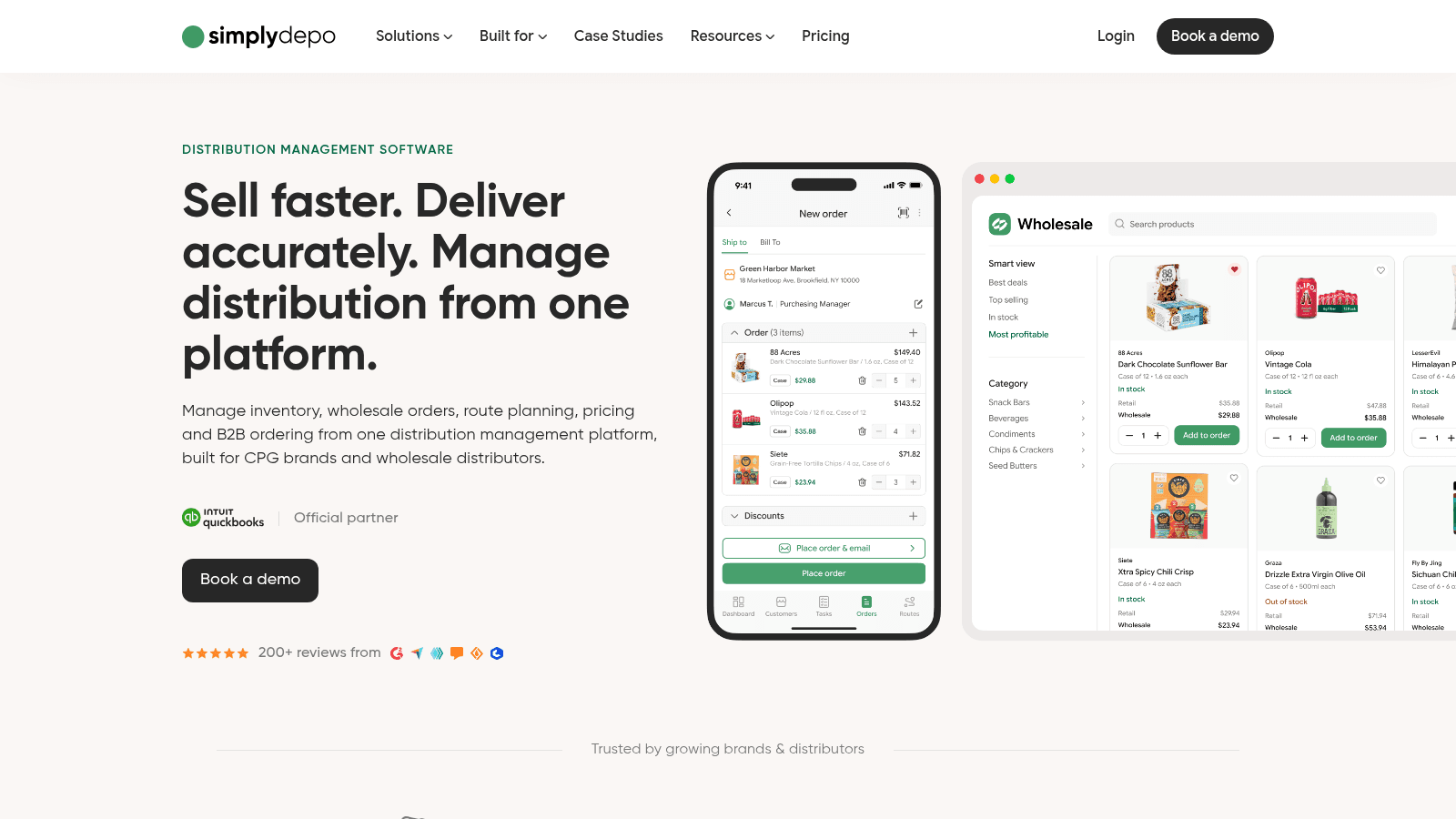
SimplyDepo’s distribution management page, simplydepo.com (August 2026).
What it addresses is the input. The platform tracks live stock by SKU with on-hand, allocated, and available quantities, deducts stock on fulfillment rather than on order entry, and raises reorder alerts against thresholds you set.
Orders written by reps in the field, placed through the B2B portal, or taken by phone all land in one fulfillment queue, so the quantity moves for the same reason regardless of how the order arrived. On ship, orders and invoices sync to QuickBooks Online, which is where the valuation actually happens.
Two limits are worth stating plainly next to that. The integration supports QuickBooks Online only, and QuickBooks Desktop is not supported, which is a genuine deal-gate for distributors still running a desktop file. There is also no native tax module, so tax is handled in the connected accounting system.
Pricing is published rather than quote-only. A team of one to five reps pays $69 per rep each month on annual billing, and the per-rep rate drops at larger team sizes. Access to a distribution management setup runs through a booked demo rather than self-serve signup, and it is available in the United States and Canada.
Choosing a Method and Then Protecting It
Inventory valuation looks like a choice between three methods and is really two separate jobs. The first is a one-time election, made with your accountant, constrained by where you report and by whether you want the LIFO filing burden in exchange for a tax timing benefit. For most distributors, FIFO or weighted average is the right answer.
The second job never ends. The method only converts a quantity into a value, so the quantity is what determines whether the value is true. A business that elects the theoretically ideal method and lets its on-hand counts drift through the year has chosen precision it cannot deliver.
If the gap in your own numbers is the count rather than the costing rule, that is a fixable operations problem. Trying the platform costs nothing for the first 30 days, with setup and team training included, so you can book a demo and walk through how stock movements would reach your ledger.
Frequently Asked Questions
Inventory valuation is the process of putting a dollar figure on the stock you still hold at the end of a period. That figure does two jobs at once: it appears as an asset on your balance sheet, and it determines your cost of goods sold, because the total cost of goods available for sale splits into only two buckets, what you sold and what you still have.
Valuation is needed because you pay different prices for the same item over time, so a rule is required to decide which costs attach to which bucket.
Most distributors are best served by FIFO or weighted average cost. FIFO keeps closing inventory close to current replacement cost and is straightforward to explain to a lender, while weighted average is simplest to operate and smooths out price swings, which suits interchangeable goods bought repeatedly.
LIFO can lower taxable income while prices are rising, but it requires filing Form 970, carries complex rules, excludes those goods from the lower of cost or market treatment, and is unavailable under international reporting standards.
Weighted average inventory valuation divides the total cost of goods available for sale by the total number of units available, then applies that single cost to both the units sold and the units remaining.
In the worked example above, $14,700 of cost across 750 cases gives $19.60 per case, so 520 cases sold produce $10,192 of cost of goods sold and 230 cases remaining are valued at $4,508. The two figures reconcile back to the original $14,700.
No, and the two are worth keeping separate. FIFO is a cost flow assumption used for accounting, and it does not require any particular physical movement of goods. You should still rotate perishable and date-coded stock oldest first, but that is a warehouse practice driven by shelf life, not by your costing election. A business can rotate stock strictly by date and still be on weighted average for accounting purposes.
Not directly, and the distinction matters. SimplyDepo is not an accounting system and does not calculate FIFO, LIFO, or weighted average values. What it maintains is the quantity that any valuation depends on: live stock by SKU, stock deducting on fulfillment, reorder thresholds, and one fulfillment queue for orders arriving from reps, the B2B portal, or by phone. Those records sync to QuickBooks Online, which performs the valuation. QuickBooks Desktop is not supported.


 Rated 4.7 on G2
Stockouts and overstock are costing you more than you think.
-
 September 8, 2026
 -
 September 8, 2026
 -
 IndustryHow to Build a Sales Territory PlanSeptember 8, 2026