Warehouse Inventory Management: Process & Best Practices


📌 Key takeaways
- Warehouse inventory management covers the full flow of goods inside a facility, from receiving and put-away to fulfillment and replenishment, with accuracy at every stage determining what happens in the field.
- The process runs through five stages: receiving, put-away, tracking, fulfillment, and replenishment. A breakdown at any stage cascades into the ones that follow.
- The highest-impact best practices are standardizing receiving procedures, replacing annual counts with cycle counting, and automating data collection at every touchpoint to eliminate manual entry errors.
A sales rep loads the van and heads out on the morning route, only to arrive at the first stop with a delivery that’s short by a full case.
The customer ordered it, the system confirmed it, but the stock wasn’t there.
Back at the warehouse, a manager is staring at a receiving log nobody has touched since last week.
This is what poor warehouse inventory management looks like in practice. Not a catastrophic failure, but a slow erosion of accuracy that undermines every order and every customer relationship.
The scale of the problem is significant. According to IHL Group’s research, the global retail industry loses $1.73 trillion annually to inventory distortion due to out-of-stock and overstocking. Zebra’s Warehousing Vision Study found that nearly 80% of warehouse associates and operations decision-makers identify inaccurate inventory and stockouts as a major challenge to daily productivity.
In this article, we’ll go over the warehouse inventory management process stage by stage and the practices that prevent accuracy from degrading under operational pressure
What does warehouse inventory management involve?
Warehouse inventory management is the process of overseeing and controlling the flow of goods inside a warehouse or distribution facility, from the moment stock arrives at the receiving dock to the moment it leaves on a delivery vehicle.
It covers receiving, storage, tracking, order fulfillment, and replenishment to keep stock levels accurate and aligned with customer demand.
It sits at the intersection of two related but distinct disciplines. Inventory management is the business-wide view: what you have, how much you have, and when to reorder. Warehouse management focuses on what happens inside the facility, specifically how the facility stores goods, how they move, and whether physical stock matches the records.
Warehouse inventory management spans both, making it one layer of the broader warehouse management process that also covers staffing, layout, and facility operations.
For CPG brands and distributors specifically, inventory accuracy has direct consequences in the field. A warehouse count that’s off by a few units isn’t just an internal bookkeeping problem. It’s a rep promising a customer something the facility can’t deliver.
The warehouse inventory management process: 5 Stages
Effective warehouse inventory management runs through five key stages. Each one carries its own accuracy risks, and a breakdown at any stage cascades into the ones that follow.
| Stage | Key activity | Primary accuracy risk |
|---|---|---|
| Receiving | Verify incoming goods against purchase orders | Undetected discrepancies enter the system |
| Put-away | Assign and record bin locations | Misplaced stock that can’t be found at pick |
| Tracking | Monitor stock levels and locations continuously | Record drift between physical and digital counts |
| Fulfillment | Pick, pack, and dispatch against confirmed orders | Wrong items or quantities leaving the facility |
| Replenishment | Trigger reorders before stock hits zero | Stockouts or excess inventory from mistimed orders |
Let’s go over each stage briefly.
1. Receiving and verification
Goods arrive, quantities are checked against purchase orders, items are inspected for condition, and records are updated in the system.
This stage sets the accuracy baseline for everything downstream.
An undetected short shipment or damaged case that gets logged as intact creates a discrepancy that no amount of downstream diligence can correct.
PO-matched receiving, where staff compare each inbound line item against the original purchase order before accepting it, catches errors at the source.
Blind receiving, where staff count and record without reference to the expected quantities, has its place for preventing confirmation bias, but requires a reconciliation step that many operations skip.
2. Put-away and slotting
After receiving, the team assigns goods to specific bin locations. The accuracy risk here is less about data entry and more about consistency: items stored in the wrong bin, or moved without a system update, become effectively invisible until a picker can’t find them.
Slotting, the deliberate arrangement of inventory based on pick frequency, reduces travel time and improves the efficiency of warehouse operations.
Fast-moving SKUs belong close to packing stations. Slow-moving stock goes deeper. Teams should revisit slotting decisions whenever sales velocity shifts significantly.
3. Inventory tracking and cycle counting
Ongoing inventory tracking means maintaining an accurate picture of what’s in the facility and where it is at any given time.
Annual physical counts are disruptive and slow to catch errors. Cycle counting, i.e., systematically counting a rotating subset of inventory on a continuous schedule, maintains accuracy without shutting down warehouse processes.
An ABC classification approach works well:
- Count high-velocity A-class SKUs weekly
- B-class monthly, and
- C-class quarterly
This keeps attention focused where accuracy matters most and catches record drift before it compounds.
4. Order picking and fulfillment
Pickers retrieve stock from bin locations, pack it, and dispatch it against confirmed customer orders.
Order fulfillment accuracy at this stage depends on how well the previous stages went.
- Accurate receiving means the right items are in the system
- Accurate put-away means they’re where the record says they are
Fulfillment errors are particularly costly for distributors operating route-based delivery: a wrong SKU in the van means a return, a re-delivery, and a frustrated account.
Distribution management software addresses this by connecting warehouse stock directly to route and order data, so the van is loaded against what’s actually available rather than what the system recorded yesterday.
5. Replenishment
Replenishment triggers when stock levels drop to a defined reorder point, calculated from lead time and average demand velocity.
Safety stock buffers against supplier delays and unexpected demand spikes.
The goal is to satisfy customer demand without holding excess inventory that ties up working capital and warehouse space.
Setting accurate reorder points requires good historical data and, for seasonal or variable-demand products, demand-driven replenishment decisions grounded in pattern analysis.
That’s where inventory forecasting methods become relevant for operations with more complex replenishment needs, covering statistical models and AI-powered demand planning.
Warehouse inventory management best practices
Process defines the stages. Best practices determine how accurately and consistently you can execute each stage.
Standardize receiving procedures
A documented receiving procedure that covers specific inspection steps, mandatory PO matching, and condition logging before acceptance is the highest-leverage point for downstream accuracy.
When every receiving team member follows the same steps in the same order, you can catch discrepancies at the door rather than discover them weeks later during a cycle count.
Inventory errors rarely originate at pick. They originate at receiving, where time pressure and inconsistent intake practices allow bad data to enter the system.
💡 Pro tip:
Cross-train at least one picker on receiving. When intake volume spikes and temporary staff step in, having one experienced person on the floor helps you catch bad data quickly.
Use cycle counting, not annual counts
Annual full physical counts consume significant labor hours and produce a snapshot that’s already partially outdated by the time the count is complete.
A rolling cycle count program maintains improved inventory accuracy continuously, catches errors faster, and requires far less disruption per count event.
If you’re a distributor managing multiple warehouse locations, the discipline of cycle counting at each facility is what keeps inventory records trustworthy across the network.
Slot by velocity and revisit regularly
Slotting optimization reduces picking time and supports lean warehousing principles by eliminating unnecessary movement.
Place fast-moving items near dispatch areas, group items that are frequently picked together, and use vertical warehouse space efficiently to increase storage capacity without expanding the footprint.
Revisit slotting decisions quarterly, or any time a product moves significantly in sales rank.
💡 Pro tip:
Pro tip: Run a dead stock audit before revisiting slotting decisions. SKUs that haven’t moved in 90 days are occupying prime locations that faster-moving stock should have. Clear them first, then re-slot.
Apply automated data collection at every touchpoint
Manual data entry is the primary source of inventory error in warehouse environments.
Barcode scanning at receiving, put-away, and pick eliminates most transcription mistakes. RFID goes further, enabling inventory monitoring without line-of-sight scans and supporting real-time data capture across large facilities.
Automated data collection improves inventory accuracy and labor efficiency simultaneously, which is why the best warehouse management software platforms now treat native barcode and RFID support as standard.
Set reorder points with safety stock buffers
Effective inventory management prevents stockouts and overstocking by building reorder logic around actual demand patterns.
A reorder point accounts for average daily usage and supplier lead time. Safety stock adds a buffer for variability in both.
The result is a system that consistently meets customer demand without carrying excess inventory.
Use inventory management software to automate reorder triggers, so replenishment fires at the right threshold without relying on someone to manually check stock levels.
Adopt lean warehousing principles
Lean warehousing eliminates waste: wasted motion, time, space, and unnecessary handling steps.
Audit warehouse layout to cut inefficient travel paths and remove redundant handling steps between receiving and put-away.
For predictable, stable-demand products, just-in-time inventory replenishment reduces holding costs by ordering only what’s needed, when it’s needed. It works best where supplier reliability is high and demand is consistent enough to keep stockout risk low.
Track the right KPIs
| KPI | What it measures |
|---|---|
| Inventory accuracy | % of records matching physical stock |
| Inventory turnover | How often total stock cycles per period |
| Order picking accuracy | % of orders picked without errors |
| Carrying cost as % of inventory value | Total cost to hold inventory |
| Stockout rate | % of orders unfulfilled due to unavailable stock |
Review these metrics monthly at minimum. When inventory accuracy drops below target, trace it back through the receiving and put-away stages.
When stockout rate rises, check whether the team has calibrated reorder points against current demand patterns or still relies on historical data that no longer reflects market trends.
How to get started with warehouse inventory management
The most productive place to start is receiving.
Standardize the intake process first, covering documented steps, PO matching, and condition logging, because everything downstream depends on that accuracy.
Once receiving is consistent, layer in cycle counting for your top-velocity SKUs and set reorder points based on actual lead times.
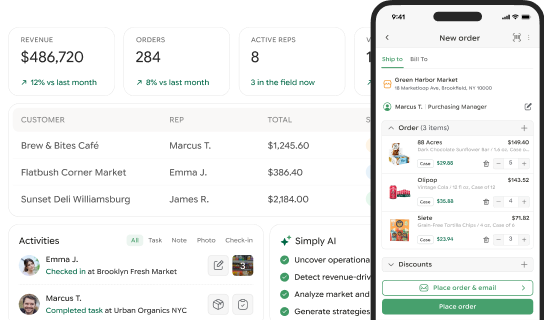
For distributors and CPG brands, the next step is connecting warehouse inventory to field sales. When reps see accurate stock levels before taking orders and warehouse teams see incoming orders before picking, most fulfillment errors stop happening.
SimplyDepo addresses exactly this: it unifies inventory, orders, route planning, and invoicing on a single platform built for distribution teams. It integrates with QuickBooks, so your financial and operational data stay in sync without manual reconciliation. Reps, warehouse staff, and finance work from the same picture.
Book a demo to see how it works for your operations.
FAQs on Warehouse Inventory Management
Warehouse inventory management is the system of processes used to receive, track, organize, and fulfill stock within a warehouse or distribution facility. It covers the physical handling of goods and the accuracy of the records that reflect their location and quantity, ensuring that what the system says is in stock matches what’s actually on the shelves.
Inventory management vs warehouse management is a common point of confusion because both involve stock. Inventory management takes a business-wide view: what products exist, at what quantities, and when to reorder. Warehouse management focuses on what happens inside a specific facility: how the team stores, moves, picks, and dispatches goods. Inventory and warehouse management work together, but they address different layers of the operation.
The core metrics for effective inventory management are inventory accuracy, order picking accuracy, inventory turnover rate, carrying cost as a percentage of inventory value, and stockout rate. These KPIs give warehouse managers a clear picture of where the operation is performing and where it needs attention.
Three practices have the highest impact on inventory accuracy:
- Standardizing the receiving procedure so staff catch discrepancies at the dock
- Implementing cycle counting on an ABC classification schedule so teams catch errors continuously rather than at year-end
- Adopting barcode scanning or RFID at every stage to eliminate manual data entry errors.
The main categories are warehouse management systems for full operational control of daily warehouse operations, inventory management software for stock tracking and reordering, and distribution management platforms for businesses that need to connect warehouse inventory to field sales and route execution.
For CPG brands and distributors, SimplyDepo covers all three, combining warehouse inventory management, order tracking, and field sales execution in one platform.
The right choice for any business depends on operational scale, order volume, and whether it operates from a single facility or across multiple warehouses.
 Rated 4.7 on G2
Stockouts and overstock are costing you more than you think.
-
 September 15, 2026
 -
 September 15, 2026
 -
 September 15, 2026