B2B eCommerce Trends That are Set to Shake Up Wholesale Ordering


📌 Key Takeaways from the Wholesale Industry
- Self-service portals really come into their own when buyers can easily re-order familiar products at the right price, in the right pack sizes, and with the delivery they want.
- Digital ordering and field sales need to be perfectly synched so that a retailer can flip between the two without having to start all over again, taking account and order information with them.
- Don’t get ahead of yourself by focusing on fancy personalisation or AI – first get the basics right on product data, fulfillment rules and reliable system connections.
- When tracking repeat orders, manual corrections and service effort, don’t forget to look at the bigger picture and measure that against online sales – is the buying experience actually getting better?
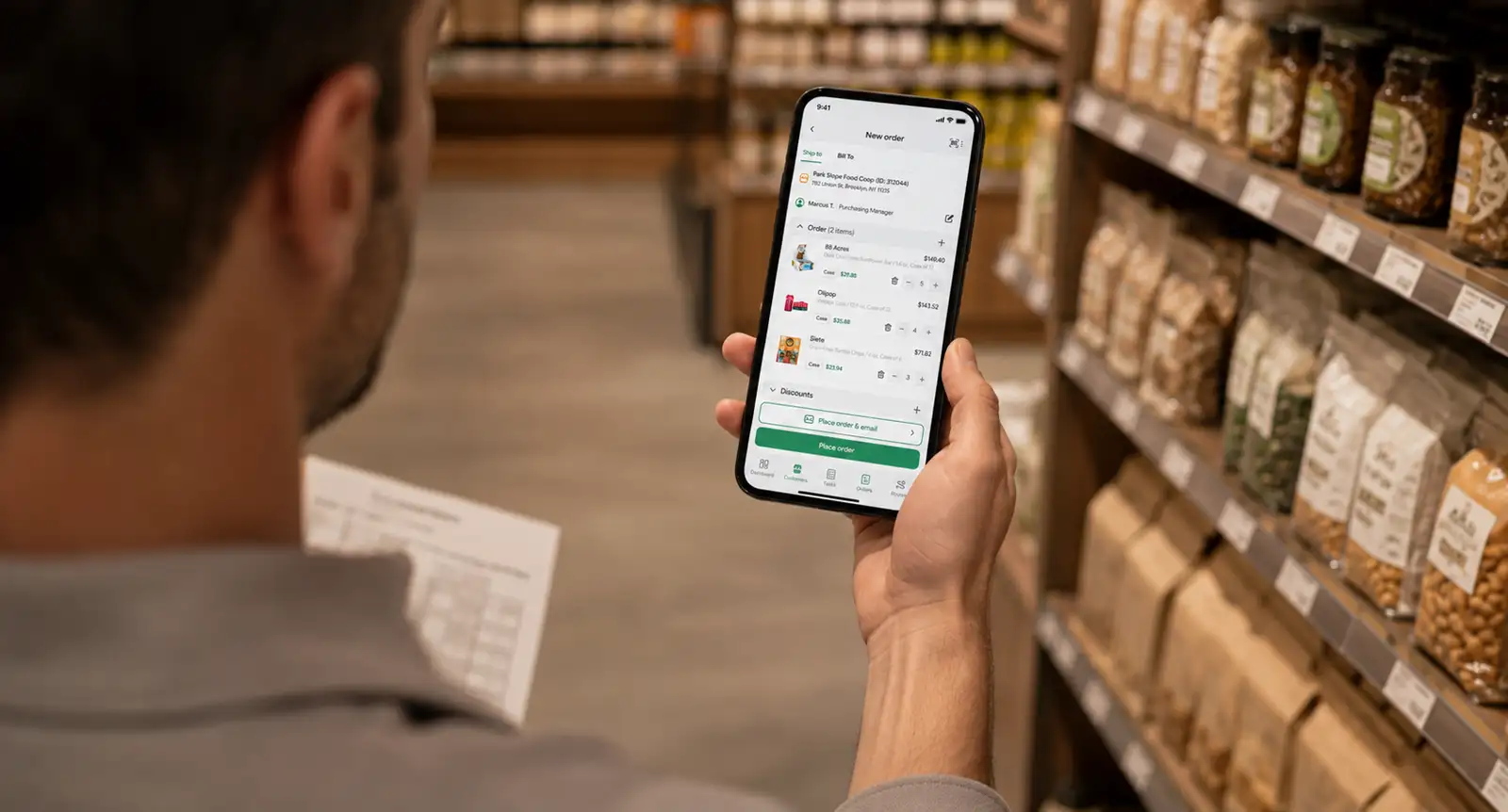
A grocery buyer spots a gap on the shelf after the distributor has left. They want to re-order a familiar drink, check the case price, and see when it’s due in. But if it takes an email, a spreadsheet and a follow-up call to do that, then a digital catalogue is only scratching the surface of the problem.
The B2B eCommerce trends that matter most to wholesale teams are about fixing that everyday hassle. Buyers want to order easily, while distributors need orders that work with their terms, product units, stock levels and delivery model.
This guide explores eight shifts worth paying attention to, and how you can put them into effect in your CPG wholesale operation. The examples are just illustrations – no customer case studies or promised results here.
What B2B eCommerce means for wholesale ordering
B2B eCommerce is the digital buying and selling between businesses. In wholesale, that usually means a retailer using a portal, mobile app, marketplace or procurement system to order from a distributor or brand.
Wholesale eCommerce is more complicated than just having a public product page and checkout button. You might have one customer ordering full cases at negotiated prices, another with a different selection, delivery schedule or purchasing process. And then there’s the national customer who wants electronic documents, and the independent store who just wants to be able to order again quickly on their phone.
The goal is to make all those differences manageable without expecting the buyer or sales team to have to remember every rule.
1. Self-service portals are becoming a standard part of account service
A good B2B self-service portal lets a buyer complete a routine purchase when it suits them best. The most valuable journey is often just simple: sign in, find the products they’ve ordered before, change quantities, review current terms, and submit.
Think of a convenience store that buys the same core snacks every week. Rebuilding that order from scratch every time is just too much work. A reorder list can give them a good starting point, provided they can see which items have been discontinued, changed prices or are just out of stock before they confirm.
Design the first release with the repeat buyer in mind rather than the first-time visitor. Product search, account access, order history, clear confirmation and a visible route to support should all work together seamlessly. A buyer shouldn’t need to call a rep just to check if their order arrived.
Start with the accounts that already place predictable repeat orders. Watch where they stop, what they ask and which corrections the office makes afterwards. That will give you a clearer picture than just looking at portal registrations.
2. Omnichannel B2B commerce is about getting reps and buyers on the same page
Wholesale buyers may browse online, ask a rep about a product they don’t know much about and then place the order later. Those interactions all belong to the same account relationship.
A 2026 McKinsey Global B2B Pulse research study found that buyers were using an average of ten different channels across their purchasing journey. That was across 4,000 decision-makers across 13 countries and multiple industries, so it’s broader than just CPG wholesale. The useful lesson for distributors is the importance of consistent information and a smooth transition between channels.
For example, a rep may talk to a retailer about a seasonal display during a store visit. The retailer should be able to review those relevant products later without losing the agreed account context. Likewise, the next rep visit should start with visibility into orders the retailer placed independently.
Decide how online orders will affect account ownership, rep credit and follow-up responsibilities before rollout. Otherwise, the portal might just feel like a rival sales channel to the people expected to promote it. Keep the rep involved in assortment, relationships and exceptions while giving buyers a convenient way to handle routine purchases.
3. Account-specific rules are what give buyers a good experience
For a wholesale buyer, personalization often starts with getting the basics right: show them the products they can buy, the prices that apply to their account and the units in which those products are sold.
A great recommendation that uses the wrong case size or displays a price the account can’t receive is just unhelpful. Get the account rules right first before experimenting with individualized promotions.
Document which system controls each rule and how exceptions get approved. If a rep negotiates a special price, decide how soon that change shows up in the buyer’s next order and how the office can track it.
The table below spells out the requirements to evaluate in any ordering workflow. These are evaluation criteria, not a claim that every platform can handle every rule.
| Rule to evaluate | Buyer experience | Test before rollout |
|---|---|---|
| Account pricing | Get the right price for product and order at all levels | A buyer with a negotiated price should see that reflected |
| Pack sizes | Show clear unit, inner-pack and case quantities | An item sold in multiple units should be clear |
| and so on…Assortment Access | Not all products are created equal, and some can only be purchased under certain circumstances | An account with a restricted product list can make things a bit tricky |
| Minimums & Cutoffs | Make sure buyers know what they’re getting into when it comes to minimum orders and cutoff dates | Have all the rules and requirements laid out before the final submission step – no surprises there |
And here’s a tip : separate a product’s minimum order quantity from the overall minimum order value or delivery threshold. They’re solving different problems, after all
When reviewing an account’s pricing, go by a consistent wholesale pricing formula as a starting point, and then factor in any discounts and service costs
Even with a user-friendly ordering process, you still need to make sure the rules are commercially sound
4. Structured Product Data – The New Infrastructure
As a retailer, you shouldn’t have to guess whether a listed price is for a single unit, an inner pack or a whole case – that’s just confusing
Clear product information stops confusion before it even gets to the warehouse
GS1 US says product data synchronization and transaction exchange serve two different purposes : the Global Data Synchronization Network shares product master data, while electronic data interchange exchanges documents like purchase orders, advance ship notices, and invoices
For distributors, the key takeaway is to get the product records straight – make sure buyers and staff are using the same info . Maintain consistent identifiers, descriptions, pack hierarchies, units of measure, images and storage info . Have someone review changes to keep front and back office on the same page
The flip side of product data is actually keeping track of changes in the data – like when a 12-unit case changes to a 24-unit case . Make changes to identifiers, labels, pricing and any existing reorder lists. Clean up the core catalog first, not the big messy one with inconsistent data
5. Where does delivery fit in the order?
Buyers need to know what happens after they submit their order
For route-based wholesale, the question might be if the order qualifies for the next scheduled delivery – not so much about can it ship tomorrow
Give buyers a clear idea of stock status, order cutoffs, delivery expectations & what happens when shortages occur
If inventory is updated on a schedule, just make sure the language doesn’t imply you’re making a live stock commitment
An order received is not the same as an order accepted for fulfillment , and the status should make sense to the buyer
For some distributors like refrigerated food, a late order might still get the order, but the customer gets a disappointed store manager
Agree on the exception workflow too – who contacts the buyer about a shortage, can they approve a substitute? will the remaining items ship separately ? answer that & keep it consistent
6. No more re-entry – let connected systems do the work
Digital wholesale ordering is undermined if someone still has to manually enter every order into another system
Connecting order capture to fulfillment and accounting systems can reduce handoffs, but details matter
map the order’s journey from submission to confirmation, warehouse release, invoice, credit or return – and identify the source of truth, fields exchanged, and who’s responsible when something goes wrong
Test integrations with a deliberately normal order – submit, update quantity, change address, and see what shows up downstream
Don’t be too proud to test failed synchronizations, duplicate submissions, and failed updates too
Automated order processing should make exception handling more visible – so make sure to have clear failure alerts, duplicate prevention, and audit trails
Start small with the one integration that removes the most repeated work – a big integration project is a hard sell when a single manual step is the bottleneck
7. AI – where to draw the line?
AI is coming up in B2B ecommerce trends but you need to define the task and how to check the result
Use AI in a controlled way – like drafting catalog descriptions or reviewing a proposed reorder – before letting it place orders or promise delivery
NIST notes that AI risks confidently generating false content – so test, monitor, and Verify AI output
Think of a beverage reorder & the assistant proposes a reorder from past purchases – a reviewer should confirm the exact SKU, case quantity, current price, availability, and any promotion before releasing the order
Your buyer’s history can suggest a starting point but it doesn’t prove current demand
Keep approved product facts separate from generated copy. Define who can approve a change and retain enough context to investigate errors. Evaluate an AI pilot on corrected mistakes, useful time saved, and review effort rather than how impressive the first demo is – these are general recommendations, not a description of SimplyDepo’s AI capabilities.
8. Beyond Simply Transferring Online Revenue
A B2B portal can bring in online orders without a corresponding increase in total sales – as long as existing orders are just being shifted from email to the web. That’s a worthwhile shift if it reduces effort or streamlines accuracy – but it needs to be measured with honesty.
Track the customer’s experience across different channels. Did the buyer manage to re-order successfully? Did the office end up making fewer corrections? Did reps spend less time checking on the order status? Are smaller accounts being easier to serve without sacrificing any level of support?
Use a small set of clear, defined metrics first, before you start rolling this out further. Keep the definitions consistent between the baseline and the pilot.
| Metric | Working Definition | Watch For |
|---|---|---|
| Repeat Purchase Rate | Accounts re-ordering within their expected cycle / eligible accounts | Different account buying cycles |
| Order Correction Rate | Orders needing manual correction / submitted orders | Consistent correction categories |
| Handling Time | Staff minutes from receipt to release | Time spent resolving exceptions |
| Fulfillment Performance | Orders fulfilled as confirmed / confirmed orders | Agreed quantity and delivery window |
| Status Inquiries | Order-status requests per 100 orders | Track actual requests, not page views |
Compare similar accounts and ordering periods. Don’t just credit a jump in average order value during a promotion to the portal.
Putting B2B Ecommerce Trends First in Your Operation
Start by looking at the recurring pain points your team has to deal with. Go over some recent orders and support requests with one sales rep, someone from the office, and the person responsible for fulfillment. Choose a buyer journey that’s common enough to make a difference and narrow enough to improve.
Don’t Fix the Tech Before Fixing the Data
Make sure the account records, product units, price lists, and delivery rules for the pilot group are all up to scratch. Resolve any obvious conflicts between what the buyer sees and what the office uses. Record the current correction rate and order-handling effort so you have a baseline to refer to.
Test a Buyer’s Full Order Journey
Phone up a manageable group of existing buyers and ask them to place a real, routine order. Explain how to get help and go through the first order right through to fulfillment. Have a rep-assisted order and a buyer-initiated reorder so you can see if the account info holds up when the buyer switches between channels.
Don’t Roll Out a New Workflow Until You’ve Sorted the Exceptions
Review the pilot’s failed submissions, price corrections, missing products, and service questions. Fix the repeated problems before you invite more accounts. Add a new workflow only when there’s a clear buyer need, an operational owner, and a measure of success.
A useful rule of thumb is: prioritize the change that’ll make the next correct repeat order easier to handle. That keeps the roadmap grounded when a new feature or trend comes along and vies for attention.
Building a Wholesale Ordering Experience Buyers Can Rely On
The strongest B2B ecommerce trends all point to the same goal: buyers can order easily, and the team can fill the order with clear information and fewer unnecessary hand-offs.
For CPG brands and distributors, that means linking self-service to the work already happening in stores, on routes, and in the office. Reliable product data, account rules, order visibility, and exception handling provide the foundation.
SimplyDepo’s B2B order management software combines buyer self-service with mobile ordering for reps, account-specific catalogs and pricing, and order tracking. Its retail execution software also connects store visits, audits, photos, and reorders in one workflow.
If disconnected ordering is making extra work for your team, have a look at SimplyDepo’s B2B order management approach and use a real account’s reorder journey to work out if it fits your operation.
Frequently Asked Questions
The practical priorities are buyer self-service, coordinated rep and online ordering, account-specific catalogs and pricing, accurate product data, clearer fulfillment expectations, and dependable system connections. AI assistance is useful when the task is well-defined and the output gets checked.
A portal can handle routine ordering while reps focus on assortment, merchandising, account development, and exceptions. Give reps visibility into online activity and define ownership and credit rules so both channels work towards the same customer relationship.
Start with secure account access, the right products and prices for each buyer, clear units, order history, simple reordering, understandable status, and an easy way to get help. Validate the actual workflow, including unavailable items and changed account terms, before adding more features.
A buyer portal provides a user-friendly interface to browse and place orders. EDI exchanges structured business documents between trading partners’ systems. Some distributors need both because different customers have different purchasing requirements. Product-data synchronization is a separate issue.
Measure repeat purchasing, correction rates, the amount of effort going into handling orders, and the actual outcomes of your fulfillment – all against your revenue. Keep an eye on your total sales across all channels, so you can tell new business from existing customers who’ve just moved online. And make sure to use a consistent yardstick, accounting for seasonal fluctuations in demand and any sales promotions you run.
Start by identifying the biggest source of repeated hassle – whether it’s getting product records in order, simplifying reorders or reducing the amount of time spent manually entering orders. Pick one account group, test the whole process, and only expand from there once you’re confident that customers can place accurate orders with ease
-
 October 8, 2026
 -
 October 7, 2026
 -
 IndustryTypes of Payment Methods for B2B and Wholesale: How to Pick the Right Mix for Your BusinessOctober 7, 2026