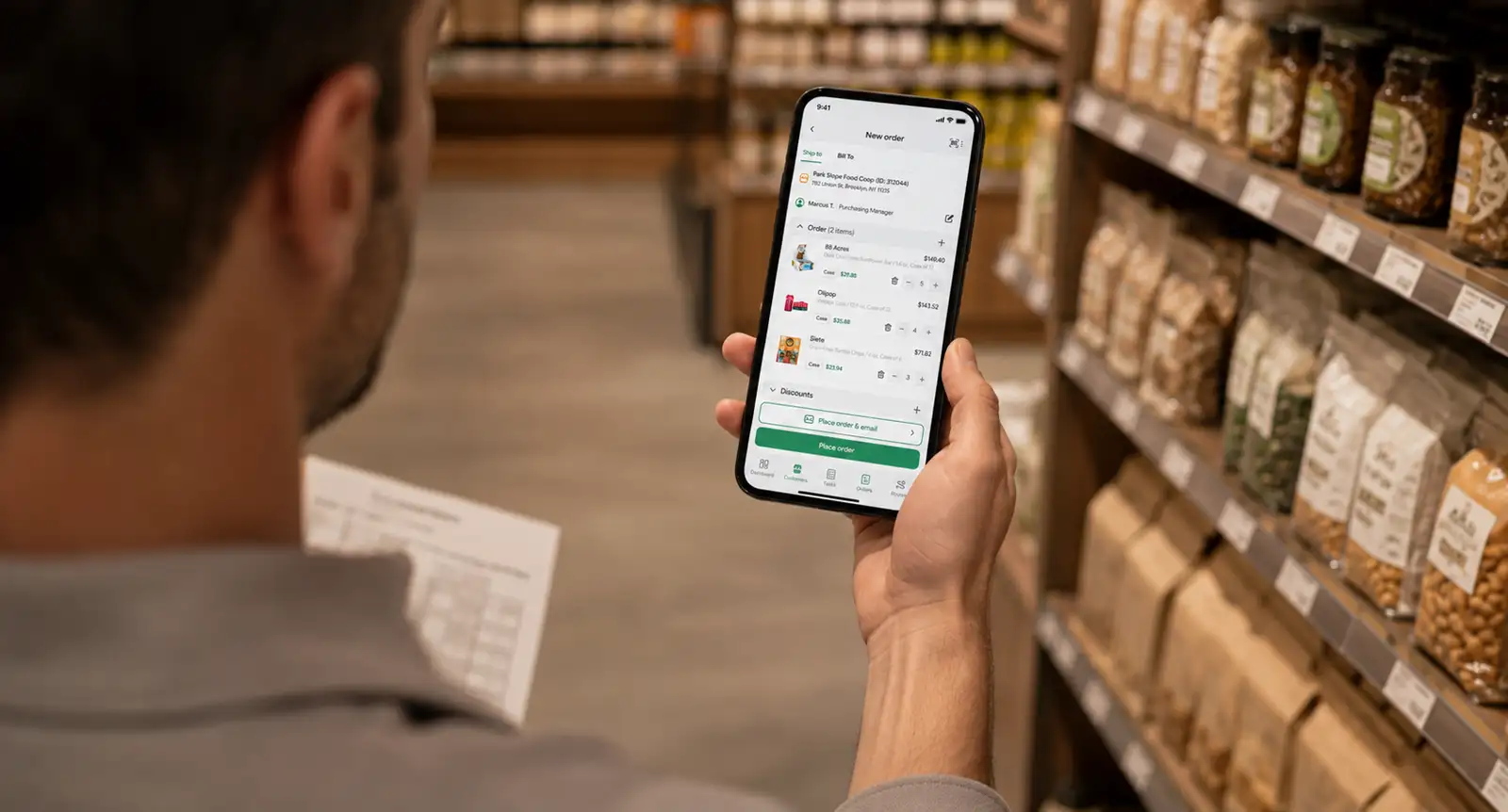
Door-to-Door Sales: Tips, Tools & How to Track Rep Performance


📌 Key Takeaways
- Door-to-door sales works best when reps know who they are visiting, have a relevant opening, and leave each conversation with a clear next step.
- Residential canvassing and cold visits to retail accounts share selling skills, but they need different qualification questions, tools, and compliance checks.
- Track attempts, conversations, qualified opportunities, and sales separately. A door count alone cannot explain performance.
- Compare reps within similar territories and sales motions, and measure results from the same prospect group over time.
- For distributors and brands, connect prospecting visits to account history, orders, and follow-up so a first conversation can become a repeat customer.
Door-to-door sales puts the first few minutes of a sales conversation under a tight squeeze. The buyer hasn’t booked a meeting, they may be busy serving other customers, getting ready to leave, or just plain not interested in what you have to offer. Your rep has to quickly establish a connection before they earn the right to a bit more of the buyer’s time.
For a manager, the challenge doesn’t stop after the conversation either. “I visited 30 locations” just about ignores the real questions that need answering. How many buyers were even available to talk? Which of those visits actually produced a real sales opportunity? Who needs a follow-up after the fact, and did any of those follow up accounts end up placing a second order?
This guide covers the practical details: preparing and delivering a useful pitch, how door to door sales software helps organize visits and follow-ups, and how to keep track of rep performance without rewarding them for doing a whole lot of nothing. We’ve got some examples focused on brands and distributors that call on retail businesses, and we’ll point out when residential sales need to be treated differently.
What’s Door to Door Sales?
Door to door sales is a classic direct selling method where a salesperson goes to a potential customer’s home or business to kick off a sales conversation. That visit might lead to an actual sale, an appointment, a product demonstration, or at the very least a agreement to follow up after the fact.
A salesperson who does door to door sales is often referred to as a canvasser or door to door salesperson. They usually work out of a specific geographic area and keep track of the outcome of each visit. And by ‘outcome’ I mean whether they made a sale or not. Treating that visit as just the same as the sale itself can make your reporting really unreliable.
In residential sales, the conversation might be about a home service with the homeowner. In B2B sales, a beverage brand rep might show up at an independent grocery store to find the person who decides which new products to buy. The second conversation involves all sorts of retail specifics like fitting the product on the shelves, the margins on the product, how to stock it, and so on. Not the same as the needs of a household, to put it mildly.
That distinction really matters when it comes to the whole process. If a retailer likes the product, but doesn’t have the power to make a purchase on their own, then that’s a qualified follow up opportunity not a lost sale – or a win if you get your way immediately.
Plan the territory before you plan the pitch
Start by defining what makes a worthwhile prospect. For a distributor, that might mean the type of store, delivery options, relevant product categories, and an order size that the business can serve profitably. A tightly defined account list helps your rep explain why they stopped at a particular location.
Next up, assign ownership. One rep should be the one who owns the next step for each prospect, even if several people are involved in the sale. Make sure to check the existing customers and previous visit history before adding a location to the route. Too many introductions from the same company in one week can make a new account feel like nobody’s paying attention.
Plan your stops by geography and then take into account buyer availability and visit purpose. A nearby store that only reviews suppliers in the morning might do better with an earlier visit than some other store that is more convenient but has a busy buyer. Route efficiency matters, but at the end of the day an efficient drive to someone who is unavailable is still a wasted visit.
Our guide to territory management talks about the factors that go into account potential and workload when designing the territory. Use those when assigning prospecting routes rather than just dividing the map into equal sized areas.
Before you leave, your rep should have a clear idea of the purpose of each stop, the relevant offer, what they can promise, and what the next step would be if the buyer is even slightly interested. Keep handy the stuff that’s relevant to the call like pricing, minimum order requirements, delivery options, and approved product claims on a phone.
Door to Door Sales Tips for Better Conversations
Start with a reason to keep listening
Introduce yourself and your company, explain why you’re there, and get permission to keep going. Keep the intro short enough that busy people can decide if the conversation is worth it.
For a retail business, an opening pitch might look something like this: “Hi, I’m Maya with Northside Beverage – we supply independent stores in the area, and I wanted to ask who handles new beverage lines here? Is this a good time for a quick question?”
This is just a script to illustrate a point and isn’t meant to be used as an example in real life. Its job is to establish the context and find the right person to talk to. Don’t go into a neighbouring store and claim they’re customers unless that’s actually true and you’re approved to share the info anyway.
Ask about fit before dragging out the pitch
Once you’ve got the right person to talk to, then ask a question that can change your whole pitch. “Are you reviewing new products this month?” is way more useful than listing out every item you have on offer straight away.
A distributor might ask which categories the store is looking to expand, how it prefers to get more stock, or what makes a new supplier worth testing. Listen for any practical constraints that might be a problem, like limited coolers space at the store or a fixed review cycle.
Qualifying early on saves people’s time. If the account isn’t worth your time or the product isn’t relevant to the store, then record that outcome and move on. There’s no need to ‘manufacture interest’ just to make an activity quota.
Make one relevant recommendation
Use the answer to the question to narrow down the offer. If a store wants to start small, explain what trial order options you can actually offer. If reliability is the concern, describe the delivery process accurately. Don’t pretend you can offer an exception to payment terms or delivery timing just to keep the conversation going – that just sets people up for disappointment. Show the buyer the nitty gritty details needed to figure out whether you’re the right fit: the product, the price, any relevant terms, and what happens after they make a purchase. A quick example or sample can really help out when it’s appropriate and you’re allowed to share it.
Handle the buyer’s objections without milking the visit for too long
An objection can actually be a signal that there’s a solvable problem – but if the buyer is plain and simple not interested, it’s time to wrap it up. If the buyer is open to it, try asking one useful question to clarify things, then accept the answer they give.
| Buyer response | What to do next |
|---|---|
| “I’m busy.” | Ask if they’d prefer a better time, and if not – high time to leave. |
| “We already have a supplier.” | If the buyer is still willing to chat, ask if there’s still something they need that we don’t cover. |
| “The minimum order is too high.” | Explain what options we have for smaller orders. Just record that they’re not interested in a bigger order right now. |
| “I need to talk to someone else.” | See how they make decisions, and figure out a good way to get the conversation back on track. |
| “We’re not interested.” | Thanks for their time, record what went down, and respect any request to leave them alone from now on. |
The goal here is to understand what went wrong, not to get into a debate over it. Record the reason so the next rep doesn’t try the same approach again. If someone asks not to be contacted again, just make sure to follow the company’s “no contact” policies.
Agree on a next step that makes sense for the buyer
A good close is one that fits with where the buyer is at. It might be an order, a taste test, or a chance to get the product sheet over to them.
For example: “Would it make sense to review a starter order on Thursday, or should I check in when their next product review is?” Just make sure you can follow through on any commitments you make.
If the buyer is willing to follow up, make sure you and the team know what channel they prefer, and who’s in charge of following up. “We’re interested” is a pretty empty phrase – “Owner asked for case pricing via email, rep to send it before the agreed call” gives the team something to go on.
A door-to-door sales script that’s actually in the real world
Use a script as a guide, but leave room for the buyer’s answers. Here’s a B2B example that brings all the steps together:
Opening: “Hey there, I’m Maya with Northside Beverage. We supply independent stores in the area. Are you the person who looks at new beverage lines?”
Permission: “Can I ask a quick question about what you’re looking for in that category?”
Discovery: “Are you trying to add something new, or just keep the stuff that’s already moving well?”
Relevant offer: “Based on that, I’d suggest starting with this part of our range. Here are the case prices and our standard order requirements.”
Next step: “Would you like to review an initial order, or would a quick follow up with the other buyer be better?”
Exit: “Thanks for the chat. I’ll follow up in the way we agreed.”
For residential sales, change up the questions to fit the household and what the service offers. Don’t just reuse a B2B script without checking the local rules and regulations.
Safety and compliance have to be planned into the route
Make sure reps know what the rules are in the areas where they’ll be working, before sending them out. Local permits, hours of operation, property access rules, and rules around soliciting can all be different. Train reps to leave when asked, respect any posted restrictions, and get out of a situation that feels unsafe.
When it comes to sales to consumers in the US, the FTC’s Cooling Off Rule says that buyers have three business days to cancel certain sales made at home or at certain other locations. The rule has its own set of exceptions and requirements, so make sure to get the compliance team to check it out.
Treat business purchases differently to consumer sales. Don’t assume the same rules apply when a store is buying inventory to resell.
Set up a simple safety routine too: agreed work areas, a way for the manager to get in touch, and a way to handle an unsafe stop. Tell reps what location data is collected, and why, and make sure customer information only gets shared with the team that needs to see it.
How to track door-to-door sales rep performance
A good scorecard should connect the visit with the outcome. Start with a small number of clearly defined stages, and make sure every rep uses the same definitions.
A visit attempt means the rep showed up to the location. A conversation means they actually talked to someone. A qualified opportunity is when the account is a good fit and there’s a real next step to take. A sale means the transaction meets your agreed reporting rules.
Don’t lump “no answer”, “buyer unavailable”, “not qualified” and “not interested” together. They all call for different actions. If the buyer just doesn’t have time, maybe you need to adjust your schedule. If the account doesn’t meet your requirements, maybe you need to look into new prospects.
Grab a short record after each visit
At least note the account or location, rep, visit time, outcome, relevant objection or qualification detail, and next action with an owner, and link the order or opportunity when one exists. Add in notes or photos only when they actually add something to the record.
Use structured outcomes for reporting, and toss in a quick note for context. A dropdown might tell a manager how often buyers are hard to pin down, while a note might mention that a particular owner is always out to lunch – both pieces of info are useful, but you shouldn’t need to file a separate end-of-day report to share them.
Pick your metrics with some clear denominators
Use these definitions as a starting point, then tailor them to your specific sales process. Our guide to B2B sales KPIs puts these visit-level measures into the context of broader sales reporting. These rates below are operational measures, not industry benchmarks to aim for.
| Metric | How to calculate it | What you should be looking at |
|---|---|---|
| Conversation rate | Conversations ÷ attempts | Timing, access, and route quality |
| Qualification rate | Qualified opportunities ÷ conversations | Prospect fit and discovery |
| Opportunity-to-sale rate | First-order accounts ÷ qualified opportunities in the same group | Offer, buying process, and follow-up |
| On-time follow-up rate | Follow-ups completed by deadline ÷ follow-ups due | Ownership and workload |
| Unique-account coverage | Target accounts attempted per rep ÷ target accounts assigned | Areas missed and repeated stops |
| New-account reorder rate | New accounts placing a repeat order ÷ eligible new accounts with a decent observation window | Customer fit and retention |
Pair the rates with their counts. A rep who converts one opportunity out of two has a 50% conversion rate – but that tells you very little on its own about repeatable performance. Review a bunch of comparable activity to see if there’s a pattern developing before you start changing targets or compensation.
For distributors and brands, follow the first order through to repeat business. That initial promotional opening order might look great in your weekly report, but it may not translate into much ongoing revenue. Track how many new accounts reorder within a time frame that fits the product’s normal buying cycle.
Follow a prospect group through the sales funnel
Here’s a hypothetical example – a rep starts out with 100 distinct locations in a week, has 40 conversations, and creates 12 qualified opportunities. By the end of an agreed follow-up window, 6 of those opportunities turn into first-order accounts.
The conversation rate is 40% – 40 out of 100. The qualification rate is 30% – 12 out of 40. And the opportunity-to-sale rate is 50% – 6 out of 12. Altogether, 6 of the original 100 attempts turn into customers – a 6% attempt-to-sale rate.
Those figures tell you different things about the process. Reporting a “50% conversion” without stating the denominator lets the result get misinterpreted.
Count repeat visits separate from one-time prospects, so you don’t get a distorted view of reach. And keep the group consistent – don’t compare sales from this week to prospects from last month – that’ll just mix up different stages of the process.
Compare territories like for like before coaching reps
Separate out new-account prospecting from visits to existing customers. Compare reps working similar types of stores, travel conditions, customer potential, and sales cycles. A dense urban route and a rural route can yield very different visit counts even when both reps are performing well.
Use the scorecard to pick a question to use for coaching. Low conversation rates might be due to buyer availability or poor route timing. High conversation rates with weak qualification could mean the list quality isn’t up to par. Qualified opportunities that don’t turn into orders might be worth taking a closer look at – is it pricing, fit, or follow-up?
Review a handful of actual visit records before deciding what explanation fits. Then agree on a change to test – like revisiting buyer-availability windows or tweaking the qualification question. Check the relevant measure again after you’ve got a meaningful sample of visits.
What to look for in door-to-door sales tools
The right tool should let a rep prepare for the visit, record it, and set the next action all while still in the field. Start with that basic workflow before comparing feature lists.
A sales rep route planner can help organize stops and cut down on avoidable travel. A mobile CRM keeps contact details and account history on hand. Task and follow-up tracking make sure an interested buyer doesn’t get lost between visits. And reporting brings the activity and commercial results together for the manager.
For teams selling to retailers, order capture and access to product information are also important. The rep should be able to tie the conversation to the resulting account or order without having to keep a separate record.
Test a complete scenario during evaluation – add a prospect, plan the stop, record “buyer unavailable”, schedule a return visit, create an opportunity or order, and check out the manager’s report. If your routes have spotty connectivity, test how records stay synced when online access is weak.
Residential canvassing teams may need address-level prospecting, household-specific qualification, or industry-specific proposal and contract workflows. Make sure those capabilities are built-in. A tool built around retail accounts won’t necessarily cover residential canvassing.
Make that next visit a whole lot easier with SimplyDepo
Good old-fashioned door-to-door sales is all about gathering valuable info at every step of the way – who’s worth visiting, what they’re actually interested in, what’s worked or not, and what comes next. This stuff is gold dust for your reps, allowing them to get back out there prepared, and for managers to get some real insight for meaningful coaching.
For brands and retailers making the rounds on retail accounts, SimplyDepo ties together routes, visits, account activity, tasks, and orders into a seamless workflow. Check out our page on the software to see how teams can keep track of visits and outcomes, while our sales rep tracking lets managers check in on rep activity and get a handle on territory coverage.
When you’re shopping around for sales software, bring a real prospecting route and the key performance indicators you’re looking to measure. Walk through a typical visit, follow up, and first order – and pay attention to whether your team can keep that account history up to date, even on the busiest of days. That’s the real test – will it help you make the next visit a whole lot more productive? Book a demo and see for yourself how well that workflow fits your accounts.
Frequently Asked Questions
It’s definitely worth it if your offer is a good fit for the area and that personal touch helps the buyer make a decision. To measure its effectiveness, just use your own qualified opportunities, customer acquisition costs, those pesky cancellations, and repeat business. Don’t get too caught up in the number of doors you knock on – it’s not the only thing that matters.
A great pitch is all about introducing yourself, explaining why you’re there, asking a relevant question, and suggesting the next step. Keep it short and sweet, and be prepared to adapt on the fly based on the buyer’s response. A retailer evaluating a new supplier is going to want different info than a homeowner thinking about a service
Honestly, there’s no one-size-fits-all answer – travel time, how crowded the area is, buyer availability, how in-depth you go on each visit, and your sales process all play a role. Take a baseline from comparable routes, and then review conversations and qualified opportunities along with the number of attempts you make, so you don’t sacrifice fit for speed.
Before you can answer that, you gotta define what you mean by ‘conversion’ – is it sales per attempt, sales per conversation, or sales per qualified opportunity? Compare the same metric across similar territories and prospect groups over a standard timeframe. Instead of taking some arbitrary online benchmark as a target, use your team’s own history to guide your expectations
Ideally, it should be tracking locations or accounts, visit outcomes, any qualification details, next steps or follow-up actions, and the opportunities or orders that come out of it. Route planning, mobile usability, and offline support may also be worth considering. If you’re in B2B, make sure the system ties in new-account prospecting to ongoing customer and order history
-
 October 8, 2026
 -
 October 7, 2026
 -
 IndustryTypes of Payment Methods for B2B and Wholesale: How to Pick the Right Mix for Your BusinessOctober 7, 2026