Consignment Inventory: Best Practices for Distributors


📌 Key takeaways:
- Consignment inventory lets retailers stock products without paying upfront, while the supplier keeps ownership until each item sells. This reduces the retailer’s risk but leaves the supplier carrying more of the inventory and cash-flow risk.
- A profitable consignment program needs clear terms around pricing, reporting, returns, damaged goods, and the consignment period. Both sides also need sales and inventory records that reconcile accurately.
- As consignment expands across more stores, real-time inventory tracking becomes critical. Distributors need visibility into what has sold and which locations need replenishment or stock rotation.
A rep walks into a regional grocery chain with a new snack line. The buyer likes the product, but this quarter’s budget is already spoken for.
Today, that conversation often continues anyway: “What about consignment?”
Consignment inventory lets a supplier place goods on a retailer’s shelf without the retailer paying for them upfront. It shifts who carries the financial risk on a new SKU, and it changes what a distributor needs to track and reconcile every week.
In this guide, we’ll cover how consignment inventory works and the practices that keep the arrangement profitable for both sides.
How does consignment inventory work in practice?
The consignment process starts before a single unit ships.
In a consignment inventory arrangement, a supplier ships products to a retailer without a sale taking place yet.
The supplier retains ownership of the consigned goods the entire time they sit on the shelf.
Once the retailer sells an item, that sale triggers payment back to the supplier under the consignment agreement. The retailer displays and sells the goods on the supplier’s behalf, and it is that sale, not the shipment, that starts the payment clock.
The consignment agreement usually spells out the consignment period, the time goods can sit before review, return, or reprice.
Unsold inventory beyond that point typically goes back to the supplier rather than becoming the retailer’s problem. That detail is what makes consigned inventory attractive to retail partners who want new products without carrying the downside.
Is consignment inventory the same as vendor managed inventory?
They overlap but are not identical.
The consignment model describes a specific ownership arrangement: the supplier retains ownership until a sale happens.
Vendor managed inventory describes a broader supply chain model where the supplier decides when and how much stock to ship, and consignment is one form that arrangement can take.
In practice, many consignment arrangements run in parallel with vendor-managed replenishment. The supplier decides when and how much to ship based on shared sales data, while payment between the two sides still follows the terms set out in the consignment agreement.
A distributor evaluating both models usually starts by asking who initiates each order. If the retailer requests stock, that leans toward consignment. And if the supplier decides when to ship, that leans toward vendor managed inventory.
Knowing which model, or which combination, applies is most useful when it is time to reconcile payments with a consignment partner.
Consignment vs. wholesale: what changes for retailers?
Wholesale requires retailers to purchase goods upfront, using their own capital to stock the shelf before a single unit sells.
Under wholesale terms, retailers buy inventory upfront and absorb whatever does not move.
Consignment flips that arrangement: the retailer pays only after the retailer sells the item, which keeps cash tied up in owned inventory to a minimum.
That shift changes more than cash flow. Retailers get a wider product range and can test new products without upfront costs, since the financial risk of unsold goods sits with the supplier instead of the store.
The usual trade-off is a lower margin per unit for the retailer, since the supplier is pricing in the inventory costs the retailer no longer has to carry.
For retailers already stretched across multiple locations, that flexibility can carry as much weight as the margin trade-off.
Let’s look at the two models side by side:
| Factor | Traditional (wholesale) inventory | Consignment inventory |
|---|---|---|
| Ownership before sale | Retailer owns stock once delivered | Supplier retains ownership until sold |
| Upfront cost to retailer | Full purchase cost paid at delivery | No upfront supply costs |
| Who carries unsold stock risk | Retailer | Supplier |
| Cash flow impact | Capital tied up in owned stock | Capital freed for other purchases |
| Typical retailer margin | Higher, since the retailer bears the risk | Often lower, to offset the supplier’s risk |
| Best suited for | Proven, fast-moving SKUs | New or unproven SKUs, seasonal lines |
Why do suppliers choose a consignment inventory arrangement?
The benefits suppliers gain
The benefits of consignment inventory show up fastest on the supplier’s side of the table. A consignment inventory arrangement lets a supplier get products onto shelves at retail locations that would otherwise want proof of sell-through first.
It also enables suppliers to reach big box retail stores, independent retail stores, and multiple sales channels at once, often across multiple locations, without asking a buyer to commit budget to an unproven item.
The visibility works both ways. Suppliers gain sales data straight from the shelf, information that is harder to get once a distributor buys inventory outright and resells it downstream.
That data can shape a supply chain strategy for the next order cycle, showing which SKUs deserve wider placement across retail locations and which ones need repositioning before the next shipment.
The risks suppliers should plan for
The same arrangement that opens doors also shifts real financial risk onto the supplier’s side of the ledger.
Suppliers can face delayed cash flow, since payment only arrives once the consignee sells the goods, and disputes can surface over unsold items or damaged or lost products in transit.
Shipping costs and shipping and returns responsibilities usually fall on the supplier too, along with the inventory carrying costs of stock that turns into obsolete inventory sitting in a retailer’s back room.
A supply chain strategy built around consignment has to price all of this in, not just the wholesale cost of goods.
A supplier managing several consignment partners at once can also see disputes multiply if reporting is inconsistent between accounts, since one retail partner’s version of “sold” does not always match another’s.
What belongs in a consignment agreement?
A consignment inventory agreement should spell out pricing, the length of the consignment period, and what happens to remaining inventory once that period ends.
Without those terms in writing, a consignment deal tends to run into disagreements the first time sales slow down.
A solid consignment stock contract also assigns responsibility for shipping and returns, sets reporting frequency for sales data, and states how the two parties handle damaged or lost products. The clearer these terms are before the first shipment leaves the warehouse, the fewer disputes come up mid-arrangement.
Retailers and suppliers who treat the consignment agreement as a living document, one both sides revisit at each renewal, tend to have fewer surprises than those who sign once and file it away.
Pricing terms in particular tend to need revisiting as a product moves from an unproven line to a steady seller, since the risk each side is carrying shifts along with it.
Managing inventory this way only works if both sides agree, in writing, on how they reconcile the numbers.
How is consignment inventory accounted for?
Consignment inventory accounting works differently from a normal purchase, because the sale has not happened yet from an accounting standpoint.
How a business chooses to record consignment goods depends on whether that sale has legally occurred. Consigned goods stay on the supplier’s balance sheet, not the retailer’s, since legal ownership has not transferred.
Retailers do not record consigned goods as assets on their financial statements. The supplier keeps the inventory value on its own books until a sale occurs, then removes it and records the corresponding sales revenue.
This distinction becomes most important at audit time, when a business needs to show which stock on hand it truly owns versus which stock it merely holds on behalf of a supplier.
Revenue only counts once consigned goods sell to a customer, and the consignor records the sale in the accounting period the consignee sells the item, not the period the goods shipped.
Both the supplier and the retailer need sales records that match on every consignment sale.
A mismatch at reconciliation time usually points to missing or double-counted units.
How can distributors manage consignment inventory effectively?
Managing consignment inventory effectively comes down to four habits: real-time tracking, regular audits, clear communication, and a plan for stock that will not sell.
Track stock in real time
Inventory tracking is the first habit that separates a smooth consignment inventory management program from a chaotic one.
Distributors need one dependable way to track inventory across every retail partner, not five different spreadsheets.
That visibility is still a challenge for many supply chain teams. A GS1 US study found that 43% of supply chain professionals struggle to maintain supply chain visibility. The same research also found that companies using real-time tracking technologies were 68% more likely to report better visibility and inventory control.
Manual spreadsheets fall apart once a program covers more than a handful of retail locations.
Real-time inventory management software removes most of the inventory management complexity that comes with tracking consignment inventory across multiple locations.
Distributors juggling consignment stock across scattered retail locations, a consignment warehouse, and field reps need something built to connect those pieces. Many lean on distribution management software instead of fragmented inventory systems that only track one warehouse at a time.
For distributors covering multiple locations, that visibility also shows which retail partners are moving stock fastest, which helps decide where the next shipment should go.
Audit consignment stock on a schedule
Physical counts are necessary, even with software in place.
That check can uncover more discrepancies than teams expect. A Marketing Science study found inaccurate inventory records in 27.3% of product audits in its retail dataset. It also found that 3.2% of items became phantom inventory, where the system showed stock that was no longer physically available.
A routine inventory audit catches discrepancies between what the system says is on the shelf and what is actually there, whether the difference comes from theft, damage, or a scan that never happened.
For consigned stock specifically, an audit also confirms that the retailer’s sales records match what the retailer has actually paid the supplier.
Scheduling these audits around the consignment period keeps the numbers aligned with when payment is actually due.
Put communication and reporting in writing
Clear communication channels between consignor and consignee prevent most disputes before they start.
That means agreed reporting intervals for sales data, a single point of contact on each side, and a shared understanding of what counts as a sale versus a return.
Regularly monitoring sales trends, not just recording individual transactions, is what lets both sides adjust stock levels before a slow SKU turns into dead stock.
Retail partners who receive consistent, structured reports on customer purchases and customer demand tend to reorder faster.
Plan for damaged, lost, or obsolete stock
Every consignment inventory management program eventually deals with stock that will not sell.
A plan for obsolete inventory, whether that means a return window, a markdown, or a donation clause, keeps unsold products from slowly eating into a supplier’s margin.
Damaged or lost products need the same clarity: who reports them, who absorbs the cost, and how quickly the consignment agreement requires that to happen.
Build this into the agreement up front to keep the relationship on steadier footing.
Make consignment inventory work at scale
The consignment inventory best practices covered here, from real-time tracking, clear agreements, regular audits, to open communication, all exist to solve the same problem.
They keep two companies’ books, shelves, and expectations in sync when neither one owns the same inventory at the same time.
Getting there usually starts with inventory management software that gives both sides real-time stock visibility.
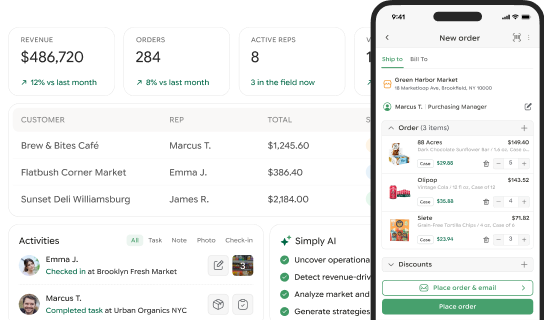
SimplyDepo builds that visibility into a single platform, syncing stock levels with live order activity across every account and keeping financial records current through native QuickBooks Online sync.
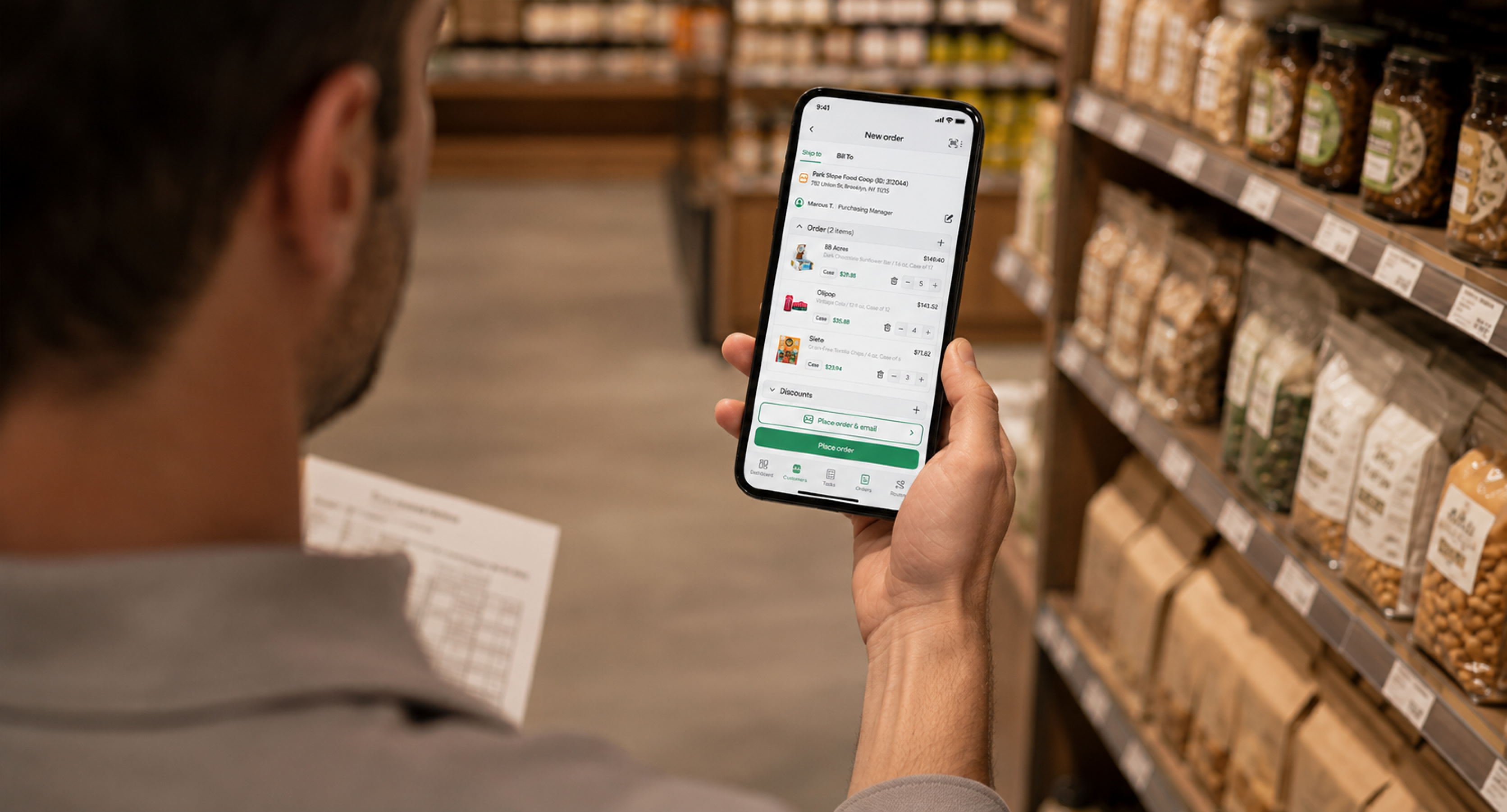
An offline-first mobile app then lets reps check and update consigned stock levels from the retail floor itself, connection or not.
That counts most for distributors adding new retail partners every quarter, where manual reconciliation stops scaling long before the sales team does.
Book a free demo to explore how SimplyDepo can support your operations.
FAQs on consignment inventory
In wholesale, the retailer buys and owns the stock immediately, taking on the financial risk of anything that does not sell. In a consignment inventory arrangement, the supplier retains ownership until the retailer sells the item, so unsold inventory returns to the supplier rather than sitting as a loss on the retailer’s books.
Consignment periods vary by category, and the consignment agreement sets the length, but 30, 60, or 90 days are common starting points. Fast-moving categories tend to use shorter periods, while seasonal or slow-turning products often run longer before a review.
Shipping costs and shipping and returns responsibilities are negotiated terms, not a fixed rule. Suppliers absorb them more often than not, since they are the party retaining ownership and most of the upside from the eventual sale. Some agreements split the cost of returns once a consignment period ends, particularly for bulky or fragile products.
Consigned goods stay on the supplier’s balance sheet as inventory value until sold. The retailer does not record them as an asset, and both sides recognize the sale and the related sales revenue, only once the consignee sells the item to a customer.
Depending on the consignment agreement, the supplier usually takes back unsold items, marks them down, or rotates them to a different retail location. The consignment period sets the deadline for that decision, so remaining inventory does not sit indefinitely, and the supplier decides whether to resell the returned stock elsewhere or write it off.
Yes. Many consignment arrangements run in parallel across brick-and-mortar retail stores, big box retail chains, and online storefronts at once. The key is whether the supplier can track consigned stock and reconcile sales data across each channel without losing visibility.
 Rated 4.7 on G2
Stockouts and overstock are costing you more than you think.
-
 September 9, 2026
 -
 September 9, 2026
 -
 September 9, 2026