Dead Stock: What It Costs You and How to Reduce It


📌 Key takeaways:
- Dead stock is more expensive than the purchase price. It ties up cash, takes up warehouse space, adds carrying costs, and blocks money that could go into faster-moving products.
- The easiest way to reduce dead stock is to catch slow SKUs before they go cold. Aging reports, inventory turnover, account-level sales data, and route-level visibility help teams act while the stock still has resale value.
- Prevention comes down to sharper buying and better visibility. Accurate forecasting, disciplined reorder points, conservative new-SKU orders, and real-time inventory tracking help distributors avoid overordering in the first place.
There is a pallet in the back corner of almost every warehouse that nobody talks about. It arrived full of promise, got shelved behind faster movers, and has not budged in a year.
On a route, it shows up as the one case a rep keeps skipping because the account never reorders it.
Either way, the product is not waiting to sell. It’s charging you rent.
That pallet is money you already spent, sitting still. And the longer it sits, the more it costs. This is the reality of dead stock, and managing it well is one of the least glamorous yet most profitable things a distribution business can do.
What is dead stock, and how is it different from obsolete or excess inventory?
Dead stock refers to unsold inventory that is not expected to sell under normal conditions. As a rule of thumb, inventory that has not sold within six to twelve months is considered dead stock. It ties up capital, occupies space, and returns nothing.
The terms get used loosely, so it helps to treat them as points on a timeline rather than synonyms.
- A product that stops moving becomes slow-moving, and left alone, it turns into excess stock
- When demand disappears entirely, it becomes obsolete inventory, also called dead inventory or dead stock: same item, later stage
Dead stock can include damaged items, expired raw materials, discontinued products, or last season’s goods that missed their window. What it does not include is customer returns or stock still in transit. Those are different problems.
📌 Quick note on terminology:
Sneaker and collectible communities use “deadstock” to mean unworn, sought-after product with high resale value, which is the opposite of what a distributor is dealing with here.
Why does dead stock happen?
Understanding the causes of dead stock is the first step toward preventing it. The reasons are predictable, and most trace back to a handful of decisions made months earlier.
1. Overordering and forecasting misses
Inaccurate demand forecasting is the most common culprit.
When you overestimate how much a product will sell, the surplus sits. Bulk-buying for a volume discount makes it worse: the savings evaporate the moment half the order becomes dead stock, and over-ordering leads straight to excess inventory.
The forecasting itself usually fails for a familiar set of reasons. Projections lean too heavily on optimism, ignore seasonality, or rest on thin historical sales data.
Accurate demand forecasting reduces the risk of overproduction, but only when the underlying numbers are clean and current.
2. Shifting demand and slow sales
Declining demand turns healthy inventory into dead inventory. Changing market trends can drop product demand suddenly, especially for seasonal items and trend-driven categories.
Poor sales performance on a new SKU that never found its audience produces the same result, and quality issues render products unsellable.
Seasonal items carry a built-in deadline. Anything left when the window closes is at high dead stock risk, which is why disciplined operators buy them conservatively and lean on universal products that keep selling after the season ends.
3. Blind spots across locations
When stock is scattered across warehouses, trucks, and customer accounts, slow-moving items are hard to catch before they age out. An excessive SKU count makes every one of these problems harder to see.
Without real-time visibility, teams reorder products they already hold too much of, and miss the early signs of falling customer demand. The stock keeps arriving on a schedule set months ago while sales quietly drift the other way. By the time the mismatch is obvious, the surplus has already become dead stock.
What does dead stock really cost you?
The purchase price is only the first layer. To understand dead stock impact, you have to stack the costs that pile on after the product lands. Across US retailers alone, McKinsey put the value of unsold goods at roughly $740 billion in 2023, and most of that cost is hidden.
The three layers of dead stock cost
The first layer is the direct sunk cost: the units you bought, multiplied by what you paid.
The second is carrying cost, the ongoing expense of storage, insurance, handling, and depreciation.
Dead stock can increase carrying costs by 20 to 30% of the inventory’s value every year, and that meter runs until the product is gone.
The third layer is opportunity cost. Capital locked in dead stock inventory cannot fund faster movers, marketing, or anything else that earns a return.
The longer dead stock sits, the more each layer compounds through shrinkage and depreciation.
An example of the cost of dead stock
Say you’re holding 500 cases of a discontinued SKU that cost $10 a case.
That is $5,000 already spent that you cannot easily get back, and the extra costs stack on top: a year of storage, insurance, and handling runs 20 to 30% of the stock’s value, while the tied-up capital forfeits whatever it could have earned elsewhere.
Here’s how it adds up:
| Cost | What it covers | Amount |
|---|---|---|
| The unsold stock | Cases you bought but cannot sell | $5,000 |
| One year of holding it | Storage, insurance, handling, depreciation | $1,000-$1,500 |
| The return you gave up | What that $5,000 could have earned elsewhere | $1,250 |
| Total cost after one year | $7,250-$7,750 |
A $5,000 buying mistake has quietly become a $7,250 to $7,750 loss, and that was only year one. The 25% return is just an illustration, so use whatever your own capital typically earns.
The same logic scales. A slow item worth $20,000 in dead stock value is never really a $20,000 problem. It is that number plus everything it costs you to keep it and everything you could not do with the cash.
Those carrying costs are not just line items on a spreadsheet either.
Dead stock occupies valuable warehouse space that could hold products that sell, and it forces staff to handle inventory that will never bring in revenue. Clearing it is how you convert tied-up capital back into cash and free the space for faster movers.
How do you spot dead stock before it’s dead?
The best dead stock management catches problems while they are still fixable. That means watching velocity, not just counting units.
Tracking inventory aging helps you identify dead stock early, and measuring inventory KPIs surfaces trouble before items become unsellable inventory.
Watch aging and turnover
Run regular inventory audits to flag slow-moving items on a schedule, and use aging reports to see how long each SKU has sat, with automated alerts as products approach the six-month mark.
Watch your inventory turnover ratio too, since a falling number is often the first sign of potential dead stock.
Group your catalog into fast movers, slow movers, and non-movers, and review the list on a set cadence.
The sooner you flag a slow mover, the more levers you still have: you can adjust pricing, shift marketing, or pause the next reorder while the item still has value. Wait too long and the only remaining option is disposal at a loss.
Track velocity by account and route
For distribution, there’s one extra layer. A SKU can look healthy in aggregate while dying in three specific accounts, and sell-through by route and by account is the early signal that warehouse-level numbers hide.
Reading historical sales data against actual demand at the account level tells you where to adjust pricing or reallocate before the product becomes dead stock.
Nearly all dead stock is preventable if you catch the slowdown early.
How do you reduce dead stock you already have?
Once inventory has stalled, your goal shifts to recovering as much value as possible.
Dead stock management at this stage is about limiting the loss, not erasing it, so the aim is to sell dead stock through whatever channel returns the most before you resort to writing it off.
The tactics below run roughly from most value recovered to least.
1. Discount, bundle, or move it
Adjust pricing first. Clearance sales and targeted discounts are the fastest way to shift dead stock and recover partial value. Offering discounts reduces dead stock items quickly, though every markdown eats into profit margins.
Bundle slow items with fast movers. A co-branded product bundle, or including a slow SKU as a free gift with a popular order, moves unsold inventory while adding perceived value for the customer.
Reallocate before you liquidate, because product that is dead in one territory may still sell in another. Move the stock to accounts that still buy it before writing it off.
2. Return, donate, or write off
Check your supplier agreements too. Depending on the contract and the product type, you may be able to return or refurbish excess inventory rather than eat the full loss.
When resale is exhausted, donating dead stock to charity clears space and can earn tax benefits through an inventory write-off.
Selling to liquidators is the next option, and scrapping is the last resort.
Whichever path you take, act promptly, because the longer dead stock sits, the less anyone will pay for it.
How do you prevent dead stock in the first place?
Dead stock prevention is always cheaper than disposal. The businesses that carry the least are not lucky; they are disciplined about a few practices.
It starts with accurate demand forecasting. Reading historical sales data and market trends closely keeps you from overordering the products least likely to sell.
Set disciplined reorder points so you replenish based on actual demand, not habit, and get your order quantities right so you never buy more than a SKU can absorb.
ABC analysis focuses attention on the high-value items that carry the most dead stock risk.
Cycle counting keeps stock levels honest between full audits. Buying conservatively on unproven products, and adopting lean inventory practices that pull stock in as you need it, keeps you from committing cash to inventory that has not earned it.
The through-line is visibility. Better inventory management is what lets you see slow items early and act while there is still value to save.
Turn visibility into fewer dead SKUs
Dead stock is money you already spent, and the discipline that prevents it comes down to two things: seeing slow inventory early, and acting fast enough to recover its value.
Both get much harder when your stock is spread across warehouses, delivery trucks, and dozens of retail accounts, and your data is not.
This is where inventory management software earns its place. The right system gives you real-time stock levels across every location, automated reorder points that prevent overbuying, and aging visibility that flags slow movers before they become dead inventory. It converts scattered counts into one live picture.
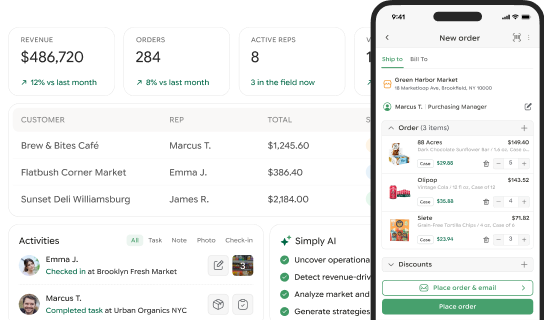
SimplyDepo is built for exactly this problem in distribution. It tracks stock in real time across the warehouse and the field, online or offline, with automated reorder points and account-specific pricing so reps never commit to a product that is not there.
Its route-level allocation lets you move slow stock to the accounts still buying it, while QuickBooks sync keeps warehouse, field, and finance on the same numbers. Instead of finding dead stock at year-end, you see it forming and act while it still has value.
Book a free demo and explore how SimplyDepo fits into your operations.
FAQs on dead stock
They describe the same problem at different stages. Slow-moving inventory becomes excess inventory, and once demand disappears entirely, it becomes obsolete or dead stock. Obsolete inventory is dead stock that has aged past any realistic chance of selling at value.
The common threshold is six to twelve months. Inventory that has not sold within that window, with no signs of future customer demand, is generally classified as dead stock. Fast-moving categories like fashion or electronics may hit that point sooner.
Start with the direct sunk cost: unsold units multiplied by unit cost. Then add annual carrying cost, roughly 20 to 30% of the dead stock value, and the opportunity cost of the tied-up capital. The all-in figure is usually far higher than the purchase price alone.
Lower is always better. There’s no universal benchmark, since acceptable levels vary widely by industry and product type, but any dead stock is stock you would rather not hold. Keeping it to a minimum through regular audits and accurate forecasting is a reasonable target for most distributors.
You rarely recover full value, but you can limit the loss. Clearance sales, bundling with popular products, and reallocating stock to accounts where it still sells recover the most. Donating unsold inventory for a tax write-off is a solid last resort before scrapping.
In many cases, yes. Businesses can often write down dead stock to its realistic value or write it off entirely, and donating it can provide additional tax benefits. Rules differ by location, so confirm the specifics with your accountant.
 Rated 4.7 on G2
Stockouts and overstock are costing you more than you think.
-
 September 16, 2026
 -
 September 15, 2026
 -
 September 15, 2026