SKU vs. UPC: What’s the Difference and Why It Matters

📌 Key takeaways:
- SKUs and UPCs are built for different jobs. A SKU is an internal code a business creates for tracking, picking, reporting, and warehouse operations, while a UPC is a standardized 12-digit code used across retailers, distributors, and marketplaces.
- Most distributors need both codes working together. The UPC gives every trading partner a shared product identifier, while the distributor’s SKU keeps internal catalogs, routes, stock counts, and reorder data organized.
- Bad SKU-to-UPC mapping creates expensive errors. Mismatched codes can lead to wrong shipments, duplicate records, rejected retailer listings, inaccurate inventory counts, and more manual cleanup for the team.
Picture a single case of ginger shots leaving a manufacturer’s dock. The consumer unit inside carries a barcode the brand printed at the factory.
The distributor who buys that case files it under a code of its own making. The retailer who stocks it on a shelf scans yet another number at the register.
One product, three different names, and every one of them doing a specific job.
That’s the practical reality behind the SKU vs UPC question.
The two get used interchangeably in warehouses and on sales calls, but they’re built for different purposes and owned by different parties.
When a rep or a picker treats them as the same thing, the result is a short shipment or an inventory count that no longer matches the shelf.
In this guide, I’ll walk you through what each code does, how they differ, how they work together across the distribution chain, and when to reach for one over the other.
What is a SKU?
A stock keeping unit, or SKU, is a unique alphanumeric code a business creates to identify and track a product inside its own operation.
It is internal and self-generated. No outside body assigns it and no license is required.
Because a business builds its own system, a SKU can encode the attributes that matter to the people managing the inventory, such as brand, flavor, size, pack configuration, or even a warehouse location.
Say you distribute a line of functional beverages. A grapefruit ginger shot in a six-pack might carry a SKU like GNG-GRP-06, while the same flavor in a twelve-pack becomes GNG-GRP-12.
Each SKU should uniquely identify one product variant, so the six-pack and the twelve-pack never share a code. That granularity is what lets you track sales trends, monitor stock levels, and pull SKU-level reports on which items move and which sit.
SKUs are unique to the business that made them. Two different companies can hold the same SKU string for entirely unrelated products, because these codes only need to be unique inside one operation.
What is a UPC?
A universal product code, or UPC, is a standardized 12-digit numeric code that identifies a product consistently everywhere it is sold.
Where SKUs are alphanumeric and variable in length, UPCs are strictly numeric and always 12 digits long.
The code breaks into three parts:
- a company prefix that identifies the brand owner
- an item reference for the specific product, and
- a final digit called a check digit that validates the scan.
UPCs are issued through GS1, the nonprofit global standards organization that maintains barcode standards for retail and the supply chain. A brand owner, usually the manufacturer, buys and licenses UPCs from GS1 rather than inventing them.
Every product variation needs its own code, so a flavor sold in six pack sizes requires six separate UPCs.
The upshot is that the same UPC follows a product across every retailer, distributor, and marketplace that handles it.
Scan that code in a warehouse in Texas or a store in Ohio and you get the same item.
A UPC is technically one member of a larger family called the global trade item number, or GTIN. That relationship is important once you start dealing with cases and pallets, which we will get to shortly.
What are the key differences between a SKU and a UPC?
| Attribute | SKU | UPC |
|---|---|---|
| Full form | Stock keeping unit | Universal product code |
| Created by | The business itself | GS1, licensed to the brand owner |
| Format | Alphanumeric, variable length | 12 digits, numeric only |
| Scope | Internal to one company | Consistent across all sellers |
| Cost | Free to create | Purchased from GS1 |
| Changeable | Yes, anytime | No, fixed once assigned |
| Encodes product attributes | Yes, such as size and pack | No, data lives in a database |
| Main purpose | Internal tracking and operations | External identification and sale |
Important to note: SKU is your private filing name for a product, and a UPC is that product’s public passport. One does not replace the other, and most distribution operations need both working side by side.
How do SKUs and UPCs work together across the distribution chain?
Follow a product from factory to shelf and you can see which code stays put and which one changes hands at every stop.
The UPC stays the same, the SKU changes at each stage
The manufacturer prints one UPC on the consumer unit, and that number does not change as the product moves downstream. The distributor who receives it assigns its own internal SKU built for its own warehouse and routes.
The retailer who buys it from the distributor files it under a third code that fits its own point of sale system. Same physical product, same UPC the whole way, but a different SKU at each business that touches it.
The UPC is the shared key that ties everyone together
Because the UPC is universal, it becomes the common reference every trading partner can agree on. Distributors map their internal SKUs to supplier UPCs, so a scanned barcode resolves to the right internal record.
That mapping is what makes barcode receiving, order accuracy, and catalog syncing possible when you carry thousands of items from dozens of manufacturers.
It also travels on the paperwork: retailers identify products by UPC on purchase orders and shipping notices, which is why the code has to be right before a single case ships.
Where do barcodes and GTINs fit in?
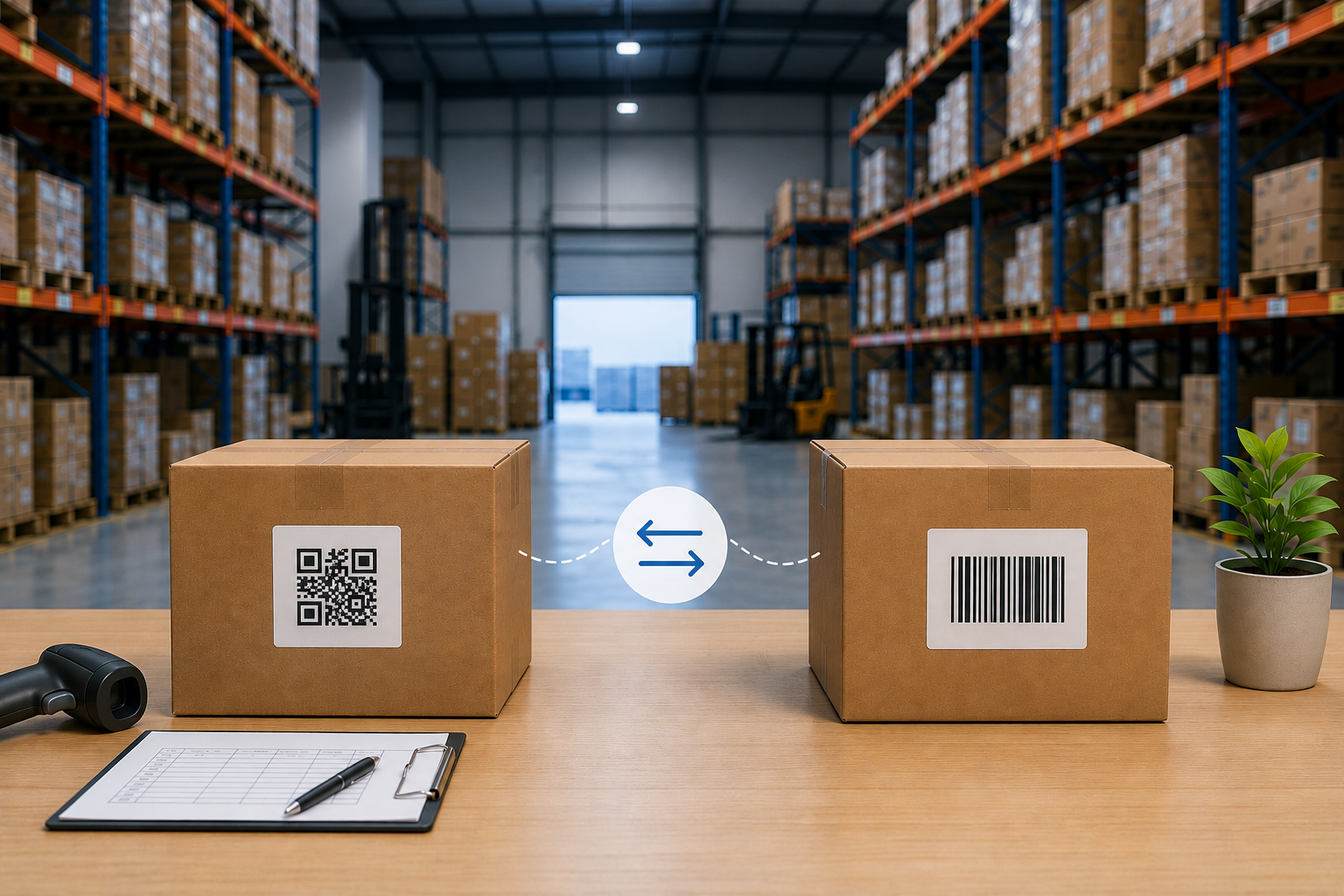
A barcode is the visual, scannable layer, the pattern of black and white lines. It’s a format, not the data itself. A barcode can encode a UPC, a SKU, a shipping code, or a warehouse location.
A UPC is the 12-digit number, technically a GTIN-12. A GTIN, or global trade item number, is the umbrella standard from GS1, and it comes in 8, 12, 13, and 14-digit lengths for different uses.
The rule to remember is that every UPC is a GTIN, but not every GTIN is a UPC. Outside North America, the 13-digit European article number, or EAN, plays the same role the UPC plays domestically.
The scale of this system is hard to overstate. The barcode now identifies more than 1 billion products and is scanned over 10 billion times a day, according to GS1 US.
That same universal system is starting to evolve: retailers have set a target to accept 2D barcodes, the QR-style codes that can carry batch and expiry data, at checkout by 2027 under a GS1 US initiative called Sunrise 2027.
When should you use a SKU vs. a UPC?
| Situation | Use | Why |
|---|---|---|
| Picking, packing, and warehouse counts | SKU | Internal operations run on your own codes |
| Van sales and mobile order taking | SKU | Reps work in your catalog, not the manufacturer’s |
| Reorder points and demand reporting | SKU | Internal analytics tie to internal identifiers |
| Listing a product with a retail partner | UPC | Retailers require the universal code to receive product |
| Purchase orders and shipping notices | UPC | Trading partners identify items by UPC |
| Onboarding a new supplier catalog | Map supplier UPC to your SKU | The UPC is the shared key for the mapping |
Use SKUs for internal inventory management and tracking, where you need control and detail. Use UPCs for external sales, where you need every partner to recognize the same item.
UPCs are also non-negotiable if you sell through major online marketplaces or large chains: platforms like Amazon and Walmart require a UPC before they will list a product, and big retailers ask for one to receive goods into their systems.
Internal control comes from your SKU codes, external interoperability comes from UPC codes, and a distribution business needs both.
What happens when SKU and UPC data is wrong?
A mismatched or missing code shows up as mis-picks and wrong shipments, retailer listings rejected for a bad UPC, inventory counts that drift from reality, and duplicate records when the same product enters your system under two different SKUs.
Each one costs staff hours to chase and erodes the trust of the retail partners you’re trying to keep.
The stakes climb as the product data itself becomes customer-facing. A 2024 GS1 US survey found that 77% of consumers consider product information important when making a purchase, and 79% are more likely to buy an item whose scannable code gives them the details they want.
The identifier is the key that unlocks that information, so an accurate, well-mapped code shapes whether a product gets found and bought. Clean SKU-to-UPC data is what keeps an item orderable and sellable across every channel you touch.
What mistakes do distributors make with SKUs and UPCs?
A handful of errors come up again and again, and each one traces back to treating these codes casually:
- Reusing one code across variations: Each size, flavor, or pack count is a separate product and needs its own UPC. Collapsing a variant family into one code breaks retailer listings and scrambles counts
- Confusing the SKU with the UPC in partner data: An internal SKU entered where a UPC belongs will fail a retailer’s or marketplace’s system, because that code means nothing outside your walls
- Using one identifier for each unit and the case: As covered above, the consumer unit and the shipping case are different trade items with different GTINs
- Losing the leading zero: Spreadsheets strip the leading 0 from a 12-digit UPC and corrupt the number. Format the column as text before importing
- No single source of truth: When SKU-to-UPC mapping lives in scattered spreadsheets, the same product ends up under conflicting records across the team, and nobody knows which one is right
How the right software keeps SKUs and UPCs aligned
SKUs and UPCs solve different problems, and a distribution operation needs both mapped cleanly to each other in one place.
That’s hard to do in spreadsheets once you are carrying hundreds of items across dozens of suppliers. This is where field sales software earns its place, holding each item’s internal SKU alongside its UPC and keeping each unit and the case as distinct trade items.
SimplyDepo is built for exactly this. Its centralized catalog management system lets you upload and manage every SKU with images, pack sizes, and pricing tiers, so field reps browse and search the same catalog they sell from.
Its barcode-based inventory management speeds up stock counts on warehouse floors, delivery trucks, and in store while cutting pick errors, and batch and lot tracking gives perishable or regulated product distributors full traceability.
Reps place B2B orders from an offline-capable mobile app that syncs when connectivity returns, so the code a rep scans in the field and the code a manager sees on the dashboard are always the same one.
Book a free demo to see SimplyDemo in action.
FAQs on SKU vs. UPC
No, they serve different purposes. A SKU is an internal, self-made alphanumeric code you use to track products inside your own business, while a UPC is a standardized 12-digit numeric code issued through GS1 that the whole market recognizes. One is private, the other is universal.
For a distributor selling to retail partners, yes. SKUs run your internal operations like picking, counting, and reporting, while UPCs are required by trading partners, retailers, and marketplaces. They work together rather than competing.
Not within one company, where each SKU should map to a single product variant. Different businesses can and do use the same SKU string for different products, because SKUs only need to be unique inside one operation.
No. The UPC is the 12-digit number, and the barcode is the scannable image that encodes it. A barcode is a format that can also carry a SKU, a shipping code, or other data.
A UPC is one type of GTIN, specifically the 12-digit version called GTIN-12. GTIN is the umbrella standard, which also includes the 13-digit EAN and the 14-digit case code.
Usually not. The brand owner or manufacturer licenses UPCs from GS1. Distributors reference the existing supplier UPC and map it to their own internal SKU rather than purchasing new codes.
-
 October 20, 2026
 -
 October 20, 2026
 -
 October 20, 2026