Wholesaler vs. Distributor: What’s the Difference?


📌 Key takeaways:
- A distributor is a contractual sales partner to the manufacturer. A wholesaler is a supply partner to the retailer. Every other difference follows from that.
- Distributors bring territory rights, rep coverage, and brand-building capability. Wholesalers bring reach and speed, with no exclusivity and no promotional obligation.
- The model you choose has operational consequences: distribution means managing routes, reps, orders, and retail execution on an ongoing basis. Wholesale largely manages itself.
The wholesaler vs distributor question comes up often in CPG, and the two roles look almost identical from the outside.
Both buy products in large quantities and warehouse them before resale. They also sell to retailers.
But the relationship each one has with a manufacturer is fundamentally different, and that difference shapes everything from pricing and territory rights to how much say a brand has over where its products end up on the shelf.
For CPG brands deciding how to reach market, and for operators building a distribution business, knowing which model you’re working is the foundation of the channel strategy.
In this guide, we’ll discuss how wholesalers and distributors operate, where their roles diverge, and how to decide which one fits your business.
Where do wholesalers and distributors sit in the supply chain?
The traditional supply chain runs from manufacturer to distributor to wholesaler to retailer to consumer.
The supply chain relies on each of these links to carry its share of the logistics burden, take on inventory risk, and earn a margin for doing so.
In practice, the chain rarely works this cleanly.
A distributor might skip the wholesaler layer entirely and sell direct to retail. A wholesaler might purchase directly from a manufacturer rather than through a distributor.
In DSD (direct store delivery) models, a distributor bypasses the wholesale tier altogether, delivering physical products straight to store shelves on scheduled routes.
What the supply chain model does clarify is this: both wholesalers and distributors are intermediaries between the people making products and the people selling them to consumers. The question is which intermediary serves which end of that chain, and on whose behalf.
What a distributor does and why manufacturers rely on them
A distributor works on behalf of the manufacturer.
When a manufacturer partners with a distributor, they enter a formal contractual relationship.
Distributors enter into agreements that define a territory, set volume expectations, outline promotional responsibilities, and often grant the distributor exclusive or semi-exclusive rights to represent a specific brand in that market.
In this sense, a distributor represents the manufacturer’s interests in a given region; they are not a passive intermediary but an active sales partner.
Unlike wholesalers, distributors provide a full suite of additional services beyond moving inventory.
What extra services does a distributor offer?
Distributors handle logistics including storage and delivery, manage their own field sales reps, provide marketing support for the manufacturer’s products, and sometimes execute in-store merchandising.
A regional beverage distributor, for example, might hold exclusive rights for a craft soda brand across three states. Their drivers visit convenience stores, restaurants, and grocery chains on a set schedule, handling delivery, shelf rotation, and reordering all at once.
The distributor carries the inventory risk for their territory.
They order products from the manufacturer, store them in their own warehouses, and take the loss if they don’t sell.
In exchange, they earn a margin on everything they sell and build a distribution network and account density that a manufacturer couldn’t build without a much larger sales organization. Distributors often provide specialized technical support and post-sales service as well, depending on the product category.
Distributors sell through different channels depending on the agreement: to wholesalers, direct to retailers, or in some models, selling directly to consumers. The defining characteristic isn’t who they sell to; it’s the contractual obligation that underpins the relationship.
What a wholesaler does and who they’re really working for
A wholesaler works on behalf of the retailer. Where a distributor’s loyalty runs upstream toward the manufacturer, a wholesaler’s runs downstream toward their retail buyers.
Wholesalers buy products in bulk from various manufacturers or distributors and resell them in smaller quantities to retailers, food service operators, or other businesses.
They operate without exclusivity. There’s no contract binding them to a specific manufacturer, no defined territory, and no promotional obligation. They choose their own product mix based on what their retail customers want, and they’ll stock competing products if those offer better margins or move faster.
What does a wholesaler bring to the table?
Wholesalers specialize in efficient distribution across a broad product range. A specialty food wholesaler might carry products from dozens of manufacturers across multiple categories, giving independent grocery retailers, ecommerce businesses, and small businesses a single source rather than forcing them to manage relationships with every supplier individually.
Wholesalers focus on freight consolidation and storing diverse inventory, which is what makes them useful to a retailer or ecommerce seller who needs reliable bulk orders from a single point of contact.
The wholesaler’s primary focus is competitive pricing.
They buy in bulk quantities to unlock lower per-unit costs that’s the wholesale model’s core logic and pass enough of those cost savings on to retailers to stay competitive.
Unlike distributors, wholesalers provide relatively basic services: storage, delivery, and order fulfillment. The profit margins are usually thinner because wholesalers are competing on price and product range rather than exclusivity and brand support.
So what’s the real difference between a wholesaler and a distributor?
The clearest way to see it: a distributor is a sales partner to a manufacturer, and a wholesaler is a supply partner to a retailer. Every other difference follows from that.
| Dimension | Wholesaler | Distributor |
|---|---|---|
| Primary focus | Supply retailers with a broad product range | Sell manufacturer’s products in a defined territory |
| Manufacturer relationship | Transactional purchase of products without a contract | Formal contractual relationship, often exclusive |
| Territory | Non-exclusive, can stock different brands | Territory-defined, distributor represents the brand |
| Services provided | Bulk purchasing, storage, delivery | Sales support, marketing support, technical support, market development |
| Inventory management | Manages large quantities across various manufacturers | Manages inventory for manufacturers within their region |
| Pricing structure | Lower prices via bulk purchasing power | Higher prices offset by value-added services |
| Business model | Volume and margin on wholesale-to-retail spread | Higher margin through exclusive service agreements |
Two of these differences carry the biggest operational weight: brand control and the services scope.
Brand control
When a manufacturer signs with a distributor, they’re granting someone else the right to represent their specific brand in a market.
That partner will decide which retail accounts to call on, how often, and how to position the product against competing products.
Brand control shifts. Unlike wholesalers, distributors act more as brand partners and handle the brand building, product promotion, and customer base development that a manufacturer cares about in a target market.
Wholesalers create no such arrangement; the manufacturer has limited say in how or where the product is sold once it leaves their facility.
💡 Pro tip:
If brand control matters to you, read the termination clause before anything else in a distribution agreement. Some contracts make it extremely difficult to exit a territory even if the distributor underperforms. Knowing your off-ramp before you sign protects you from being locked into poor execution with no leverage.
The services scope
Wholesalers provide transactional services: storage, delivery, and order fulfillment. That’s largely where it ends.
Distributors go further, offering marketing and sales support, managing accounts on the manufacturer’s behalf, and acting as a business-to-business extension of the manufacturer’s sales team in their territory.
For a CPG brand, choosing a distributor means trading margin for coverage and capability. Choosing a wholesaler means prioritizing reach and speed over service depth.
What about businesses that do both?
In reality, many businesses blur the line between wholesalers and distributors. The term ‘wholesale distributor’ is common in CPG and food service precisely because many operators do both things simultaneously, sometimes across different product lines, sometimes for the same ones.
For instance, a beverage operator might hold a formal exclusive agreement with a beer brand, making them the exclusive distributor for that product.
The same business might also buy snack products from a cash-and-carry and resell them to the same retail accounts via purchase orders without any formal agreement, which is wholesale.
Wholesalers and distributors can coexist inside the same operation. From the outside, they look identical. But from the manufacturer’s perspective, the nature of the relationship is completely different.
What matters isn’t the label. It’s the function being performed and whether a formal agreement defines the relationship.
If there’s a contract, a territory, and product promotion responsibilities, that’s distribution. And if there’s just a purchase order and a price list, that’s wholesale.
Many DSD operators run both models inside the same operation, and the distinction has real implications for how each product line is managed, priced, and tracked.
Which one is right for your brand or operation?
Choosing between them depends on your business goals. Here’s a decision frame for manufacturers and CPG brands evaluating channel options:
| If you’re a manufacturer and… | Consider… |
|---|---|
| Entering a new territory with no existing retail relationships | Distributor; they bring market access and brand-building capability |
| Selling a broad product range through many retailers without brand complexity | Wholesaler; faster reach, lower overhead |
| Running a premium brand where shelf placement and promotions are important | Distributor; exclusivity and rep support protect how the brand shows up at retail |
| Operating in DSD channels (convenience, food service, route delivery) | Distributor; route coverage and account density are the core asset |
| Testing a new target market at low volume | Wholesaler; lower commitment, faster entry, easier to exit |
| Selling to ecommerce businesses or small businesses at scale | Wholesaler; their procurement process and bulk order capability suit this well |
The choice also has downstream operational implications that most brand-side conversations skip.
Choosing a distribution model means committing to a level of operational coordination: route planning, order visibility, rep performance tracking, inventory management, and promotional execution all become ongoing management responsibilities.
A wholesale relationship is largely self-managing by comparison. Those operational requirements are worth thinking through before you sign a distribution agreement.
Where does the retailer fit in all of this?
Retailers sit at the end of both chains. They purchase products from wholesalers or distributors and sell them to consumers.
Unlike wholesalers and distributors, retailers don’t carry inventory risk for upstream partners, don’t hold territory agreements with manufacturers, and don’t provide marketing or logistical services back up the chain.
Their job is to sell through. Whether they source from a wholesaler or a distributor depends on the product category, the supplier’s go-to-market model, and which arrangement offers better pricing and service at the volumes they need.
Government agencies and institutional buyers operate similarly. They purchase directly through established supply channels rather than managing upstream distribution relationships.
Make the distribution model work, operationally
Knowing the difference between a wholesaler and a distributor gets you to the right strategic decision. Running that model well is a different challenge entirely.
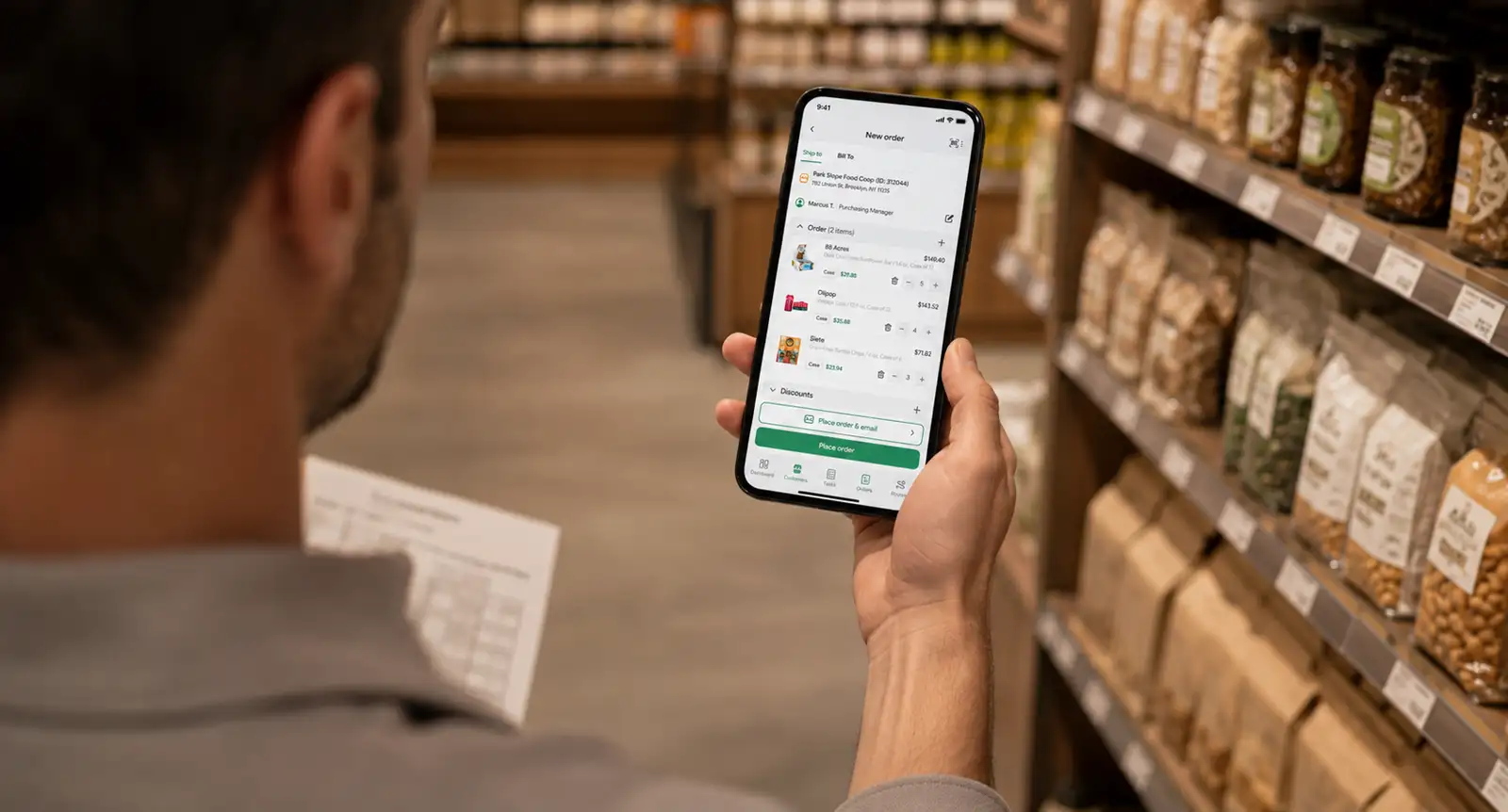
For brands and operators managing distribution on the ground, the operational layer adds up fast: routes to plan, accounts to track, orders captured in the field, inventory reconciled across stops, and field reps whose daily output has a direct line to revenue.
Distribution management software is built for exactly this layer. Choose a platform like SimplyDepo that integrates order management, route planning, field sales, and retail execution into a single platform. It offers QuickBooks integration, so back-office accounting stays in sync without manual reconciliation.
If coordination overhead is starting to slow you down as you scale, book a demo to see how SimplyDepo handles it.
FAQs on Wholesaler vs. Distributor
Not exactly. A wholesale distributor is a business that combines both functions: buying in bulk quantities from various manufacturers (often under some form of agreement) and reselling to retailers. The term is common in CPG and food service.
A pure distributor holds a formal exclusive territory agreement with a manufacturer and provides active sales and promotional support. A wholesale distributor may do less of that on some product lines, even if they operate like a full distributor on others.
Yes, and many are. A food and beverage operator might hold a formal distribution agreement for one brand while buying other products without any agreement and reselling them at wholesale. The two functions coexist inside the same business. What determines which function applies to a given product is whether there’s a formal contractual relationship with the manufacturer that includes territory, promotional obligations, or exclusivity.
The relationship with the manufacturer. Distributors generally enter formal contracts with manufacturers that define territory, volume commitments, and promotional responsibilities. A wholesaler buys inventory without an exclusive relationship and is free to stock competing brands alongside yours. The wholesaler serves the retailer; the distributor serves the manufacturer.
Both earn a margin between their purchase price and their resale price.
Distributors tend to command higher profit margins because of the value-added services they provide, including warehousing, dedicated field sales coverage, account management, and promotional execution.
Wholesalers are known for offering lower prices based on bulk purchasing power, operating on thinner margins with lower service overhead.
Neither model is inherently more profitable; it depends on volume, category, and operational efficiency.
When brand control, shelf placement, and territory development are important. Distributors offer promotional capability, rep coverage, and market-building that wholesalers don’t.
The trade-off is reduced flexibility: exclusive agreements limit the manufacturer’s ability to change partners or add channels quickly. If you’re a premium brand entering a new market and need someone who will actively sell your product, a distributor is usually the right call.
DSD, or direct store delivery, is a model where product moves directly from a distributor or manufacturer to the retail store, bypassing the wholesale tier. DSD operators typically hold manufacturer agreements and service their retail accounts directly via route sales reps on set schedules. It’s a distributor-led model at its core, designed for physical products that require frequent restocking or hands-on in-store service.
-
 October 20, 2026
 -
 October 20, 2026
 -
 October 20, 2026