Cross-Docking: How It Works and When Distributors Should Use It

📌 Key takeaways:
- Cross-docking moves products directly from inbound to outbound transport with little or no storage, helping distributors reduce inventory holding costs and speed up fulfillment.
- It works best for high-velocity, predictable-demand, or time-sensitive products where fast throughput creates a clear operational advantage.
- Success depends on synchronized scheduling, real-time inventory visibility, supplier reliability, and facility layouts designed for product flow rather than storage.
- Many distributors use a hybrid approach, applying cross-docking to fast-moving SKUs while relying on traditional warehousing for slower-moving or less predictable inventory.
Under a traditional warehousing model, it goes through receiving and putaway. Then it sits. Maybe a day, maybe three, until someone pulls it for a pick-pack-ship cycle.
By the time it reaches the retailer, the window for peak freshness is already narrowing.
Now picture that same pallet arriving, getting sorted on the dock within the hour, and rolling out on an outbound truck bound for three different retail stores before noon.
No waiting for a pick cycle, no storage time eating into product quality or margin.
That second scenario is cross-docking. For distributors running high-velocity or perishable product lines, it is one of the most effective logistics strategies available because it eliminates the hold-and-wait model entirely.
In this guide, we’ll go over how the cross-docking process works, the types of cross-docking, and how to decide whether it is the right fit for your operation.
What is cross-docking?
Cross-docking is a logistics process in which goods transfer directly from inbound to outbound transport at a distribution hub, with little or no long-term storage.
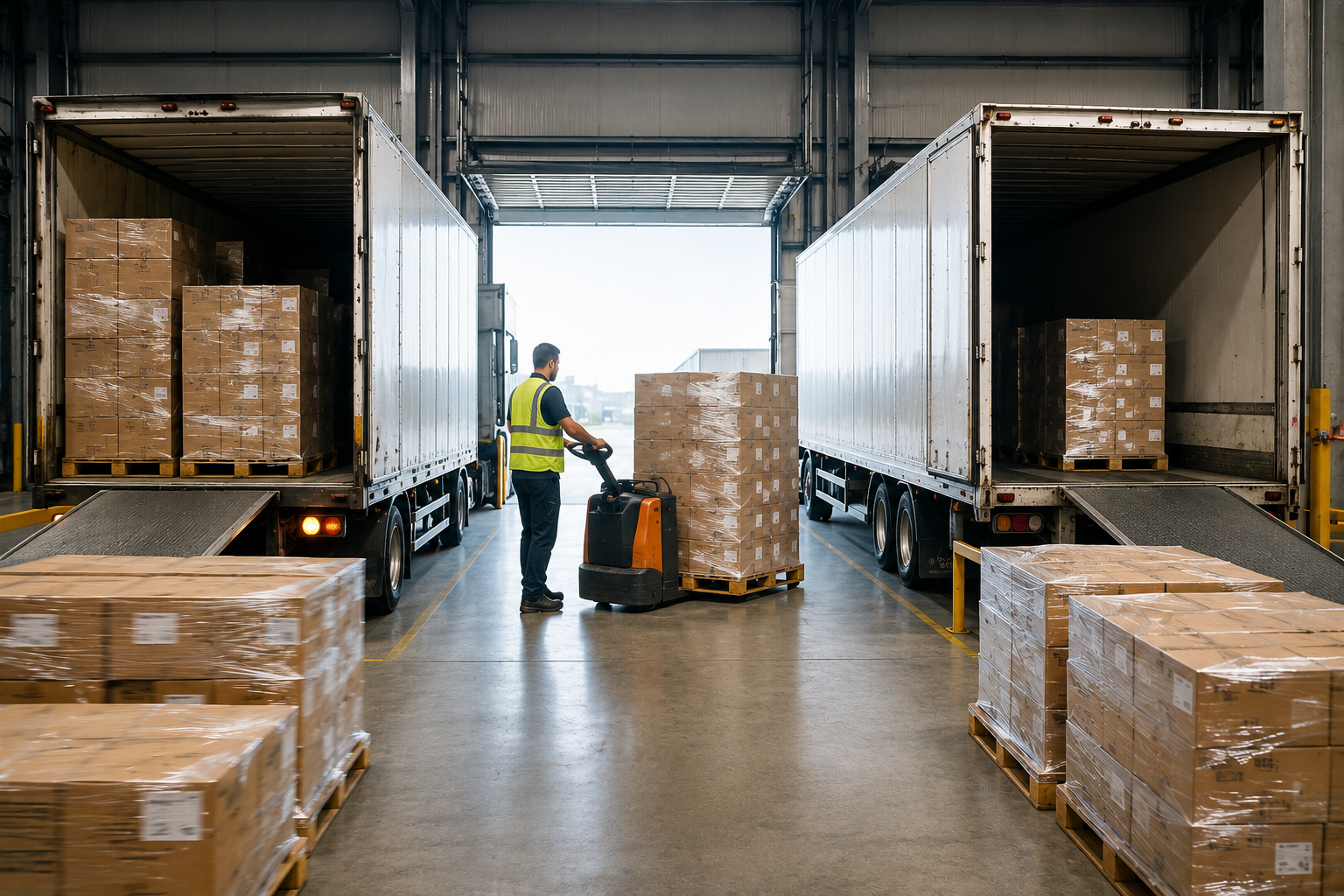
Instead of being placed into a warehouse, product arriving on inbound trucks is sorted at the dock and loaded directly onto outgoing vehicles, usually within 24 hours of arrival.
The name describes the mechanics: the product physically crosses the dock from the receiving side to the shipping side. Inbound dock doors on one end of the facility accept deliveries; outbound dock doors on the other end load departing trucks. The staging area between them is the only “storage” involved, and you have to measure it in hours, not days.
Cross-docking system was pioneered by the trucking industry in the 1930s and has since become a core logistics strategy across retail, food and beverage, CPG, and pharmaceutical distribution.
How does the cross-docking process work?
The mechanics of cross-docking have three sequential stages. Each one depends on the previous, which is why timing and coordination are fundamental to making the system work.
1. Receiving inbound shipments
Inbound trucks arrive at the cross-docking facility and back up to the inbound dock.
Workers unload the product immediately scan using barcodes or RFID, so the warehouse management system (WMS) knows what has arrived, in what quantity, and where it needs to go.
Incoming shipments may arrive pre-labeled by the supplier or may require identification at this stage. Speed here sets the pace for everything downstream.
2. Sorting and staging
Once received, workers sort products by destination, outbound route, or retail account.
In pre-distribution models, suppliers sort and label product before it leaves their facility, which means this step happens largely before arrival.
Whereas in post-distribution models, sorting happens on-site using current demand data pulled from the WMS.
Either way, the staging area holds product only long enough to coordinate outbound loading, measured in minutes to a few hours at most.
The staging area is not a storage area. Nothing gets a bin location or a pick list.
3. Loading outbound transport
Sorted product moves from the staging area to the outbound dock doors, typically by conveyor, forklift, or pallet jack.
Loads are consolidated by destination or delivery route, and outgoing trucks depart on pre-scheduled windows.
The entire inbound-to-outbound cycle, from the moment incoming and outgoing vehicles are coordinated to the moment outbound shipments roll, is completed within 24 hours.
What are the key types of cross-docking?
Not every cross-docking setup runs the same way. Distributors have several models to work with, each suited to different product types, supply chain structures, and levels of demand certainty.
1. Pre-distribution cross-docking
In pre-distribution cross-docking, suppliers pack product by destination and label each unit before it ever leaves their facility.
When the truck backs up to the inbound dock, the allocation work is already done. This produces the fastest throughput and the lowest handling overhead at the hub.
Pre-distribution works best when demand is known in advance and destination allocation is fixed; conditions that apply well to high-volume CPG routes and retail replenishment programs with stable order patterns.
2. Post-distribution cross-docking
Post-distribution cross-docking brings product into the cross-docking facility in bulk and sorts it on-site, using current demand signals to determine where each unit goes.
Allocation decisions happen closer to shipment time, which makes this model more flexible when order volumes fluctuate across retail accounts.
However, there’s a tradeoff: it requires more sortation capacity at the hub and a more capable WMS to handle the real-time decision-making.
Distributors managing multiple retail outlets with variable weekly orders tend to favor this approach.
3. Opportunistic cross-docking
Opportunistic cross-docking does not require a structural overhaul of the warehouse.
Instead, the WMS identifies that an incoming shipment matches an existing outbound order and, rather than putting the product away, routes it directly to the outbound dock.
It can happen within a conventional warehouse operation, making it a practical entry point for distributors seeking to capture cross-docking benefits without committing to a full facility redesign or a major upfront investment.
Cross-docking vs. traditional warehousing: What’s the difference?
The difference between the two models comes down to what happens to product after it arrives.
Traditional warehousing
Incoming shipments go through a full receive-putaway-store-pick-pack-ship cycle. Inventory can sit in storage space for days, weeks, or months depending on demand patterns.
Every additional handling touchpoint raises labor costs and the risk of damage.
The advantage is flexibility: a warehouse can absorb demand variability and serve as a buffer against supply chain disruption.
Cross-docking
Product flows through rather than sitting. That keeps inventory holding costs low and reduces the number of handling steps, which compresses lead times without adding complexity.
For fast-moving goods with consistent demand, this is a significant operational and financial advantage: speed and lower storage costs in exchange for the buffer that warehousing provides.
Running a hybrid model
The comparison is not binary. Many distributors use cross-docking for high-velocity SKUs and traditional warehousing for slower movers or products with irregular demand.
The right balance depends on product mix, order predictability, and the throughput volume that justifies the coordination overhead cross-docking requires.
| Point of differentiation | Cross-docking | Traditional warehousing |
|---|---|---|
| Storage time | Hours (generally under 24 hours) | Days to months |
| Inventory holding costs | Low | Higher |
| Handling touchpoints | Minimal | Multiple (receive, putaway, pick, pack, ship) |
| Best for | High-velocity, predictable demand | Variable demand, slow movers, seasonal stock |
| Flexibility | Lower | Higher |
| Lead time | Shorter | Longer |
| Setup complexity | Higher (scheduling, tech, facility) | Lower |
What Are the Benefits of Cross-docking for distributors?
Lower inventory carrying costs
For distributors, cross-docking eliminates the need for long-term storage, which removes a significant cost layer from distribution operations.
Warehouse space, labor for putaway and retrieval, shrinkage, and the risk of product obsolescence all decrease when inventory stops sitting.
Distributors handling perishable goods or time-sensitive goods find this helpful.
Storage costs are not just a budget line item; they are a freshness risk that compounds with every extra day a product spends in a warehouse.
💡 Did you know?
McKinsey reports that AI-enabled planning and inventory optimization can reduce inventory levels by 20-30%. The takeaway is simple: every improvement that reduces unnecessary inventory, whether through better planning or faster product flow, can unlock meaningful cost savings.
Faster order fulfillment
Compressing dwell time at the hub directly shortens the total time between supplier and shelf.
Product that arrives Tuesday morning and ships Tuesday afternoon reaches retail stores faster than product that sits in storage until Thursday.
For retail accounts running just-in-time replenishment programs, that speed is a competitive differentiator.
Cross-docking enables rapid delivery in ways that traditional warehousing cannot match, which is important as retail chains continue to tighten their replenishment windows.
Fewer handling touchpoints and better quality control
Each time workers unload, scan, put away, pick, pack, or load a product, they increase the risk of damage, mislabeling, or picking errors.
Cross-docking reduces handling time and the total number of steps the product goes through, thereby lowering damage rates and improving delivery accuracy.
Better inventory management of inbound flows also makes it easier to conduct quality control checks at the point of receiving, before product moves downstream to retail stores.
When cross-docking makes sense for distributors
Remember that cross-docking is not a universal upgrade. It creates real operational advantages under specific conditions and introduces real friction when those conditions are not in place.
Distribution networks are becoming more agile. Gartner found that 73% of companies have changed their supply chain networks in recent times to improve resilience and flexibility. With cross-docking, you can achieve the same goals by helping products move through the network faster.
Cross-docking works well when:
✅ Product velocity is high: Fast-moving SKUs with consistent demand are the natural fit. If a product turns over quickly and order patterns are predictable, the coordination investment pays off
✅ Goods are time-sensitive: Perishable food, beverages, and pharmaceutical products lose value with every day in storage. Cross-docking is built for exactly these categories
✅ Inbound shipments arrive pre-sorted: When suppliers can prepare store-ready or route-ready loads, the work at the hub is minimal and throughput is fast
✅ Demand and destinations are known: Cross-docking is most efficient when outbound allocation is clear before the truck arrives
✅ Volume justifies the infrastructure: Real-time visibility tools, scheduling coordination, and facility design all require investment. At sufficient throughput, that investment pays back through lower transportation costs, reduced labor costs, and faster fulfillment
Cross-docking doesn’t work well when:
❌ SKUs are slow-moving or seasonal with unpredictable demand
❌ The tech stack cannot support real-time inventory tracking and scheduling
❌ Supplier reliability is inconsistent, since delays in inbound shipments can disrupt the entire operation
❌ Volume is too low for the coordination overhead to be worthwhile
How Cross-docking works in CPG and beverage distribution
CPG distributors handling grocery, beverage, snack, and consumer goods categories are among the most natural candidates for cross-docking.
Product velocity is high, demand from retail stores is relatively consistent, and retailers increasingly expect tight replenishment windows that traditional warehousing struggles to deliver at scale.
Here’s how CPG distributors use cross-docking
- Post-distribution cross-docking is common in grocery and beverage consolidation operations, where a hub receives large shipments from multiple food producers and sorts them into store-specific or route-specific outbound loads
- Consolidation cross-docking reduces shipping costs by merging smaller loads into larger, fuller outbound shipments
- Deconsolidation cross-docking handles the reverse: large shipments divided into smaller loads for final destination delivery across a dispersed retail network
Role of technology
The coordination demands are real. Cross-docking creates intense pressure on logistics staff for immediate product sorting, and it requires precise scheduling of incoming and outgoing vehicles throughout the day. And that’s why, the right technology stack is essential.
Inventory management software gives distribution teams live visibility into stock levels across warehouses and routes, so inbound arrivals and outbound departures can be coordinated against accurate, real-time data rather than lagging spreadsheets or manual counts.
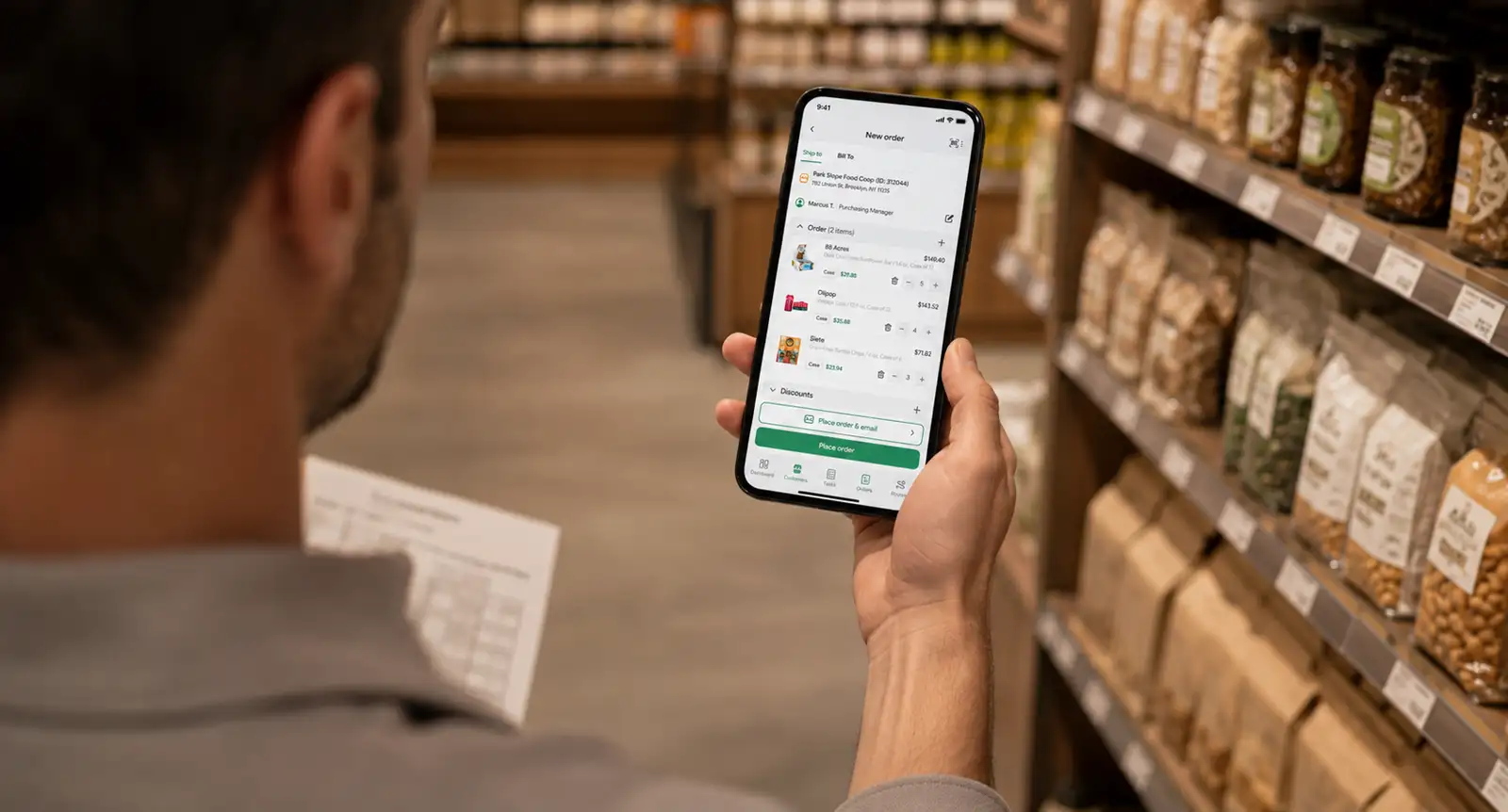
Distribution management software connects orders, routes, inventory, and field execution in one place, eliminating the scheduling gaps that cross-docking cannot afford.
A platform like SimplyDepo does both.
SimplyDepo gives warehouse operators and route managers a shared, real-time view of stock and orders.
As a result, sorting decisions are made faster, outbound loads are built accurately, and scheduling coordination happens in real time across warehouses, drivers, and field teams.
That visibility helps distributors maintain the speed and precision that make cross-docking effective.
If you’re a CPG and beverage distributor evaluating whether to implement cross-docking, getting the data infrastructure right is where preparation starts.
Prerequisites for cross-docking to work
The cross-docking benefits come with genuine operational prerequisites. Understanding what the system demands helps distributors assess readiness before committing.
Synchronized scheduling
Inbound and outbound windows must align. Outgoing trucks need to be staged and ready when inbound product finishes sorting.
If an outbound vehicle departs before the sort is complete, or if inbound delays push arrival times back, the flow breaks and product stacks up on the dock.
This requires precise coordination among multiple stakeholders: suppliers, carriers, and warehouse operators.
Cross-docking depends heavily on supplier reliability. One unreliable vendor can create bottlenecks that ripple across the entire supply chain.
Initial setup costs for this coordination infrastructure can also be substantial, which is worth factoring into any ROI assessment.
💡 Pro tip:
Track dock-to-dock time as a KPI. Measuring how long product spends between receiving and outbound loading helps identify delays before they turn into missed delivery windows.
Real-time visibility technology
Cross-docking relies on real-time data sharing between supply chain partners.
- Warehouse management systems (WMS) track product location and movement throughout the facility
- Transportation management systems (TMS) coordinate inbound and outbound schedules
- Barcode and RFID scanning capture product identity as it moves through the cross-dock warehouse
Without this layer of visibility, coordinators cannot track incoming shipments accurately, stage product correctly, or confirm outbound loads before trucks depart.
Miscommunication at any point can lead to lost inventory or incorrect shipments, and cross-docking offers limited flexibility for last-minute order changes once the sort has begun.
Physical facility design
Cross-dock facilities are designed around flow rather than storage.
Smaller and mid-sized operations typically use an I-shaped layout: inbound dock doors on one side, outbound dock doors on the opposite side, with a clear staging lane between them.
Larger facilities with 150 or more dock doors often use a T-shaped or X-shaped configuration to keep distant doors closer to the central flow and reduce internal travel time.
Product moves in one direction and does not backtrack.
Cross-docking places heavy pressure on physical layouts and loading docks; insufficient door capacity creates congestion that slows the entire operation.
Opportunistic cross-docking can work within existing warehouse layouts with fewer modifications, making it the most accessible starting point for operations that are not built for cross-docking.
Is cross-docking right for your distribution operation?
Cross-docking can reduce inventory carrying costs, shorten fulfillment times, and keep fast-moving products flowing through the supply chain with fewer delays.
But remember, those benefits depend on execution. Without reliable scheduling, real-time inventory visibility, and strong coordination between warehouses, carriers, and field teams, the model quickly loses efficiency.
For distributors handling high-volume, predictable-demand, or time-sensitive products, cross-docking can be a powerful way to improve speed and reduce operational overhead. The key is having systems that support the flow of inventory from arrival to delivery.
SimplyDepo helps distributors manage inventory, orders, routes, and field operations from a single platform, giving teams the visibility needed to support efficient cross-docking workflows. Book a demo to see how it fits into your distribution operation.
FAQs on cross-docking
Cross-docking is a logistics process where inbound shipments are transferred directly to outbound transport at a distribution hub with little or no storage time. It reduces inventory holding costs and lead times by removing the storage and handling steps that traditional warehousing requires. Cross-docking is particularly effective for high-velocity or time-sensitive goods.
Fast-moving goods with consistent demand and predictable destinations are the strongest fit: perishable foods, beverages, consumer packaged goods, and pharmaceutical products.
Traditional warehousing stores inventory through a receive-putaway-pick-pack-ship cycle, and product can sit for days or months. Cross-docking moves product directly through the dock without long-term storage. Warehousing offers flexibility for variable demand; cross-docking delivers speed and lower carrying costs for predictable, high-velocity product flows.
The baseline requirements are a warehouse management system (WMS) for inventory visibility and product tracking, barcode or RFID scanning for receiving and sorting, and a transportation management system (TMS) for scheduling inbound and outbound loads. Real-time data sharing between suppliers, the distribution hub, and carriers is essential. Cross-docking is too coordination-intensive to manage through manual processes.
Yes, with the right starting point. Opportunistic cross-docking, in which a WMS identifies an incoming shipment that matches an existing outbound order and bypasses putaway, operates within an existing warehouse layout without requiring major infrastructure changes. It’s the lowest-commitment entry point and allows smaller operations to capture some cross-docking benefits before committing to a purpose-built facility or full operational redesign.
-
 October 20, 2026
 -
 October 20, 2026
 -
 October 20, 2026