Inventory Management Services: Outsource vs. In-House


📌 Key takeaways:
- Outsourcing works best when you lack warehouse infrastructure or face sharp seasonal swings. A 3PL gives you ready-made capacity, but storage, handling, and fulfillment fees grow as order volume increases.
- In-house inventory management gives you more control as you scale. It makes more sense when you already have space and staff, especially if you need real-time visibility across locations, batches, expiry dates, or delivery routes.
- Compare both options using your actual costs and projected order volume. A breakeven calculation shows when the lower variable cost of running in-house begins to outweigh its higher upfront investment.
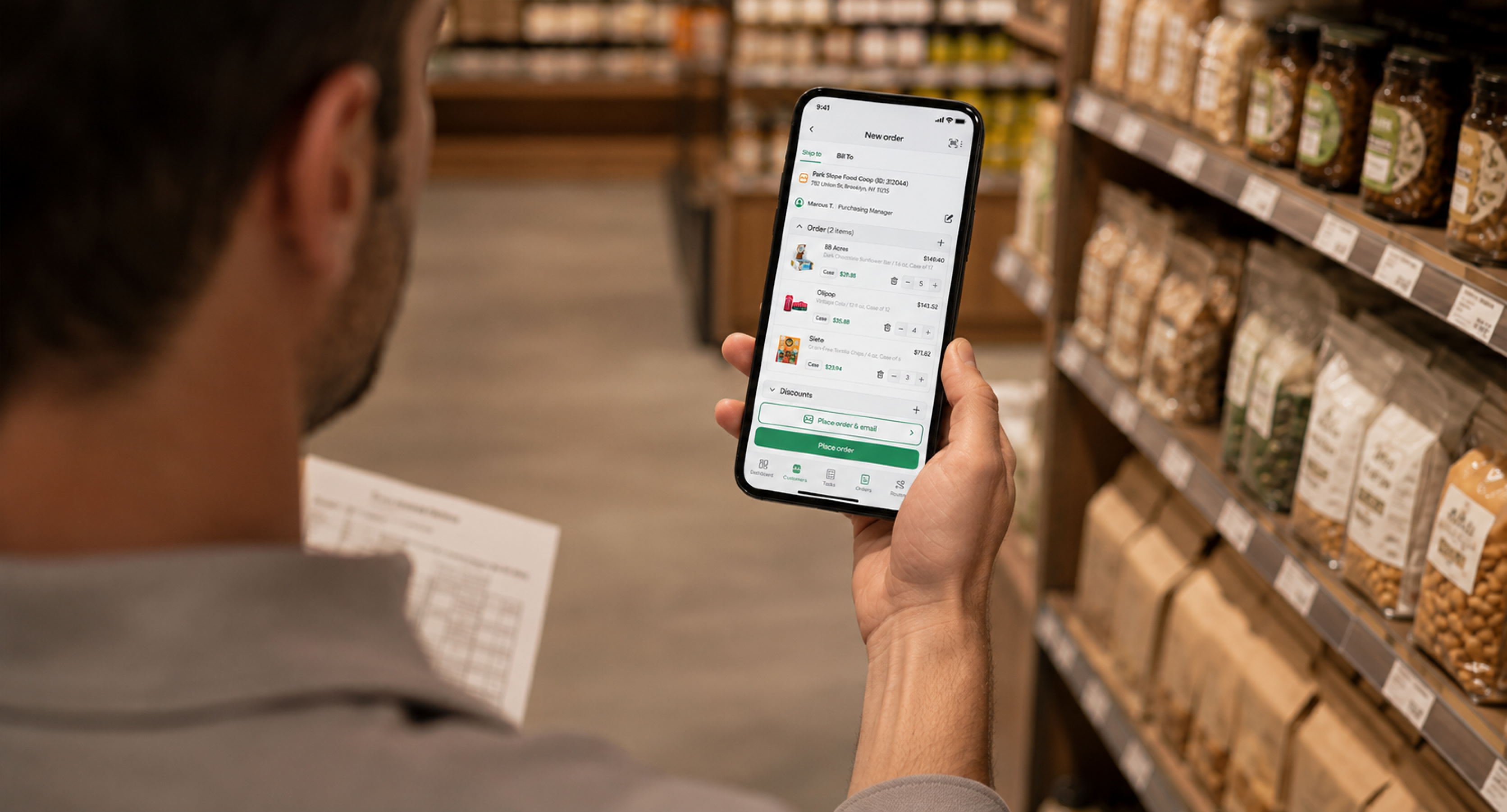
A rep stands in a store aisle, phone to their ear, asking the office a simple question: is this SKU in stock?
Nobody can answer with confidence. The warehouse count says one thing while the last order says another, and the truck already left an hour ago.
The real choice hiding behind that question is bigger than picking a vendor. It is whether to hand the whole problem to an outside provider or fix how the work runs internally. In this article, we’ll walk through both paths, what each one costs, and how to tell which fits your operation.
The stakes are pretty high. When a product is not on the shelf, the buyer moves to whoever has it in stock. For a distributor, the model you choose to manage inventory decides how often you hold the account or hand it to a competitor.
What do inventory management services include?
The phrase inventory management services means different things depending on who is selling it. Before you can decide anything, let’s separate the three models that all get filed under the same label.
1. Third-party logistics (3PL) providers
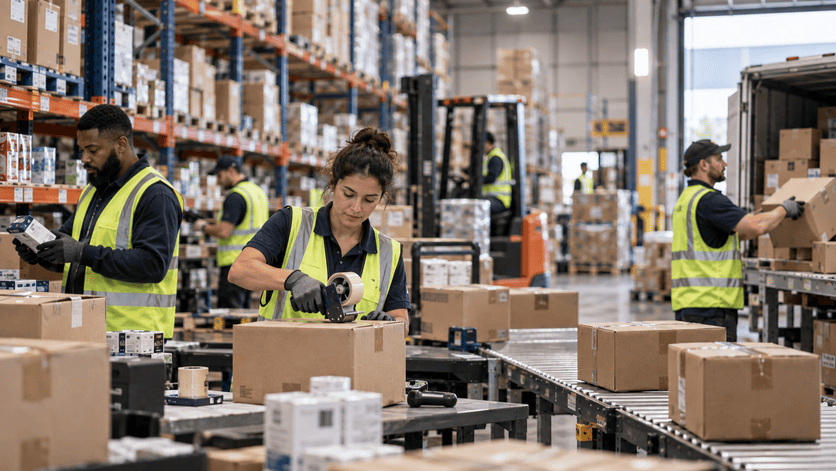
3PL companies physically hold your goods. They store products, handle order fulfillment, pick and pack shipments, and manage the flow of goods from your suppliers to your customers.
In this model your physical inventory lives in someone else’s warehouse. You pay for storage, labor, and handling, and fulfillment leaves your building completely. This is what people usually picture when they hear “inventory management company.”
2. Inventory consultants
Consultants improve your processes rather than run them. They may redesign warehouse layout, sharpen demand forecasting, or rework your inventory counts and cycle-count schedule.
What they usually do not provide is the day-to-day infrastructure. They hand you a better plan, then leave execution to your team and your existing systems.
3. Inventory management software
Software is the technology layer that lets your own people run operations with the discipline of a dedicated warehouse. Inventory management software handles inventory tracking, connects your sales channels to a single database, and keeps stock levels current across every location.
The choice comes down to two of these. Either a 3PL runs fulfillment for you, or software lets your own team run it, with consultants advising either way. That’s the comparison the rest of this article works through.
When does outsourcing inventory management make sense?
Handing operations to a provider is the right call in specific situations, not as a default. The clearest signal is that you lack the physical foundation and building it is not worth your time.
Signs you have outgrown do-it-yourself fulfillment
You have no warehouse space, no fulfillment staff, and no desire to become an expert in warehouse management and operations. A 3PL gives you that capability immediately, without a lease or a hiring spree.
Seasonal fluctuations are another trigger. When customer demand can triple during a peak window, a provider absorbs the spike so you are not paying for empty warehouse space the other ten months of the year.
What a 3PL takes off your plate
Outsourcing inventory management can significantly reduce operating costs for teams where logistics is not the core business. Storing inventory, managing logistics, and coordinating shipments all become someone else’s daily job.
That frees your leadership to focus on the product and the customer. If fulfillment was never your competitive edge, letting a specialist run it is a reasonable trade.
What are the hidden costs of outsourcing?
Outsourcing looks simpler on the surface, and often is at first. The catch is that its costs and constraints surface later, once you are already dependent on the arrangement.
Fees that scale with volume
A 3PL charges across several layers: storage, pick and pack, handling, and returns processing.
Each fee looks manageable on its own, but together they form a cost structure that grows in direct proportion to your order volume.
As your business grows, so does that bill, often faster than you projected. A rate that looks cheap at a hundred orders a month can be a serious expense at a thousand.
Reduced inventory visibility and control
When stock lives in someone else’s building, your inventory visibility is no longer immediate.
Updates lag and discrepancies take longer to investigate, and you end up working from a report rather than a live view.
Even small changes to how you operate can require provider coordination. Introducing batch tracking or adjusting a picking workflow becomes a negotiation instead of an internal decision.
Operational lock-in
Over time your processes bend to fit how the provider works, not how your business needs to evolve. What began as convenience can harden into dependency.
For companies running on thin margins or requiring tight control, that dependency is the real cost. You gave up the ability to change quickly, and you may not notice until you need it.
💡 Pro tip:
Ask a 3PL what happens when they make the mistake. Get their error rate on picks and their policy when an order ships wrong. A cheap per-order rate means little if you eat the cost of their mistakes in refunds and lost accounts.
When is it better to run inventory in-house?
For many small and mid-sized operations, the stronger long-term move is keeping the work internal while upgrading the tools that support it. This makes sense when the hard part is already handled and the real problem is the system around it.
When spreadsheets stop scaling
If your team relies on disconnected tools or a shared spreadsheet, the bottleneck is the lack of a structured inventory system.
Orders take longer, tracking inventory gets harder, and human error starts to compound. Poor demand forecasting leads to excess inventory on some shelves and stockouts on others, and both cost you.
A 3PL cannot fix a broken internal process; it just moves the process somewhere you can see even less of it.
Industries where control is non-negotiable
Some operations cannot afford to lose visibility. Food and beverage, wholesale, and distribution businesses need to track batch numbers, expiration dates, and stock movement across multiple locations with precision.
These workflows are difficult to outsource without giving up the accurate inventory data they depend on. When account-specific pricing and route-based selling are involved, the control has to stay in-house.
Protecting margins and cash flow
Outsourcing adds recurring fees that rise with volume. Upgrading your internal systems is largely a one-time investment that makes your existing operations more efficient.
Better stock management also frees working capital. Carrying too much inventory ties up cash, and automated inventory management improves cash flow by keeping stock closer to real demand.
The upside of doing this well is measurable. McKinsey found that distributors applying AI to demand forecasting can cut inventory levels by 20 to 30%, the kind of reduction that comes from a smarter internal system.
What in-house asks of you in return
The in-house path is not free of tradeoffs. You carry the upfront cost of software and setup, and someone on your team has to implement it and learn it.
You also keep the labor. The staff, the counts, and the day-to-day problems stay yours to manage, where a 3PL would have absorbed them.
The upside is that this effort compounds, while outsourcing fees keep recurring.
Outsource vs. in-house: A side-by-side comparison
No single model wins for everyone. The right answer depends on what you already own, how much control you need, and how fees behave as you grow.
The decision matrix
I’ve laid out the benefits and tradeoffs of outsource vs. in-house inventory management. Score your own operation against each row.
| Factor | Outsource to a 3PL | Run in-house with software |
|---|---|---|
| Upfront cost | Low, no capital outlay | Moderate, software plus setup |
| Cost as you scale | Rises with order volume | Cost per order falls with efficiency |
| Inventory visibility and control | Indirect, through provider dashboards | Direct, real-time, immediate |
| Speed to launch | Fast, infrastructure is ready | Slower, you implement and train |
| Flexibility to change workflows | Limited by the provider | Full, on your own terms |
| Best fit | No infrastructure, seasonal spikes, fulfillment not core | Own space and staff, need tight control, margin-sensitive, many locations |
Read the table by weight. If you own the warehouse and need control, the bottom rows in the right column outweigh upfront cost. If you have no infrastructure and unpredictable volume, outsourcing is the stronger fit.
How to calculate your 3PL vs. in-house breakeven point
Run both paths over the same window and see where they cross.
Every option has two kinds of cost:
- Fixed cost: Stays relatively stable as order volume changes. For in-house fulfillment, this can include software, warehouse space, equipment, and setup. A 3PL may also charge onboarding fees, monthly minimums, or platform fees
- Variable cost: Rises as your fulfillment activity grows. For a 3PL, this includes pick-and-pack and handling fees, while storage and returns may be priced separately. In-house, labor, packaging, and other fulfillment expenses rise as volume increases
The two paths can trade places as you grow. A 3PL puts more of your fulfillment spend into usage-based charges, so your total bill rises with activity. In-house requires more investment upfront, but the incremental cost of fulfilling each additional order can be lower.
The point where the two paths cost the same is your breakeven volume.
For a simplified comparison where the 3PL has no meaningful fixed costs:
Breakeven orders = in-house fixed cost ÷ (3PL variable cost per order − in-house variable cost per order)
Say running fulfillment in-house costs $5,000 a month before you ship an order. Each order then costs you $4 to fulfill, while your 3PL charges $9 per order.
Your breakeven volume would be:
$5,000 ÷ ($9 − $4) = 1,000 orders per month
At 1,000 orders, both options cost $9,000 a month. Above that volume, in-house starts to become cheaper under this cost model. Below it, the 3PL costs less.
Two things keep the math honest:
- Use your projected volume, not today’s. Run the numbers at the order volume you realistically expect over your planning window.
- Include costs that are easy to overlook. Setup and training belong on the in-house side. For a 3PL, account for onboarding, monthly minimums, storage, surcharges, and exit fees where applicable.
Real fulfillment costs will not always move in a straight line. A 3PL may lower its per-order rate at higher volumes, while an in-house operation may suddenly need another employee or more warehouse space.
Use the breakeven point as a benchmark, then test the numbers at a few realistic order volumes before you commit.
Is a hybrid model the right answer?
You can choose to not pick a single lane. A blended approach is common, and for some businesses it is the only sensible one.
The typical split sends part of the work outside and keeps the rest in. For instance, a brand might use a 3PL for national e-commerce order fulfillment while running local delivery and direct-store-delivery routes on its own team.
Distribution and consumer-goods operators land here often, because route-based selling and account-specific pricing strategy resist outsourcing while overflow fulfillment does not. You keep the high-control work close and hand off the commodity work.
What makes a hybrid work is a single source of truth. Field, warehouse, and finance all need to see the same real-time inventory tracking, no matter who physically holds the stock. Without that shared view, the split just doubles your blind spots.
For distribution teams, distribution management software coordinates stock, routes, pricing, and orders across territories from one system.
How do you decide? A short scorecard
Answer these five quickly and honestly, then see where the weight falls.
- Do you already own warehouse space and staff? If yes, in-house leans ahead, because you have already paid the biggest fixed cost.
- Is fulfillment a core differentiator for you? If no, outsourcing that work is easier to justify.
- Are your volumes steady or spiky? Steady favors an in-house system with predictable cost per order; sharp seasonal swings favor a provider’s elastic capacity.
- Do you need batch, expiry, multi-location, or route-level control? If yes, in-house or hybrid protects the visibility you cannot afford to lose.
- Are your margins thin enough that volume-scaling fees would hurt? If yes, the in-house or hybrid path guards your unit economics as you grow.
Tally the answers. For a lot of growing distributors, the honest result is not a clean win for either side, but a hybrid with one system holding it together.
So, which inventory management approach wins?
Outsourcing buys convenience at the price of control and rising fees. Running the work in-house buys control and better economics as you scale, if your team has the right tools.
A hybrid needs one real-time system so every part of the operation reads from the same numbers.
Whichever path you choose, the deciding factor is whether you have inventory management software that keeps stock accurate and visible across warehouses, routes, and customer locations at the same moment.
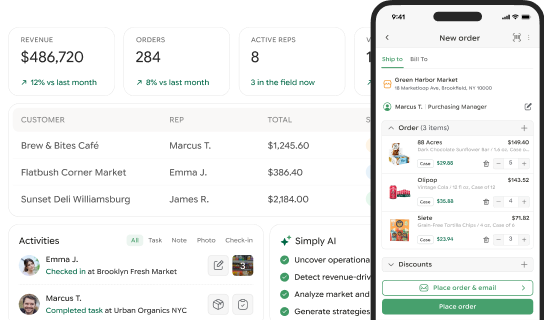
This is where SimplyDepo fits for distribution and consumer-goods teams. It unifies stock control, order processing, route planning, and field execution in one platform, with real-time multi-location visibility, QuickBooks sync, offline mobile access, and account-specific pricing built in.
Automated reorder triggers fire purchase orders when stock hits a set threshold, so field and warehouse teams work from live data.
Whether you outsource, insource, or blend the two, it starts with knowing exactly what you have and where it is.
Book a free demo to see how SimplyDepo can support your inventory management system.
FAQs on inventory management services
Inventory management services fall into three models. A 3PL physically stores and ships your goods, a consultant redesigns your processes, and inventory management software gives your own team the tools to run operations in-house.
A 3PL runs fulfillment for you, holding your stock and shipping orders from its own warehouse. Inventory management software keeps the work in-house and gives your team real-time control over stock levels, order fulfillment, and reporting. One outsources the operation; the other equips you to run it yourself.
Yes, and many operators do. In the hybrid model, you can send national e-commerce fulfillment to a 3PL while keeping local delivery, route-based selling, or high-control SKUs in-house. It works best when a single real-time system keeps warehouse, field, and finance aligned regardless of who holds the stock.
When manual entry, stockouts, and reconciliation errors start costing you orders and margin. If your team spends hours reconciling counts or reps cannot see live stock levels, the spreadsheet has become the bottleneck. That is the point to move to a structured inventory system like SimplyDepo.
Outsource when you have no warehouse or staff, face sharp seasonal spikes, and treat fulfillment as a cost rather than a differentiator. Choose software when you already own the space, need tight control over multi-location or route-based stock, and want cost per order to fall as you scale.
Move in stages. Bring your highest-control products in first, such as batch-tracked or account-priced SKUs, and run them on your own system while the 3PL still handles overflow. Once your team is comfortable and the data is accurate, expand the in-house share on your own timeline.
 Rated 4.7 on G2
Stockouts and overstock are costing you more than you think.
-
 September 16, 2026
 -
 September 15, 2026
 -
 September 15, 2026