What Is a Sales Territory? Definition, Design, and Examples


📌 Key takeaways:
- A sales territory is an ownership boundary. The territory decides which accounts belong to a rep and how often each one gets seen, while the route only decides in which order the stops happen in that week.
- Account count is the weakest way to balance a territory. Opportunity, workload, drive time, and data quality all weigh more, and two territories holding the same number of accounts each can differ by hours of work per week.
- The right number of accounts is a calculation, not a benchmark. Work back from selling hours, drive time, average visit length, and required visit frequency, then build to roughly 85 percent of that ceiling so there’s room to absorb new accounts.
You’ve had this conversation. A rep tells you their territory is impossible, and you’re not sure whether that’s true or whether they are having a bad quarter.
It’s a hard thing to check. Account counts look similar across the team, activity data shows everyone visiting stores, and the rep who is struggling is not obviously doing less than the rep who is hitting the numbers.
Since you don’t have an obvious datapoint, the issue stays unresolved. But there’s an easy way to fix it.
It starts with being precise about what a sales territory is. Figure out what it is meant to balance and how many accounts one rep can carry before the coverage promise is too big to deliver. Often enough, the rep is right.
What is a sales territory?
A sales territory is a defined market segment that one sales rep or team is responsible for selling to and servicing. The segment can be drawn on geography, on industry, on customer type, or on a named list of accounts.
Picking which factor to draw the territories on is the first major step in sales territory design.
What a sales territory contains
Underneath the definition, a territory bundles three separate commitments.
- The first is a boundary rule, which decides whether any given account belongs here or somewhere else.
- The second is an owner, who carries responsibility for revenue and customer relationships within it.
- The third is a coverage promise about how often those accounts get attention.
The boundary rule weighs more than the boundary itself. When you draw a boundary once, it is a snapshot of the accounts you had that day, whereas a rule like “every independent grocer inside these ZIP codes” keeps sorting new accounts into the right territory as they appear.
💡 Pro tip:
Write your boundary rule as a single sentence before you draw anything. If you cannot state it in one line, new accounts will get assigned by whoever picks up the phone first.
Designing those rules and measuring what comes back is the ongoing part of territory management.
What sales territories are for
Clear ownership is the point. Almost everything else follows from it.
When every account has exactly one owner, two sales reps stop competing internally for the same buyer. Market coverage improves as well, since accounts stop falling through the cracks due to miscommunication. Workloads get balanced deliberately across sales representatives, instead of piling up wherever the last reorganization left them.
Territories also make performance legible. A quota only means something when you know what opportunity sits behind it, and clear territory boundaries make one rep’s number comparable to another’s. Without them, rep performance reads as individual effort when it’s often just territory luck.
A rep who sees the same buyers repeatedly also develops real depth in that market, which is hard to fake and harder to replace. All of it depends on one factor: territories should reflect current customer needs and business priorities rather than last year’s org chart.
Sales territory vs. region, route, and account list
Sales leaders and sales managers use these four words interchangeably, and the confusion costs money, because each one answers a different operational question.
| Object | Answers the question | Changes how often | Owned by |
|---|---|---|---|
| Region | What part of the map is this? | Rarely, tied to org structure | A manager or director |
| Territory | Which accounts are whose? | Quarterly to annually | One rep or team |
| Account list | Who is in the territory right now? | Continuously, in the CRM | The rep, in the system of record |
| Route | In what order do I visit them this week? | Weekly or daily | The rep, within the territory |
A rep can redraw a route on Monday morning without asking anyone, but they cannot redraw a territory. Confuse the two, and you get complaints that the “territories are broken” when the real problem is that Tuesday’s route is inefficient.
What are the main types of sales territories?
Before you pick a structure, ask what makes your accounts different from each other. If a corner store and a regional chain buy in completely different ways, that difference should shape the split more than location does.
Five structures cover almost every team, and each one breaks in its own way.
1. Geographic territories
The boundary rule is location: ZIP codes, counties, metro areas, or custom-drawn shapes. This is the default for any team that has to physically arrive at the account, and it’s the most common structure in field sales.
Its failure mode is subtle. Equal-area territories are almost never equal-workload territories once density and drive time enter the calculation. When you have unbalanced territories, it triggers frustration and rep turnover long before anyone figures out the design problem.
2. Industry and channel territories
Here, you split by what kind of buyer the account is. In B2B, that means verticals like healthcare or finance. In distribution, it means independents, regional chains, and foodservice.
Industry-based territories fit when the selling motion differs sharply between segments, since pitching a chain buyer has almost nothing in common with pitching an independent store owner. Reps build sector fluency, which is the mechanism behind the higher conversion rates this structure tends to produce. This structure fails when accounts outgrow their category.
3. Customer-type territories
This one splits by company size or lifecycle stage: SMB, mid-market, enterprise accounts, or new business against current customers. This fits organizations whose customer segments buy in different ways, where a junior rep can work volume while a senior rep works complexity.
The failure mode is the cutoff. Thresholds are arbitrary, so they get argued over every planning cycle, and accounts near the line end up with nobody.
4. Product-line territories
The boundary rule shifts to what is being sold rather than who is buying, which suits portfolios where product lines demand unique technical or category knowledge. A rep who sells one line all day gets sharper on it than a generalist ever will.
The failure mode is scheduling collisions. Two reps from the same company land on the same buyer’s calendar in the same week, and the buyer wonders whether anyone there talks to each other.
5. Named and strategic account territories
Some accounts get assigned by name, regardless of location or type. These are the high-value accounts whose revenue justifies dedicated attention. In enterprise sales, that’s the Fortune 500 model, and in distribution, it’s the national chains.
The obvious risk is concentration. The quieter one is forgetting to lower the quota on the territory you just took the account from.
In practice, you’ll land on a hybrid. Named accounts come out first, geography sits underneath, and a channel split goes on top where the selling motion calls for it. Apply those layers in the same order every time, and the model will work for you.
What makes a sales territory well designed?
Teams usually split territories by account count because it’s the easiest number to balance. It’s also the least useful one.
Four inputs matter more, and getting them right pays. Territory optimization drives 10 to 20 percent growth without adding headcount, and the four below are the main factors.
1. Opportunity, not account count
Two territories holding 60 accounts each can carry wildly different revenue potential. Balance on addressable revenue instead, built from historical sales data and market data rather than headcounts. Total addressable market by territory is another metric that makes a quota defensible when a rep pushes back on it.
2. Workload, including the visits nobody counts
Service time varies enormously by account type. A chain reset might take an afternoon while an independent reorder takes 15-20 minutes, so two territories with the same account count can differ by hours per week.
Sales cycle length belongs here as well. A territory weighted toward long-cycle accounts eats rep time for months before it shows anything in pipeline coverage.
💡 Pro tip:
Time 20 real visits before you set your service time average. Reps tend to underestimate chain work and overestimate independent stops, and a guessed average skews every territory built on it.
3. Drive time and account density
Inside sales teams can ignore this one, but field teams can’t.
Two territories can look identical on a map and be nothing alike in practice. A river with one bridge or a downtown where parking costs fifteen minutes a stop…reps have to accommodate factors beyond the data sheets, so you should measure drive time, not distance.
4. Data quality and rep fit
Poor customer data produces poor territory assignments, and no amount of advanced planning can survive a stale CRM. Clean the account records before you draw anything.
Then assign complexity to experience, not seniority. Your best rep should get the hardest accounts, which isn’t always the same thing as the biggest ones.
One more thing: if comp doesn’t follow the territory design, reps will work around it. A rep paid on total volume will chase whatever closes fastest, wherever it sits.
How many accounts should a sales territory have?
Nobody can answer this for you without knowing how often your accounts need visiting. But you can work it out in about ten minutes with numbers you already have.
- Start with selling hours per week. Take the working week and subtract admin, meetings, and reporting.
- Subtract drive time. Use what your reps actually log, not what the map suggests.
- Divide by average visit length. That gives you visits per week.
- Multiply by the weeks in your call cycle. Now you have total visit slots.
- Divide the slots across your account tiers, based on how often each tier needs seeing.
Say a rep has 30 selling hours and loses 8 to driving, leaving 22. At 45 minutes a visit, that’s 29 visits a week, or 116 slots across a four-week cycle. Here’s what that buys:
| Tier | Visit frequency | Slots per account | Accounts | Slots used |
|---|---|---|---|---|
| A | Weekly | 4 | 10 | 40 |
| B | Every two weeks | 2 | 20 | 40 |
| C | Monthly | 1 | 36 | 36 |
| Total | – | – | 66 | 116 |
So this rep can carry 66 accounts. Visit frequency moves this number more than anything else, since making every account weekly drops the same rep to 29.
Build to about 85% of whatever your number comes out to. A territory packed to capacity has nowhere to put new accounts. It also means that when a rep quits, the reps covering for them have no room to absorb the extra stops.
💡 Also read:
AI Route Planning for Field Sales: How Smart Algorithms Cut Drive Time and Increase Revenue
Sales territory examples
Let’s look at some worked examples, each using a different boundary rule, with the numbers visible.
A geographic territory for a regional beverage brand
One rep covers a metro cluster of about 70 accounts, split between independent grocers and convenience stores. The top 12 accounts get a weekly visit, the middle 24 get biweekly, and the tail gets monthly.
The interesting decision was the eastern edge. On paper the natural boundary was the county line, which would have added 15 accounts, but those accounts sat across a highway costing 40 minutes each way in afternoon traffic. The boundary follows the highway instead. Territory mapping software surfaces that kind of decision, and a ZIP code list hides it.
A channel territory for a snack brand
Two reps work the same city under different boundary rules. One owns four regional chain headquarters. The other owns 120 independents.
Four accounts against 120 looks indefensible until you count what sits behind each chain decision: a category review cycle, a promotional calendar, and 60 to 90 individual stores where the planogram either gets executed or does not. Count stores rather than headquarters, and the chain rep is covering closer to 300 than four.
A named account carved out of a geographic territory
A regional grocery chain grows past the point where a field rep can serve it, so it becomes a named account under a key account manager. The carve-out is straightforward. The adjustment is where teams get sloppy.
Two things have to move with it. The field rep’s quota comes down by the volume that just left, and someone still has to service the shelf in those stores weekly, which usually stays the field rep’s job.
Skip either step and you have created a rep measured on revenue they no longer control. Aligning territories to a shifting go-to-market strategy means adjusting the surrounding structure, not just moving the account.
Bring territory design into practice
Go back to the rep from the opening, the one telling you their territory is impossible. The answer was sitting in the territory sheet the whole time, visible to anyone who compared drive time and account mix instead of visit counts.
Spreadsheets hold up until they don’t. Once you’re tracking assignments, call cycles, and coverage across a dozen reps, the version in someone’s Downloads folder stops matching reality. A route planning software keeps the assignment rule and the visit schedule in one place, so a change to either shows up in both.
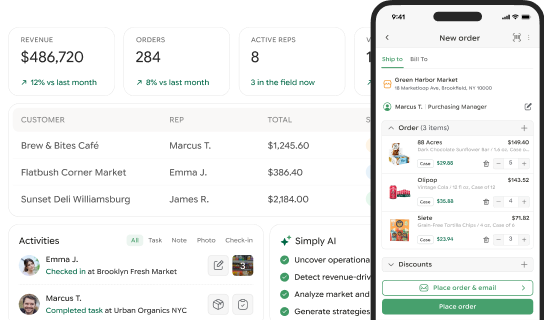
SimplyDepo is one such software built for CPG and distribution. Managers build optimized routes, assign visits, and track retail execution in real time across territories.
Visit prioritization ranks accounts by sales performance, visit history, and growth signals, so a rep’s day reflects the coverage promise rather than convenience. Reps capture orders and log activity from the mobile app online or offline, which keeps territory performance data accurate enough to redesign against next quarter.
Schedule a demo today and see how SimplyDepo can help you with territories.
FAQs on sales territory
A beverage rep who owns every independent grocer and convenience store inside four ZIP codes has a geographic sales territory. The boundary is location, the rep owns those accounts, and each one sits on a set visit cadence. That single assignment is what gives the wider sales organization predictable sales coverage.
Geographic, industry or channel, and customer type are the three you will see most often. Product-line and named-account territories exist too, and hybrids are common once you start assigning territories at scale. The right structure depends on what varies most across your accounts, so this is a sales strategy decision and not just geography.
Each rep gets a defined set of accounts and a visit cadence, then works that book against a quota tied to its revenue potential. Sales territory management keeps the assignments current as accounts grow or churn. Done well, it balances sales efforts across multiple reps and makes rep performance comparable.
Start with territory data on revenue potential, workload, and drive time, then build sales territories against those inputs rather than account count. A data driven plan protects fair distribution and leaves room for new leads. Automated territory planning shortens the cycle, and regular reviews catch imbalances early.
Balance on opportunity and workload rather than account count, since two territories with the same number of accounts can differ by hours of work each week. Weigh revenue potential, service time, and drive time together. Fair distribution is what keeps reps from treating the plan as a sales investment made against them.
Review quarterly and redraw far less often. A review checks whether workloads have drifted and whether coverage still matches your sales goals, which takes an afternoon. Redrawing disrupts customer relationships and resets quota, so it should follow a real trigger like a new rep or a channel your rule has no category for.
 Rated 4.7 on G2
Stop leaving revenue on the table between territories.
-
 September 16, 2026
 -
 September 15, 2026
 -
 September 15, 2026