Cycle Counting: Smarter Alternative to Physical Inventory Counts


📌 Key takeaways:
- Cycle counting replaces annual warehouse shutdowns with smaller, scheduled counts that help teams catch inventory errors throughout the year.
- Real-time inventory tools make cycle counting easier to scale by syncing warehouse, field, and reorder data in one system.
Every warehouse has a version of the same ritual. Once a year, operations grind to a halt. Reps stop selling, docks stop moving, and everyone in the building spends a weekend clutching a clipboard and squinting at bin labels.
By Monday the numbers are reconciled and the books are closed, and nobody looks at a shelf again until the next annual shutdown.
The problem is that inventory does not wait twelve months to drift. A miscounted case here, a returned unit never logged there, a pick pulled from the wrong slot, and within weeks the number in the system stops matching the number on the shelf.
The annual count catches all of it at once, long after the damage is done, and tells you nothing about which day it started.
Cycle counting flips the arithmetic. Instead of counting everything once a year, you count a little bit every day, all year long, and you catch problems on a 30-day cycle instead of a 365-day one.
In this article, we’ll cover how it works, the methods worth using, how often to count, and how to build a program that keeps your books honest without ever shutting the warehouse down.
What is cycle counting in inventory management?
Cycle counting is a perpetual auditing method where you count a small, specific subset of your inventory on a rolling schedule, then repeat, so that over a set period every item gets counted at least once without a full stock freeze.
It sits opposite the physical inventory count, where a business halts operations to count every item at once.
The point is not to count less. It is to count smarter. By focusing on a handful of items at a time, cycle counting stays out of the way of daily fulfillment.
At the same time, it surfaces errors that silently erode inventory accuracy: shrinkage, data entry mistakes, misplaced stock, and picking errors that would otherwise compound until year-end.
Why the annual count alone is not enough
An annual count gives you one accurate snapshot per year and eleven months of decay. The moment counting stops, the records start drifting again, and you have no visibility into that drift until the next shutdown.
Cycle counting turns auditing into a continuous feedback loop.
Daily cycle counts help catch inventory errors sooner than quarterly or annual inventory counts. Finding a variance in a bin this week means you can trace it to a receiving error, a mislabeled slot, or a rep who pulled stock without logging it, while the trail is still warm.
How does cycle counting work?
You divide your inventory into groups, assign a counting frequency to each group, and count a small set of items every working day. It helps you use limited counting resources where they have the highest impact.
The real work is in the setup. You need to decide which items should be counted more often, how items will be selected each day, and what your team should do when the physical count doesn’t match the system record.
When these rules are clear, cycle counting becomes a repeatable process instead of a one-off stock check.
Grouping and frequency
Not every item deserves the same attention. High value items that move weekly carry far more risk than a slow box of packaging inserts that has not moved since spring. Counting them at the same cadence wastes effort on the wrong stock.
So you sort inventory items into tiers and count the high-risk tiers more often.
A high-priority group might get counted monthly, a mid-tier group quarterly, and the long tail once or twice a year. The counting labor stays roughly constant week to week, but it lands where errors actually happen.
Counting and reconciling
Each counting day, a worker counts the assigned items, records the physical quantity, and compares it to the system quantity.
A match confirms accuracy. A mismatch, or inventory variance, triggers a reconciliation, and tracing it means walking back the inventory transactions that touched the item since its last count.
Strong cycle counting programs set a variance threshold so small that expected differences do not turn into full investigations.
Any variance above that threshold should trigger a root-cause check. The team should freeze the bin, recount the item, trace where the number went wrong, and only then adjust the system record.
What are the main cycle counting methods?
There are several ways to decide which items to count and how often. The inventory cycle counting methods that are key for most distribution and CPG operations are ABC analysis, control group cycle counting, random sample cycle counting, and usage-based counting.
You can run them alone or blend them into one inventory management strategy.
Each method answers the same question differently: where is the risk concentrated, and how do we point counting effort at it?
1. ABC analysis (the Pareto method)
ABC analysis, sometimes called the ABC counting method, is the most widely used method, and the most powerful for a catalog with uneven value or velocity. It is based on the Pareto Principle, which suggests that roughly 80% of outcomes stem from 20% of causes.
Applied to inventory, this cycle counting process splits items into three classes:
- “A” items represent roughly 20% of parts tied to about 80% of sales
- “B” items account for the next tier
- “C” items make up the long tail of low-impact stock
A-items get counted most frequently, C-items least.
The weakness of ABC analysis is that low-value items can drift for months between counts, and a cheap component that stocks out can still stall an entire order. A blended program guards against that.
2. Control group counting
Control group counting is how you test the process before betting the warehouse on it. You pick a small set of items and count them repeatedly over a short window until the process runs clean.
A shoe retailer, for example, might test control group counting on an area it is confident is accurate, and once the process works well there, apply it to the entire warehouse.
Think of it as a way to validate counting procedures and train staff before scaling.
3. Usage-based counting
Usage-based counting keys on movement. Items that get picked, replenished, returned the most, get counted more often. The logic is simple: every inventory transaction creates a chance for an error.
High-usage cycle counting is the sharpest version, focusing on the frequently sold items that move fastest.
A lighter variant counts items at natural checkpoints, such as when a SKU hits its reorder point or a picker empties a bin, so the count happens without a separate trip.
4. Random sample and diminished population counting
Random sample cycle counting selects inventory items at random on each counting day.
It gives an unbiased read on inventory accuracy without the setup that ABC classification demands.
Diminished population counting refines the random approach. Once an item has been counted, it drops out of the pool until every item in the group has been counted, then the population resets. It guarantees full coverage over the cycle and stops the same handful of items from being counted repeatedly while others are skipped.
Here is how the methods compare at a glance:
| Method | How items are selected | Best for | Watch out for |
|---|---|---|---|
| ABC analysis | By value or sales velocity, split into A/B/C tiers | Catalogs with uneven value or demand | Low-value items drifting between rare counts |
| Control group | A fixed small set counted repeatedly | Testing and refining the process before scaling | Not a standalone long-term method |
| Usage-based | By transaction frequency | High-turnover operations | Slow movers getting ignored |
| Random sample | Items chosen at random each count | An unbiased accuracy read with minimal setup | No priority weighting toward high value |
| Diminished population | Random, but counted items drop out until the group resets | Guaranteeing full coverage over the cycle | Slightly more tracking overhead |
How do you set cycle counting frequency?
A common starting point is to count A-items monthly, B-items quarterly, and C-items once or twice a year. Treat this as a baseline, not a fixed rule. The right frequency depends on how often errors show up in your own inventory data.
For example, say you have a 2,000-SKU catalog and use a quarterly ABC cycle counting schedule. A-class items may be counted every four weeks, which means each item is checked about 13 times a year. B-class items may be counted four to six times a year, while C-class items may be counted once or twice. The warehouse keeps running throughout because only a small set of items is counted each day.
The main benefit is a shorter detection window. Instead of finding a variance during an annual physical count, you may catch it within 30 days. That makes it easier to trace the issue back to a receiving error, file a dispute with a 3PL, or fix an incorrect bin location before the next sales peak.
Let variance tune the schedule
Cycle counting frequency should change as your data changes. If one item group keeps coming back accurately, you can count it less often. If a zone keeps showing variances, count it more often.
Track error rates by product type, warehouse zone, shift, or process step. Patterns in those discrepancies can point to theft, receiving mistakes, picking errors, or weak handoffs between teams. That turns cycle counting into a diagnostic tool, not just a counting routine.
Why does cycle counting beat a full physical count?
1. The warehouse keeps running
A full physical inventory count means a shutdown and lost selling time, often with overtime piled on to get through it.
Cycle counting spreads the same work across the year in slivers small enough to absorb into a normal shift, so your inventory management system never has to go dark.
2. Speed of detection
A yearly count finds a problem up to twelve months after it started. Whereas a cycle count finds it within the item’s counting window, close enough to the source to still fix the cause, whether it is theft, damage, or human error.
3. Accuracy over time
Continuous counting holds records near-accurate all year instead of spiking once and decaying from there.
The true cost of inaccuracy is not the count itself; it’s what bad numbers do downstream.
The downstream cost of inaccurate records
Bad inventory data does not stay contained.
Units present on your books but not physically on the shelf get amplified in your order cycle, so the safety stock you think you have could be inaccurate. And you could oversell products you believed were in stock, leading to backorders.
Shrinkage compounds the same way. When the count comes back short of the record, the difference is inventory lost to theft, damage, or paperwork error.
The cost adds up: the National Retail Federation’s most recent security survey put average shrink at 1.6% of sales, or $112.1 billion across the industry. Cycle counting catches that leak while it is still small.
Distribution operations tend to lose accuracy because of delayed reorder triggers that do not reflect real-time depletion, disconnected field sales data that leaves warehouse teams blind to demand, and reliance on periodic counts instead of continuous tracking.
How do you build a cycle counting program?
Start small, prove it works, then scale. A control group is the natural first step: count a handful of items daily until the process and the people counting are reliable.
From there, classify the full catalog with ABC analysis, assign frequencies, and build a rolling daily schedule so coverage is even.
Cycle counting best practices you must follow
1. Keep count sessions short, blind, and controlled
Count in small, manageable groups rather than large batches, since fatigue is where miscounts creep in. Keep counting and recording as separate duties so the person counting cannot adjust the book, and use blind counts, where the counter cannot see the expected number, to strip out confirmation bias.
2. Use technology to remove data-entry errors
Lean on technology to cut human error. Barcode scanners and mobile counting devices feed counts straight into the inventory management platform, removing the manual data entry step where a transposed digit can corrupt inventory records. A warehouse inventory management system that supports scheduled counts keeps the whole cycle count system running on rails.
3. Stick to a regular counting cadence
Schedule counts regularly and keep the cadence consistent. Frequent counts on the right items catch inventory discrepancies sooner, hold inventory cost down, and keep stock levels trustworthy across multiple locations.
Turn cycle counting into a repeatable inventory workflow
Manual cycle counting can work when your inventory is small. But it starts to strain when you are tracking thousands of SKUs across warehouses, delivery vehicles, and field reps who move stock the office cannot always see.
Spreadsheets make that harder. They lag behind real stock movement, and that lag is where errors hide.
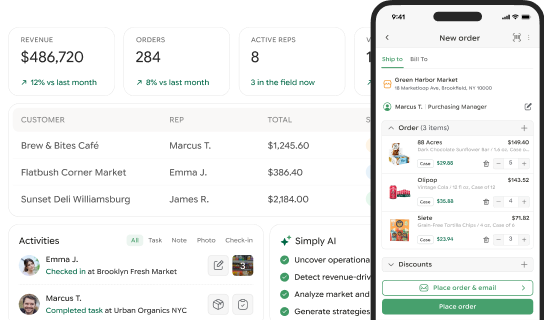
This is where inventory management software becomes useful. The right system gives your team a live view of stock across locations, catches depletion through automated reorder triggers, and keeps warehouse and field inventory data in sync.
SimplyDepo is built for the realities of distribution work. It tracks the SKU pipeline from inbound stock to outbound fulfillment, gives teams real-time visibility across warehouses, supports stock counts from the field, and syncs offline updates once reps reconnect. It also automates reorders so teams can act before stock runs too low.
For distribution and CPG teams, inventory is always moving across routes, accounts, and locations. A live connection between the warehouse and the field helps turn cycle counting from a manual check into a workflow your team can trust every day.
Book a demo to see SimplyDepo in action.
FAQs on cycle counting
A physical inventory count tallies every item at once, usually annually, and requires a full operational shutdown. On the other hand, cycle counting counts a small subset of items on a rolling daily schedule so every item gets counted over a set period without ever halting the warehouse. Cycle counting catches errors continuously, while a physical count captures a single yearly snapshot.
Frequency should follow risk. A common ABC approach counts high-priority A-items monthly, mid-tier B-items quarterly, and low-priority C-items once or twice a year. The right cadence depends on your variance data: count items or zones that keep throwing discrepancies more often, and count consistently clean items less.
ABC analysis sorts inventory into three classes based on value or sales velocity. A-items are the roughly 20% of SKUs tied to about 80% of sales and get counted most often; B-items are the middle tier; C-items are the low-impact long tail counted least. It concentrates counting effort where the financial and operational risk is highest.
Yes, and that is the primary advantage. Because each count covers only a small slice of inventory, cycle counting folds into a normal working shift without a stock freeze. Reps keep selling and docks keep moving while a worker counts the day’s assigned items, which is why growing operations run cycle counts continuously and reserve full physical counts for annual accounting close.
Cycle counting does not prevent shrinkage on its own, but it detects it far earlier. By catching variances on a roughly 30-day cycle instead of at year-end, it surfaces the receiving errors, misplacements, and losses that make up shrinkage while the cause is still traceable and the loss is still small enough to correct.
 Rated 4.7 on G2
Stockouts and overstock are costing you more than you think.
-
 September 16, 2026
 -
 September 15, 2026
 -
 September 15, 2026