3PL vs In-House Distribution: What’s Best for CPG?

📌 Key takeaways:
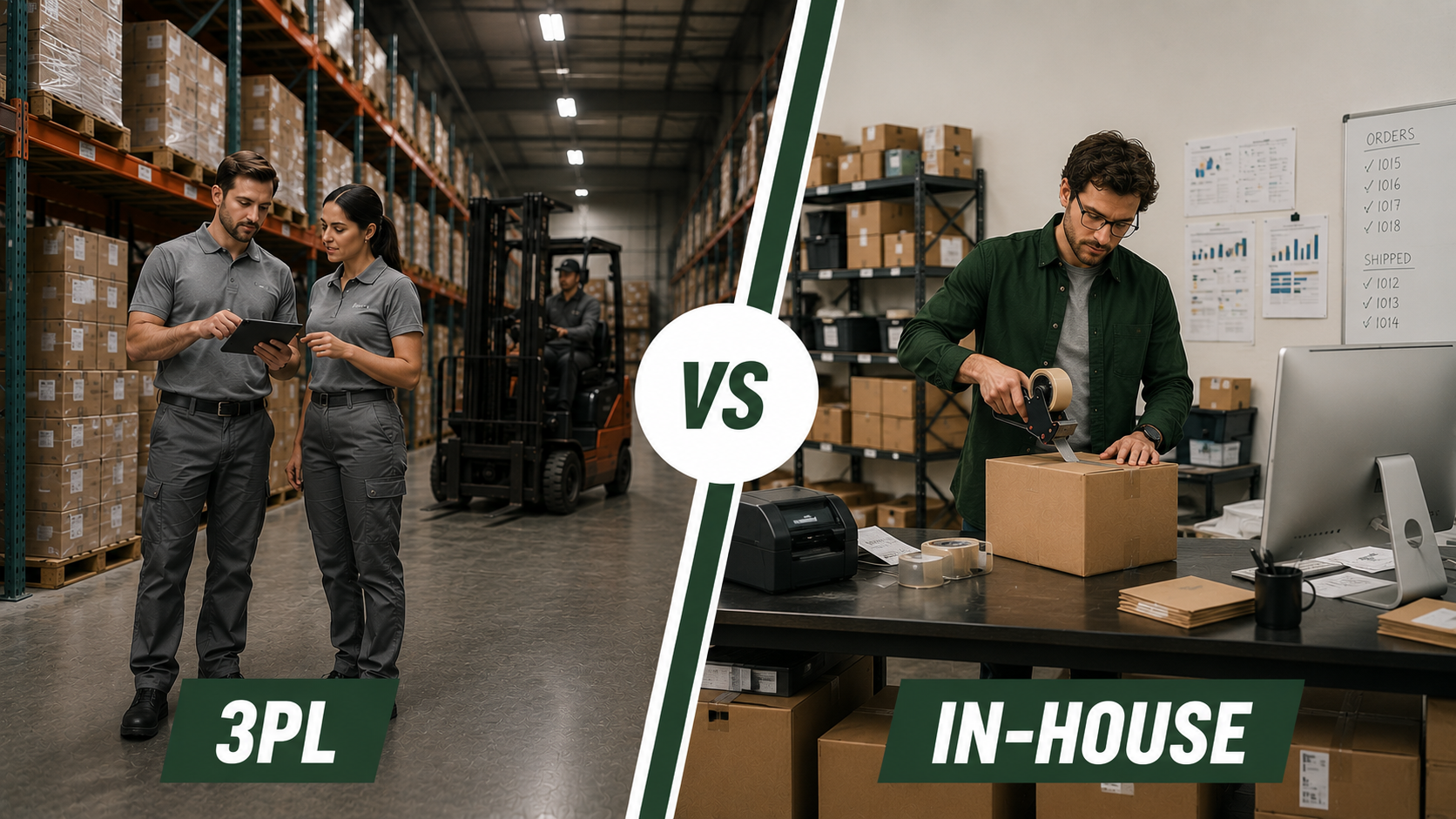
- A 3PL trades control for scale. In-house trades scale for control. Neither is the right answer by default; it changes as your volume, markets, and channel mix evolve.
- In-house distribution is underrated as a competitive advantage. Brands with reps in stores catch out-of-stocks, execute promotions on time, and build retailer relationships that directly affect velocity. That visibility has real revenue consequences.
- Watch for the breaking points: rising chargebacks and stalled expansion signal in-house has outgrown itself. Slipping shelf execution and slow promotional response signal a 3PL is no longer enough.
The brands that lose shelf position to better-funded competitors usually blame the competition. The real culprit is often the distribution decision they made a year ago and never revisited.
That decision determines what your reps do every day, what you can see at the account level, and how much drag you’re carrying into every new market.
In-house or 3PL is not a one-time call you make early and move on from. The model that fits a brand doing 300 orders a month across two markets will not fit a brand doing 3,000 orders a month across eight markets.
In this article, we’ll talk about how to evaluate both models at each stage of business growth and how to know when it’s time to switch.
What’s the difference between 3PL distribution and in-house distribution?
With 3PL distribution, a third-party logistics provider takes on the warehousing, order fulfillment, and shipping on your behalf.
You send inventory to their warehousing and distribution network, they handle the fulfillment operations (picking, packing, and shipping), and you pay for the services you use. Third-party logistics providers own the infrastructure: the warehouse storage solutions and the transportation management systems. You don’t.
With in-house logistics, your brand runs the operation. You hold your own inventory, manage your own warehouse operations, coordinate transportation services directly or run your own delivery fleet, and put your own reps on the road to service accounts.
A third path, the hybrid model, is increasingly common among growing CPG brands. It means owning direct store delivery routes in core markets while leaning on a 3PL for geographic expansion, long-haul replenishment, or channels like ecommerce where in-house fulfillment gets complicated real quick.
What do 3PL services include?
A full-service third-party logistics (3PL) provider does more than move boxes.
Beyond warehousing services and order fulfillment, established 3PL providers handle inventory control, transportation services, and reverse logistics for returns and exchanges.
Some 3PL providers also offer cross-docking, moving incoming goods directly to outbound shipments when products do not need long-term storage.
They run advanced inventory management systems that give brands real-time visibility into stock levels without building or maintaining that infrastructure themselves.
Many offer flexible warehousing that adjusts to seasonal demand, so brands aren’t paying for storage space they don’t need in slow months.
They also absorb the full capital cost of warehouse space and equipment. For brands expanding into new regions, that removes a significant financial risk: the alternative is to sign long-term leases and commit to fixed overhead before you know whether demand in that market will justify it.
How do the two models compare on control, scale, and brand visibility?
The operational and strategic dimensions of this decision look different depending on your channel mix.
| Dimension | In-house distribution | 3PL distribution |
|---|---|---|
| Operational control | Full: routes, packaging, delivery standards, timing | Partial: defined by SLAs, not direct oversight |
| Scalability | Requires investment ahead of growth | Scales with volume; capacity on demand |
| Brand visibility in-store | High: own reps manage shelf presence | Lower: shelf execution depends on retailer or separate merchandising team |
| Retail compliance | Brand-managed; chargeback risk if under-resourced | 3PL with documented compliance workflows handles EDI and routing guides |
| Speed to market (new region) | Slower: requires hiring, routing, vehicles | Faster: tap into existing 3PL network |
| Cost structure | Fixed overhead; becomes more efficient at scale | Variable; predictable per-order rates |
The dimension that gets the least attention in this debate is brand visibility.
In-house distribution means your reps are physically in the store. That presence translates to better sell-through data and stronger relationships with retail buyers and store managers.
A 3PL can move product from strategically located warehouses to a retailer distribution center efficiently. What it can’t do is put someone in front of the store manager every Tuesday to check the shelf and close a reorder.
Supply chain efficiency through a well-structured logistics network is important, but so is what happens after the product arrives. CPG brands running their own retail execution consistently capture better visibility into what’s happening at the account level than brands relying on a 3PL dashboard to tell them how the week went.
Higher customer satisfaction at the retail level tends to follow brands that control their own in-store presence.
💡 Also read:
Which distribution model fits your growth stage?
The right answer to the 3PL versus in-house question changes as a brand grows. Treating it as a one-time binary choice is where many brands go wrong.
Stage 1: Early growth (under 500 orders per month, 1-2 regional markets)
At this stage, in-house almost always makes more sense. Order volume is too low for 3PL providers to price attractively without minimum monthly fee exposure that can exceed what in-house operations would cost.
Keeping distribution in-house also lets a brand learn its own logistics processes before handing that visibility to a third party: which routes work, which accounts reorder fastest, where the margin actually lives.
The risk at this stage is treating in-house logistics as inherently manual. Brands that set up the right route accounting and order management processes early build a foundation for accurate order fulfillment that scales as volume grows.
Stage 2: Regional scale (500-2,000 orders per month, expanding into new territories)
This is the inflection point where the in-house vs. 3PL question gets serious.
Warehouse space starts straining and hiring complexity increases. Route planning across multiple territories becomes hard to manage without dedicated logistics solutions.
The decision turns heavily on channel mix. Brands with a strong DSD operation in defined markets have reason to hold onto in-house distribution.
Whereas brands primarily replenishing retailer distribution centers alongside ecommerce may find that outsourced logistics handles supply chain operations more efficiently, while the brand focuses on field sales and account growth.
Stage 3: Multi-regional or national expansion
At national scale, 3PL or hybrid almost always wins on cost and speed. Building owned warehousing and distribution infrastructure across multiple regions requires capital and time that few growing CPG brands have available.
A well-structured logistics network through an established 3PL third-party logistics partner gives brands immediate access to fulfillment centers without long-term contracts for physical space.
Many brands land on a hybrid model permanently: own the relationships and shelf execution in core markets, and outsource the logistics where scale and supply chain efficiency matter more.
Outsourcing logistics at this stage also frees up the team to focus on core competencies: product, sales, and marketing, rather than warehouse operations and transportation management.
💡 Pro tip:
If you’re evaluating a 3PL for the first time, run a parallel period before fully committing. Keep in-house operations running in one market while the 3PL handles another. The cost of overlap for 60 to 90 days is almost always less than the cost of a botched transition that disrupts active retail accounts.
How to identify if your current distribution model is no longer working?
Signs your in-house distribution is breaking down
The signals here are operational:
- Order error rates climbing as volume outpaces the team’s capacity
- Fulfillment operations consuming hours that should be going toward sales and new account development
- New territory expansion stalling because there’s no viable way to extend routes without a significant hiring push
Retail chargebacks increasing quarter over quarter is a particularly telling signal. It usually means logistics management and compliance workflows aren’t keeping pace with the number of accounts the brand is servicing.
Shipping costs also tend to creep up because in-house carrier relationships don’t scale the way 3PL-negotiated rates do.
Signs your 3PL arrangement is no longer enough
For brands using a 3PL, the signs tend to be strategic rather than operational
- Shelf execution slipping because no one is physically present to catch out-of-stocks or fix planograms and displays
- Losing a key account and only finding out when the reorder stops coming
- Trade promotions that launch on the brand’s end but take two weeks to show up in-store because replenishment runs on the retailer’s DC cycle, not yours
Customer satisfaction at the account level erodes when the brand has no physical presence to manage it.
Choosing the wrong 3PL provider (one without a proven track record in CPG or without documented retailer compliance programs) can damage your brand’s reputation with key accounts before you’ve had a chance to build it.
Initial setup cost for 3PL services is also a big investment, particularly when you consider EDI integration and dedicated account manager onboarding.
These aren’t reasons to avoid 3PL. But they’re reasons to evaluate carefully.
The hybrid model often emerges from exactly this diagnosis: a brand realizes it needs 3PL infrastructure to scale geographically but in-house execution to stay competitive in the accounts that actually drive velocity.
Can in-house distribution be a competitive advantage?
In a category where shelf presence drives velocity, yes. The common assumption that in-house distribution is a cost center brands endure until they can afford outsourced logistics misses what the model offers at the account level.
Brands running their own routes have reps in stores.
Those reps catch out-of-stocks before they become lost sales. They execute promotions the day they launch rather than waiting for retailer DC replenishment cycles.
They build relationships with store managers that translate into better placement and faster reorders.
A 3PL partner can tell you that an order shipped. It cannot tell you that your secondary display has been pushed to the back of the aisle.
The argument against in-house logistics usually centers on cost and complexity, and those concerns are real.
The problem is almost never the model itself. It’s running the model across spreadsheets, WhatsApp threads, and disconnected tools, each showing part of the picture.
Brands that consolidate inventory management, route planning, order capture, and retail execution into one connected system close most of the efficiency gap without giving up the control advantage.
💡 Pro tip:
Track rep visit frequency by account alongside reorder rate. Most brands assume their best accounts reorder because of the product. The data usually shows it’s because a rep was there recently. That correlation is the clearest argument for keeping in-house distribution in your highest-velocity markets.
What should CPG brands look for in a 3PL partner?
CPG-specific capabilities
Lot tracking and FEFO (First Expired, First Out) inventory management are non-negotiable for food, beverage, and supplement brands.
Temperature-controlled warehouse storage matters for perishables.
Look for 3PL warehousing facilities that offer secure storage tailored to your product types, confirmed in writing, not just mentioned in a sales call.
Advanced inventory management systems with real-time tracking are table stakes; if a provider can’t give you live visibility into stock levels, your inventory control depends on their reporting cadence rather than live data.
Retailer compliance programs
Each major retail account maintains its own routing guide, pallet specifications, labeling standards, and ASN requirements.
Missing any of these triggers chargebacks. A 3PL with documented compliance workflows for specific accounts manages these logistics processes systematically.
Freight forwarders and freight brokers embedded in a 3PL’s network can handle the complexity of multi-retailer compliance better than a brand managing it in-house without dedicated infrastructure.
Service range and scalability
The best 3PL partners cover your actual channel mix rather than forcing you into a standard service model.
That means fulfillment services for DTC orders, warehousing services for retail DC replenishment, expedited shipping options for time-sensitive accounts, and the ability to handle reverse logistics for returns without building a separate process.
Brands that expand into international markets can use a 3PL’s existing footprint to store goods closer to those customers rather than shipping everything cross-border on every order.
Transparent pricing and service fees
Request a written fee schedule covering every line item before signing: receiving fees, storage rates, pick-and-pack costs, minimum monthly commitments, peak surcharges, EDI setup, and exit terms.
Review the pricing structure carefully. 3PL services vary significantly in how they structure service fees.
Providers that bundle everything into an opaque monthly rate make it difficult to evaluate overall supply chain efficiency or reduce costs over time.
Tech integration and delivery performance
A warehouse management system that connects with your existing systems (QuickBooks, your ERP, your ecommerce platform) is essential for real-time inventory visibility and accurate order fulfillment.
Evaluate 3PL providers on their delivery performance metrics, not just their quoted rates.
A dedicated account manager who understands your accounts and can proactively flag issues is a strong signal that the provider has built a relationship model that supports business growth.
Geographic coverage
Where your inventory sits determines what you pay to ship it. For dense CPG categories like beverages, supplements, and household goods, placing stock in warehouses close to your customers directly reduces per-unit shipping costs.
The same logic applies to market expansion. A 3PL’s existing warehouse network lets you enter new regions without committing to infrastructure before you know the demand is there.
The model is the starting point. The systems are what make it work.
Whether a brand runs its own distribution or partners with a 3PL, the operational gap between good execution and poor execution comes down to visibility. Brands that know what’s happening in their accounts, routes, inventory, and order pipeline in real time make better decisions at every stage of the supply chain.
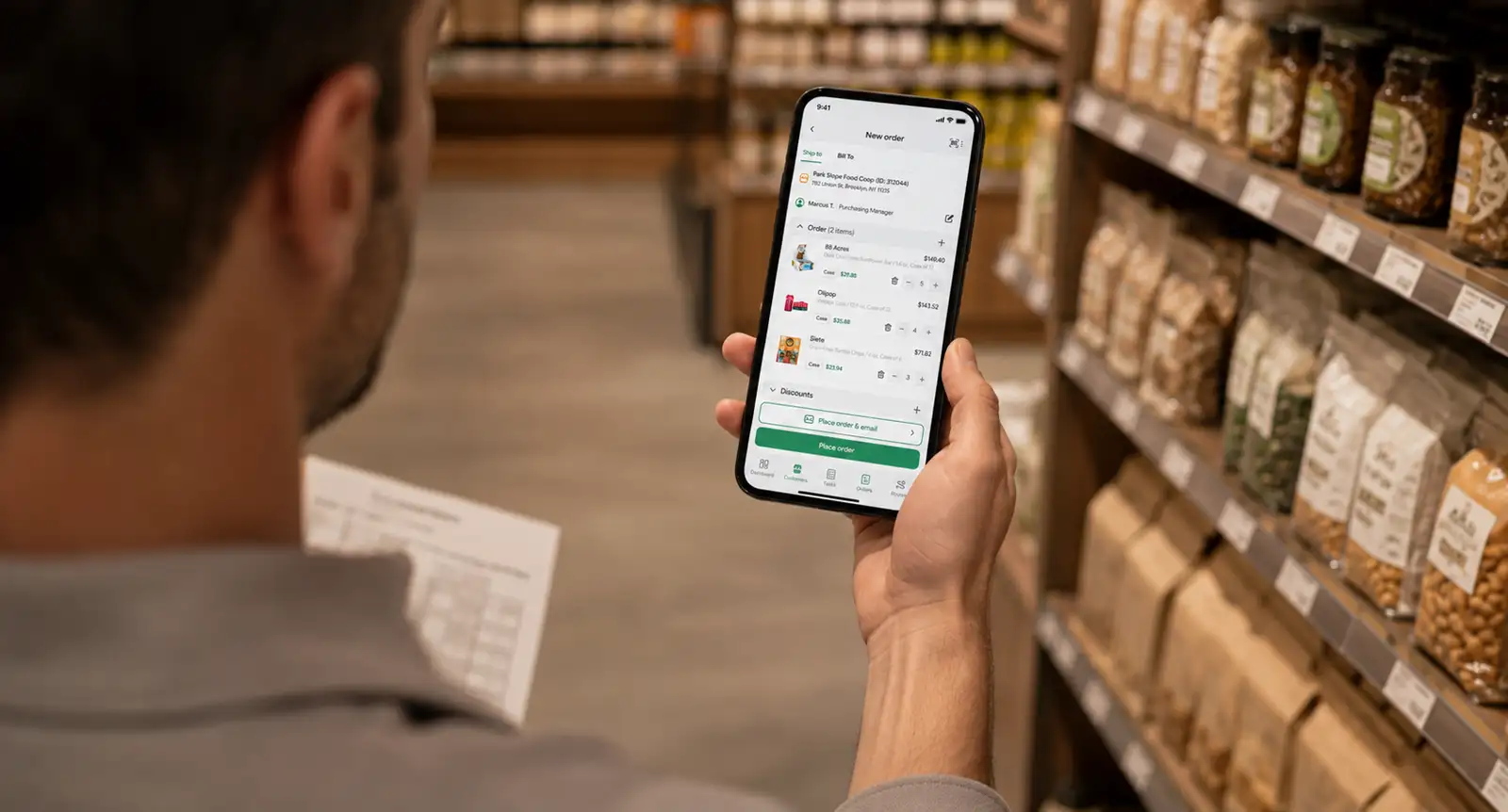
For CPG brands and distributors managing in-house distribution, distribution management software like SimplyDepo brings orders, routes, inventory, field sales, and invoicing into one mobile-first platform. Reps can capture orders, complete store audits, and manage account data from the field, and everything syncs back to the central dashboard automatically.
If coordination overhead is starting to show as you scale, book a demo to see how SimplyDepo handles it.
FAQs on 3PL vs In-House Distribution
3PL distribution for CPG brands means outsourcing warehousing, order fulfillment, and shipping to a third-party logistics provider. The 3PL stores your inventory, picks and packs orders, manages outbound shipping, and in most cases handles retailer compliance requirements like EDI and routing guide adherence. The brand retains ownership of the product and customer relationships while the 3PL owns the operational infrastructure.
The clearest signals are consistent order volume above 500 per month, geographic expansion into territories where in-house routes aren’t viable, and fulfillment operations consuming time that should be going toward core business activities like sales and product development. Brands growing 20% or more year-over-year should evaluate the switch before in-house strain affects service levels. Acting before the breaking point means a smoother transition with less disruption to retail accounts and customer satisfaction.
For in-house operations, the clearest signals are rising order error rates, fulfillment consuming leadership time, retail chargebacks increasing, and geographic expansion stalling because routes can’t be extended without significant hiring.
For 3PL arrangements, the warning signs are typically strategic: declining shelf execution, slow promotional response times, and losing visibility into what’s happening at the account level.
Both sets of signals point toward the same question: whether the current model still fits the stage the brand is operating at.
Yes, particularly for brands running direct store delivery in defined markets. In-house logistics becomes cost-competitive at higher volumes when supported by route optimization and order management software.
The challenge is eliminating manual processes: brands still running logistics operations on spreadsheets absorb costs and errors that a connected platform removes. In-house also preserves the in-store visibility and retailer relationships that a party logistics provider arrangement can’t replicate.
A hybrid model in distribution means owning DSD routes and field execution in core markets while using a 3PL for geographic expansion and retailer DC replenishment. It’s increasingly common for mid-market brands going national: keep the in-store control advantage in markets where shelf presence drives velocity, and use 3PL infrastructure to reach new regions without the capital investment of building owned warehousing and distribution there.
-
 October 8, 2026
 -
 October 8, 2026
 -
 October 7, 2026