EDI vs. B2B eCommerce: What’s the Difference?


📌 Key takeaways:
- The US Census Bureau counts EDI as e-commerce. Its official definition of e-commerce sales covers orders placed over “an Internet, mobile device (M-Commerce), extranet, Electronic Data Interchange (EDI) network, electronic mail, or other comparable online system.”
- The useful distinction is not technology but who initiates. EDI is a machine-to-machine agreement with a partner you have already negotiated; a B2B storefront is a place a buyer browses and decides.
- Most distributors need both, because their customer list is not uniform: a handful of chains generate EDI volume while the long tail reorders by phone, text or email.
- Wild Blood moved reordering across 200-plus Austin retail accounts from phone, text and email to a self-service storefront while keeping two distribution partners on the wholesale side.
Search this question and you get a comparison table almost immediately, usually published by a company that sells one of the two things. The tables are not wrong so much as beside the point, because they treat EDI and B2B e-commerce as competing purchases when most distributors end up running both.
The framing also hides the more useful question. A wholesaler with 300 accounts does not choose a technology, it chooses which of its customers gets which ordering path, and that decision is about buyer behavior and volume rather than about file formats.
Framing it as EDI vs B2B eCommerce suggests that one of them has to win. This guide covers what each actually is, where they genuinely differ, how an order moves through each, and a rule for deciding which of your accounts belongs on which.
EDI vs B2B eCommerce: The Short Answer
EDI and B2B e-commerce are not opposites, and the official statistics say so plainly. The US Census Bureau’s Annual Wholesale Trade Survey defines e-commerce sales as sales “where the buyer placed an order, or the price and terms of the sale were negotiated, over an Internet, mobile device (M-Commerce), extranet, Electronic Data Interchange (EDI) network, electronic mail, or other comparable online system.”
An EDI order is e-commerce by the government’s own accounting. So is an emailed order, which is a detail worth holding onto the next time someone tells you their business is not doing e-commerce yet. EDI in eCommerce is therefore a channel inside the category, not a rival to it.
What actually separates them is who starts the transaction and how much was agreed in advance. EDI assumes a negotiated relationship, a signed spec and a system on both ends; a storefront assumes a person with a login who wants to look at your catalog and decide.
That difference produces everything else: the cost, the onboarding time, the kinds of customers each serves well, and whether a new account can start ordering this week or next quarter.
What EDI Is, and What It Assumes About the Buyer
EDI is the exchange of business documents as structured, machine-readable messages in a standard format, most commonly the ASC X12 sets used across North American retail and distribution. A purchase order arrives as an 850, you acknowledge with an 855, ship against an 856 and bill with an 810.
The technology is unremarkable. The assumptions underneath it are the interesting part.
EDI assumes both parties already agreed on price, terms and items, because none of that gets decided inside the message. It assumes the buyer has a system capable of generating documents, which in practice means a buyer of some size. And it assumes enough volume to justify a per-partner setup, since every new trading partner needs its own mapping against its own implementation guide.
Those assumptions describe a chain retailer, a large distributor or a hospital group. They describe almost none of the independent accounts a growing brand sells to, which is why EDI alone leaves most of a customer list unserved.
What B2B eCommerce Is, and What It Assumes
B2B e-commerce, in the sense people usually mean it, is a storefront where your customer signs in, sees the catalog and pricing that apply to them, and places an order themselves. It is closer in shape to a consumer checkout than to a document exchange, with account-level pricing bolted on.
Its assumptions run the other way. It assumes the buyer wants to browse, that pricing can be resolved at the moment of ordering, and that a new account can be onboarded in minutes rather than through a certification cycle.
It also assumes someone maintains the catalog. A storefront is only as good as its product data, and a portal with stale pack sizes or missing images generates support calls instead of orders.
The trade-off is directional. EDI is expensive to start and nearly free to run at volume; a portal is cheap to start and needs continuous merchandising attention to keep earning its place.
EDI vs B2B eCommerce, Side by Side
The comparison below is written from the distributor’s side of the transaction rather than the software vendor’s, so the rows are the things that change how you operate rather than feature checkboxes.
| Dimension | EDI | B2B eCommerce storefront
|
|---|---|---|
| Who initiates the order | The buyer’s system, automatically | A person, by signing in and browsing |
| Typical customer | Chains, large distributors, group buyers | Independents, small chains, new accounts |
| Onboarding time per customer | Weeks to months, including certification | Minutes to days |
| Cost shape | Per-partner setup plus transaction volume | Platform cost, largely flat as accounts grow |
| Where pricing is decided | Negotiated beforehand, outside the message | Resolved at order time from the account’s price list |
| Catalog discovery | None, the buyer already knows the item | Central, the buyer browses and finds items |
| What breaks it | A spec change or a mapping error | Stale product data or a confusing catalog |
| Failure visibility | A rejected file, often found late | An abandoned cart or a phone call |
The last row is the one operators underrate. An EDI failure is silent until a functional acknowledgment goes missing or a deduction appears, while a portal failure announces itself because a human gives up and calls your rep.
How EDI Ecommerce Order Processing Differs From a Portal Order
Both paths end with an order in your system, and the middle looks nothing alike. Following one order down each path is the fastest way to see where EDI in eCommerce actually differs from a storefront in day-to-day work.
Through EDI, the buyer’s system emits an 850 on a schedule. Your translator receives it, validates it against the agreed map, returns a 997 to confirm the file parsed, and drops the order into your order management system. Nobody looked at it. If the item number is wrong, the file rejects and someone investigates hours later.
Through a portal, your customer signs in, sees their own price list, adds cases and submits. Validation happens in front of them: an unavailable item shows as out of stock, a minimum order quantity blocks checkout, and a wrong pack size is visible as a picture and a description before they commit.
EDI eCommerce order processing and portal ordering therefore fail in opposite directions. The practical difference is where errors get caught. EDI catches structural errors after the fact and cannot catch a buyer ordering the wrong thing correctly; a portal catches intent errors in the moment but depends on your catalog being right in the first place.
That is why running both raises a question neither one answers alone, which is whether the two paths write into the same order record. When they do not, your order management workflow ends up with two versions of the day’s demand and a reconciliation job nobody owns.
B2B Integration: EDI, APIs and the Portal Layer
EDI is one integration among several, and it is no longer the only one your customers and vendors expect. Postman’s State of the API report for 2025, based on more than 5,700 developers, architects and executives, found that 82% of organizations have adopted some level of API-first approach and 25% now describe themselves as fully API-first, a 12% increase on 2024.
That shift does not retire EDI. Modern B2B integration, EDI and APIs side by side, is additive rather than a replacement, and a chain that runs on X12 is not going to accept a REST call because your vendor prefers one.
What it changes is the shape of the middle. A distributor today typically has EDI to a few large partners, an API or native connector to accounting, a storefront for the long tail, and often a marketplace or two, all of which need to land in one place.
The failure mode is predictable: each channel gets connected to a different system, and inventory becomes a matter of opinion. Keeping intake unified is the whole argument for omnichannel order management, and it matters more as channel count rises than any single channel’s technology does.
Which Channel Each of Your Customers Belongs On
Sort by volume and by whether the buyer has a system, not by how important the account feels. EDI vs B2B eCommerce is a decision you make per account rather than once for the whole company, and those two variables settle it for almost every customer you have.
A customer with real order volume and a purchasing system belongs on EDI, because the per-partner setup amortizes and the buyer’s own workflow expects it. A customer ordering weekly by text belongs on a portal, because you will never recover an EDI setup cost across their volume and they have nothing to send a document from.
The middle is where judgment lives. An account with decent volume and no purchasing system usually belongs on a portal with a rep who checks in, because the constraint is the buyer’s capability rather than the size of the order.
Run each account through these five questions and the placement answers itself in most cases.
- Does the buyer have a purchasing system that generates orders, or does a person place them?
- Has the customer asked for EDI, or named it as a condition of growing the account?
- Would the per-partner setup cost recover within a year at this account’s current volume?
- Does the order repeat with little variation, or does the buyer need to see what is available?
- Is anyone on your side already re-keying this customer’s orders by hand?
A yes to the last question is worth acting on regardless of which channel wins, because manual re-entry is the cost both options were meant to remove and it is the one you are paying today.
One warning about sequencing. Do not build the portal for the accounts you wish you had; build it for the reordering behavior you can already see in your own history, then let the catalog earn the browsing traffic.
Start by pulling the accounts whose orders repeat with little variation, because a predictable B2B ecommerce workflow is the one a buyer will adopt without training.
What EDI for Ecommerce Cannot Do
EDI is excellent at executing an agreement and incapable of forming one. That single limitation explains most of the disappointment distributors report after an expensive implementation.
An 850 arrives with item numbers already chosen, so nothing in the channel introduces a buyer to a product they have not bought before. There is no browsing, no search, no related-items panel and no promotion a buyer can discover on their own, which means EDI will faithfully reorder your existing mix and never grow it.
Pricing is equally fixed. Rates were negotiated outside the message, so a promotional price or a volume offer requires a conversation and often a document change rather than a toggle in a catalog.
Customer acquisition is outside its scope too. You cannot onboard a new independent account onto EDI in an afternoon, and a buyer without a purchasing system has nothing to send from, so every account below a certain size is unreachable by this channel at any price.
None of that is a flaw. EDI was designed to remove cost and error from transactions you have already won, and it does that better than anything else. The mistake is expecting a settlement mechanism to also perform sales, which is the job the storefront and your reps do.
What Ecommerce EDI Implementation Involves
Ecommerce EDI implementation is mostly not about EDI. The implementation of EDI in e-commerce operations is really a data project, because your catalog, pricing and inventory have to be clean enough to serve two channels that expose different faults in the same records.
| Workstream | What it covers | Which channel exposes it
|
|---|---|---|
| Catalog normalization | One identifier per sellable unit, consistent pack and size | Both, immediately |
| Account pricing | Price lists resolved per customer without manual edits | Portal at order time, EDI at invoice matching |
| Inventory truth | One available-to-promise number across channels | Portal shows it, EDI assumes it |
| Document mapping | Building each partner’s implementation guide | EDI only |
| Storefront merchandising | Images, descriptions, categories, search | Portal only |
| Order routing | Getting both intakes into one fulfillment queue | Both, and this is where most projects slip |
Sequence the shared work first. Catalog, pricing and inventory serve both channels, so doing them once before either project starts is the difference between one cleanup and two, and it is the part a software vendor is least likely to quote you for. Budget the implementation of EDI in e-commerce environments around that shared cleanup rather than around the mapping.
There is a staffing consequence people miss. An EDI implementation in e-commerce teams usually lands on the same one or two people who also maintain the storefront catalog, so running both projects in the same quarter tends to mean neither finishes. Any EDI implementation in e-commerce settings competes for exactly the people the catalog depends on.
Sequence them a quarter apart and staff the catalog work explicitly. Most software for wholesalers differs less on features than on how much of that ongoing maintenance the platform absorbs rather than hands back to your team.
Running Both Without Keeping Two Sets of Numbers
The operational goal is one order record regardless of how the order arrived. Any architecture that satisfies that is defensible; any that does not will produce a monthly argument about what actually sold.
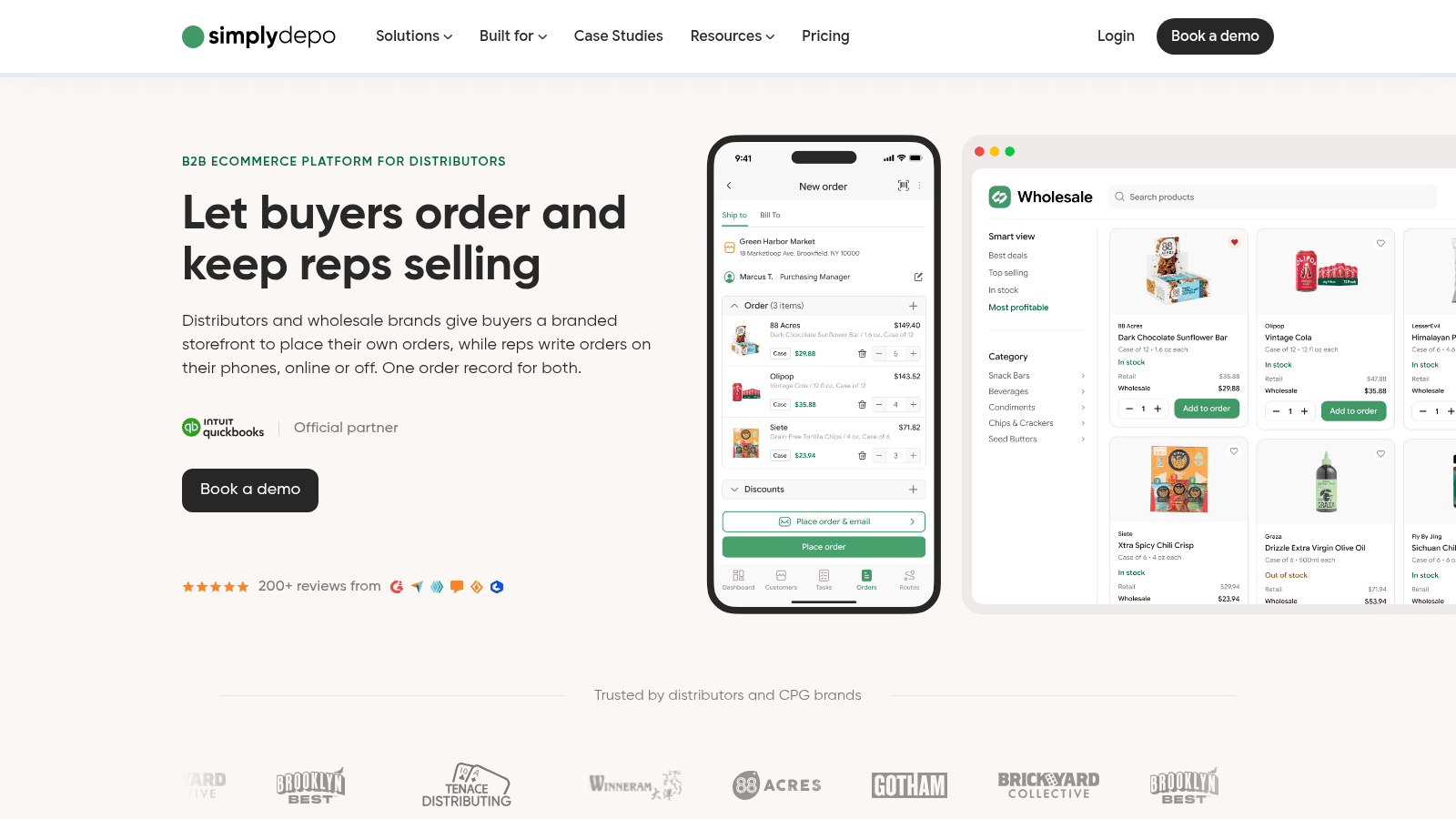
SimplyDepo’s B2B eCommerce platform page, simplydepo.com (August 2026).
SimplyDepo approaches this from the field-sales side rather than the storefront side. Buyers get a branded self-service storefront for their own reordering, reps write orders on a phone whether or not there is signal, and both produce the same order record with per-customer price lists applied automatically. Its B2B ecommerce platform also carries the pricing and promotions engine, invoice generation and QuickBooks Online sync that the reconciliation problem above depends on.
The honest positioning limit matters on this particular question. SimplyDepo is field-sales-first with a customer portal attached rather than a standalone e-commerce platform, and EDI support is in development rather than shipping today. If your requirement is X12 transmission to a chain retailer this quarter, that is an EDI provider’s job, not this platform’s.
Three further boundaries are worth knowing before you evaluate it. Bookkeeping stays where it already lives, because the platform connects to QuickBooks Online rather than standing in for an accounting system, and that connection covers the Online edition only.
Trying it also means talking to someone first, since no self-serve signup exists. Sales teams in the one-to-hundred-rep range are the intended fit, and it sells into the US and Canadian markets rather than globally. What a buyer actually sees when they log in is set out on the B2B portal software page.
How Distributors Sequence This in Practice
The usual sequence is portal first, EDI when a customer forces it. That is not a technology preference so much as an ordering of returns: a storefront pays back across every independent account you already have, while EDI pays back on the specific partner that required it.
Wild Blood is a workable illustration of the first half. The brand secured more than 200 retail accounts in Austin along with two distribution partners, and the Wild Blood case study records reordering moving from phone, text and email only to self-service through an Order Direct storefront, with direct and distributor activity visible in one platform rather than distributor performance arriving in a monthly report.
Notice which problem got solved there. Not document formats, but the fact that a rep could see what an account had ordered before walking in, and that a store owner could reorder at 11pm without finding someone’s mobile number.
The distributors who struggle are usually the ones who did this in the opposite order under deadline pressure, connecting EDI to a catalog nobody had cleaned.
Both channels then hand off to the same downstream steps, which is why supply chain order management is the layer that absorbs the cost of getting either one wrong.
Deciding Without Overbuying
EDI vs B2B eCommerce has a boring answer: they are different tools for different buyers, and the government’s own statistics treat both as e-commerce. The interesting question is which of your accounts belongs where, and you can answer that from data you already have.
Pull last year’s orders, sort accounts by volume, and mark which ones have a purchasing system capable of sending a document. The top of that list is your EDI case whenever a partner asks for it. Everything below is a portal case you can act on now, and it is usually the larger share of your customer count even when it is the smaller share of revenue.
Fix the catalog either way. To see how a single order record handles rep-written and buyer-placed orders side by side, book a demo.
Frequently Asked Questions
Yes, in official US statistics. The Census Bureau’s Annual Wholesale Trade Survey defines e-commerce sales to include orders placed over an EDI network alongside internet, mobile, extranet and email orders. The everyday usage of “e-commerce” to mean a storefront is narrower than the statistical definition, which is a common source of confusion when distributors report their channel mix.
Only if a customer requires it. A portal serves buyers who browse and decide; EDI serves buyers whose purchasing systems generate orders automatically and who will not order any other way. Many distributors run for years on a portal alone and add EDI when their first chain account makes it a condition of doing business.
The cost shapes differ more than the totals. EDI carries per-partner setup and mapping costs plus transaction volume charges, so a fifth trading partner costs again, while a storefront is largely a flat platform cost that does not rise much as you add accounts. For a long tail of small buyers the portal is cheaper; for one high-volume chain that mandates EDI, there is no portal alternative.
B2B integration is the general problem of connecting your systems to your trading partners’ systems, and EDI is one method of solving it. APIs, flat-file transfers and marketplace connectors are others. Postman’s 2025 report found 82% of organizations have adopted some level of API-first approach, which means the partner asking you to integrate today may want an endpoint rather than an X12 file.
They can, and they should. If the two channels land in separate systems you get two versions of demand and a manual reconciliation every month. Check at evaluation time whether portal orders and imported EDI orders appear in one fulfillment queue with one inventory position behind them, because retrofitting that later is significantly harder than specifying it up front.
 Rated 4.7 on G2
Still re-entering orders manually?
-
 September 16, 2026
 -
 September 15, 2026
 -
 September 15, 2026