Omnichannel Order Management: How to Unify Orders Across Every Channel


Customers no longer shop through one channel. They browse websites, compare products on marketplaces, use mobile apps, and visit physical stores.
McKinsey research confirms that this blended shopping journey is here to stay, as physical stores remain important even while digital and AI-powered tools become more common.
This creates more sales opportunities. But it also creates challenges. Orders come from different sources. Inventory updates live in separate systems. Customer data gets scattered.
Because of this, teams can struggle to track orders, confirm stock availability, and fulfill purchases on time. As channels grow, keeping everything synchronized becomes harder.
This is where omnichannel order management helps. It connects orders, inventory, fulfillment, and customer data in one place, so teams can see what’s happening across every channel without jumping between tools or checking updates manually.
A simple omnichannel order management definition is the process of managing orders across all sales channels from one central system.
It gives teams clear visibility, reduces manual work, prevents errors, and helps them make faster decisions when demand changes or order volumes grow.
In this guide, you’ll learn how it works, why it matters for growing businesses, which problems it solves, what features to look for, and how to build a smoother fulfillment process across every sales channel.
What is omnichannel order management?
Omnichannel order management is the process of managing and coordinating orders from all sales channels through one connected system.
Instead of handling website orders, marketplace sales, retail purchases, and mobile transactions separately, businesses bring everything together in a single view.
The goal is simple. Every order, inventory update, and fulfillment activity stays connected. This helps teams work faster and make better decisions without switching between multiple platforms.
It’s important to understand how this differs from multichannel management. In a multichannel setup, a business sells through several channels, but those channels often operate independently.
Here’s the difference in practice:
- Multichannel management → Each sales channel may have its own order data, inventory updates, and fulfillment process. Teams often need to check several systems to understand what’s happening.
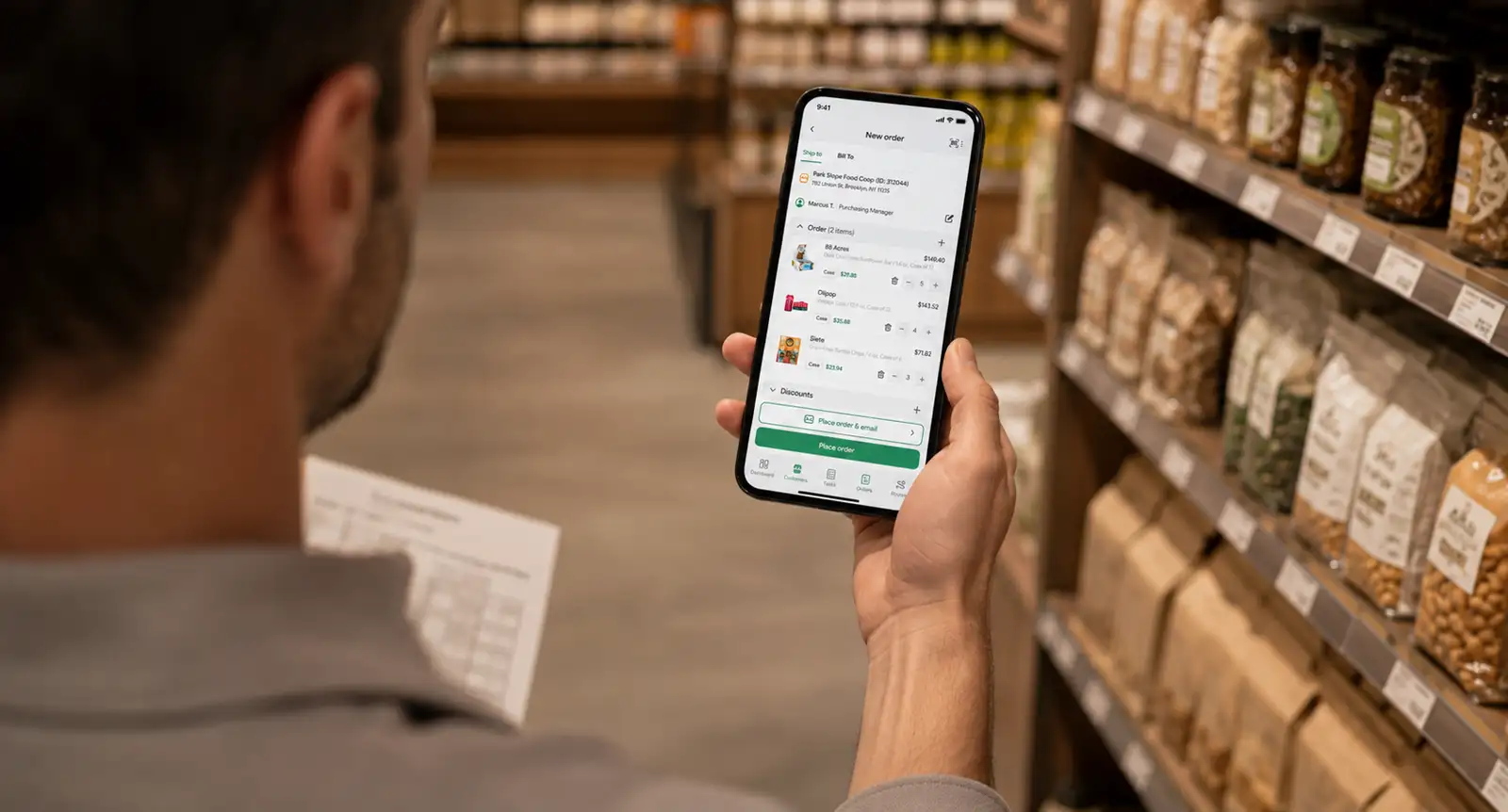
- Omnichannel management → All channels share connected data, so teams can manage orders from a central B2B ordering app. This makes it easier to track purchases, update inventory, and support customers without losing context.
This connected approach makes daily operations easier. When a customer places an order, inventory updates across the entire system. Teams can see the same information regardless of where the order originated.
A key part of this process is centralized order orchestration. This means the system automatically coordinates how orders move from purchase to delivery.
It can route orders to the best warehouse, prioritize fulfillment locations, update inventory levels, and track order status in real time.
Customer experience also improves significantly. Modern shoppers expect flexibility. They want to buy online, pick up in store, receive accurate delivery updates, and see reliable product availability across channels.
According to Forrester research, three-quarters of US online adults consider it important for brands and retailers to show in-store product availability on their websites.
When order data stays connected, businesses can deliver faster processing, better inventory accuracy, fewer fulfillment mistakes, clearer delivery updates, and more consistent customer interactions across all channels.
An effective omnichannel order management strategy focuses on creating one connected process for orders, inventory, fulfillment, and customer data.
When every channel works together, businesses gain better visibility, improve operational efficiency, and deliver a smoother experience from purchase to delivery.
Why do businesses struggle to unify orders?
Managing orders across multiple sales channels sounds simple. In reality, it becomes more complicated as a business grows. New sales channels, fulfillment locations, and software tools often create disconnected processes that are hard to manage.
One of the biggest challenges is fragmented order data. Orders may come from an ecommerce website, online marketplaces, retail stores, social commerce platforms, and mobile apps.
When each channel operates separately, teams often lack a complete view of customer activity, order status, and fulfillment progress.
Disconnected sales channels create several common problems:
- Separate systems → Order information is stored in different platforms, making it harder to track activity, compare updates, and maintain consistency across channels.
- Manual updates → Teams spend time transferring data between systems, correcting mistakes, and reconciling order information instead of focusing on faster fulfillment.
- Inconsistent information → Different channels may display different inventory levels, order statuses, or fulfillment updates, which can confuse teams and customers.
Inventory synchronization creates another challenge. Stock levels change constantly as customers place orders across multiple channels.
If systems don’t update in real time, inventory data can quickly become inaccurate. This increases the risk of overselling products, creating stockouts, or disappointing customers with canceled orders.
💡 Pro Tip
Check how often each sales channel refreshes inventory data before connecting new tools. Even a short delay can create stock conflicts during peak hours, promotions, or fast-moving product launches.
Fulfillment can become equally complex. Many businesses ship from multiple warehouses, retail locations, or third-party logistics providers.
Without centralized coordination, orders may be routed inefficiently. This can increase shipping costs, create delays, and make it harder to meet delivery expectations as order volume grows.
Data visibility also becomes harder to maintain. Teams need accurate information to plan inventory, prioritize orders, and solve fulfillment issues quickly.
Customer service teams usually feel these problems first. Customers expect fast answers about order status, delivery updates, returns, and product availability.
If support agents need to search through multiple systems, response times slow down and customer satisfaction can suffer.
This is why many growing businesses invest in omnichannel order management.
The right order management software connects orders, inventory, fulfillment, and customer data into one system, helping companies reduce complexity, improve visibility, and create a more consistent experience across every sales channel.
How does an omnichannel order management system work?
An omnichannel order management system connects orders, inventory, fulfillment, and customer data across all sales channels.
Instead of managing separate workflows for each channel, businesses use one centralized platform to coordinate everything from purchase to delivery.
Order capture across channels
The process begins when a customer places an order through an ecommerce website, online marketplace, mobile app, social commerce platform, or physical store.
The system captures order information from every channel and brings it into one central location. Teams can manage incoming orders from one dashboard instead of checking multiple platforms.
This creates a more efficient workflow, improves visibility, and reduces manual work.
Inventory synchronization
Once an order enters the system, inventory data updates automatically. Stock levels change as products are sold, shipped, returned, or restocked.
Real-time synchronization helps businesses maintain accurate stock visibility across all channels.
It also reduces overselling, stockouts, and delayed order processing. As inventory changes, updates are reflected throughout the system, helping teams make better fulfillment decisions.
Order routing and fulfillment
After inventory is verified, the system decides how the order should be fulfilled. It reviews available stock, warehouse locations, shipping costs, and delivery requirements.
Common routing decisions include:
- Route an order to the nearest warehouse → Reducing shipping time and transportation costs.
- Ship from a retail store → Using local inventory to fulfill customer demand.
- Split an order between locations → Ensuring all items can be delivered when stock is spread across facilities.
Once the order is assigned, teams pick, pack, and ship the products. Status updates move back into the system automatically, helping both employees and customers track progress throughout the fulfillment process.
Returns and exchange management
Returns and exchanges are also part of the order lifecycle. Customers may return products through a different channel than the original purchase location.
A connected system keeps return data synchronized across inventory, fulfillment, and customer records. This helps businesses process refunds faster, support exchanges more efficiently, and maintain accurate inventory counts without creating additional manual work.
How data flows across the ecosystem
Behind the scenes, information moves continuously between connected systems.
A connected distributor management system helps keep these updates synchronized across orders, inventory, fulfillment, and customer records. Every action triggers an update across the order network.
For example:
- New orders → Inventory levels update automatically.
- Shipments → Order statuses change in real time.
- Returns → Stock availability and customer records are refreshed.
- Customer service requests → Support teams see the latest order details.
This constant flow of information is what makes omnichannel order management effective.
Instead of relying on disconnected systems and manual updates, businesses create a connected environment where orders, inventory, fulfillment, and customer data stay synchronized.
The result is better visibility, faster fulfillment, improved operational efficiency, and a smoother customer experience.
What are the key benefits?
Managing orders across multiple channels can quickly become difficult when systems, inventory, and fulfillment processes are disconnected. A centralized approach helps businesses create more efficient operations while delivering a better customer experience.
The benefits go beyond simple order management. Businesses gain greater visibility, improve fulfillment performance, make better inventory decisions, and build a stronger foundation for growth.
As sales channels and order volume increase, these advantages become even more valuable.
| Benefit | Business impact | Example |
|---|---|---|
| Improved customer experience | Creates a smoother and more consistent buying journey across every sales channel | Customers receive accurate inventory information, reliable delivery updates, and consistent service regardless of where they shop |
| Increased order accuracy | Reduces fulfillment mistakes, duplicate records, and manual data-entry errors | Teams work with synchronized order and inventory information instead of managing separate systems |
| Faster fulfillment | Improves order processing speed and delivery performance | Orders can be routed to the nearest warehouse or store with available inventory |
| Reduced operational complexity | Simplifies daily workflows and reduces manual work | Employees spend less time switching between platforms and reconciling information |
| Better inventory utilization | Helps businesses use available inventory more efficiently | Stock can be balanced across warehouses, stores, and fulfillment locations based on demand |
| Support for growth and scalability | Makes it easier to manage increasing order volume and additional sales channels | Businesses can expand operations without adding the same level of complexity |
Together, these benefits help businesses operate more efficiently while meeting rising customer expectations.
Teams spend less time correcting errors, searching for information, or manually updating records. Instead, they can focus on improving fulfillment performance and supporting customers.
💡 Pro Tip
Track how much time teams spend switching between systems before and after centralizing order management. This creates a simple way to measure efficiency gains beyond fulfillment speed or order accuracy.
A connected system also helps leaders make better decisions. With accurate data available across the organization, businesses can identify inventory trends, monitor fulfillment performance, and respond more quickly to changes in demand.
This level of visibility becomes increasingly important as operations become more complex and customer expectations continue to rise.
This is one of the main reasons businesses invest in omnichannel order management.
The right B2B order management software connects orders, inventory, fulfillment, and customer data in one system, giving companies the flexibility and control needed to support long-term growth.
As operations expand, teams can continue delivering accurate orders, efficient fulfillment, and a consistent customer experience across every channel.
These improvements not only support day-to-day operations but also help businesses stay competitive in a rapidly changing retail and ecommerce environment.
What should an effective strategy include?
Building a connected order operation takes more than software. Businesses also need clear processes, aligned teams, and consistent data. Without structure, even the best technology can create confusion instead of efficiency.
A successful system starts with a strong foundation and scales as the business grows.
Create a single source of truth
One of the most important goals is creating a single source of truth for orders, inventory, fulfillment, and customer data. Everyone should work from the same information.
When teams rely on separate spreadsheets or disconnected systems, errors become more common. A centralized data environment improves visibility and helps employees make faster decisions.
Connect sales, inventory, and fulfillment systems
Data should move freely between critical business systems. Orders, inventory updates, shipments, and returns should be synchronized automatically.
Key connections often include:
- Sales channels → Ecommerce stores, marketplaces, retail locations, and mobile apps.
- Inventory systems → Warehouses, stores, and distribution centers.
- Fulfillment systems → Shipping carriers, logistics providers, and fulfillment partners.
When these systems work together, information stays accurate and reduces the need for manual updates. The right retail operations software can help teams manage sales channels, inventory locations, and fulfillment operations more efficiently.
Establish consistent order workflows
Consistency helps businesses reduce mistakes and improve efficiency. Teams should follow standardized processes for order processing, fulfillment, returns, and customer support.
Clear workflows make it easier to train employees, scale operations, and maintain service quality as order volume grows.
Align teams across departments
Order management affects multiple departments. Sales, operations, warehouse teams, inventory managers, customer support, and leadership all rely on the same information.
Alignment becomes easier when everyone understands responsibilities and follows shared processes. Regular communication also helps teams resolve issues before they affect customers.
Define performance metrics
A strategy should include measurable goals. Without performance tracking, it becomes difficult to identify improvement opportunities.
Common metrics include:
- Order accuracy → Measures how often orders are fulfilled correctly.
- Fulfillment speed → Tracks how quickly orders move from purchase to shipment.
- Inventory accuracy → Compares recorded inventory against actual stock levels.
- Customer satisfaction → Helps measure the overall buying experience.
These metrics provide valuable insights into operational performance and customer experience.
Plan for scalability and future channels
Business needs change over time. New sales channels, fulfillment locations, and customer expectations can create additional complexity.
A strong omnichannel order management strategy should support future growth from the beginning.
Systems and workflows should be flexible enough to accommodate new marketplaces, retail locations, fulfillment partners, and technologies without requiring a full redesign.
Businesses that plan ahead are better prepared for seasonal demand spikes, new product launches, and expansion into additional markets.
When businesses focus on connected data, standardized workflows, team alignment, and long-term scalability, they create a foundation that supports both operational efficiency and sustainable growth.
What challenges should you prepare for?
Implementing a connected order operation offers significant benefits, but it also comes with challenges. Understanding these obstacles early helps businesses plan better, avoid delays, and reduce unnecessary complexity.
One of the most common issues is data silos. Many businesses use separate systems for ecommerce, inventory, fulfillment, customer support, and accounting.
Connecting them can be difficult, especially when each platform stores data differently or updates information at a different speed.
Several common obstacles appear during implementation:
- Data silos → Important information stays separated across different systems, making it harder to get a complete view of orders, inventory, and fulfillment activity.
- Legacy platforms → Older technology may limit connectivity, automation, and real-time data sharing. Businesses may need extra tools, custom integrations, or phased upgrades.
- Inventory inaccuracies → Stock levels become unreliable when updates are delayed or teams follow inconsistent processes. This can lead to overselling, stockouts, and fulfillment issues.
- Organizational resistance → Teams may hesitate to change familiar workflows, especially if they don’t understand the benefits of the new system.
- Ongoing maintenance → Systems and integrations need regular monitoring to keep data accurate and workflows running smoothly as operations grow.
Inventory accuracy deserves special attention. Even after systems are connected, small discrepancies can affect fulfillment performance, customer satisfaction, and planning.
Change management also matters. New workflows often affect sales, operations, fulfillment, inventory teams, and customer support. Clear communication and proper training help employees adapt faster and use the system correctly.
💡 Pro Tip
Involve frontline teams before finalizing new workflows. Warehouse staff, support agents, and operations managers often spot practical gaps that leadership or software vendors may miss.
This is why planning matters as much as technology. While the omnichannel order management definition focuses on connecting orders across channels, successful implementation involves more than technology alone.
It also depends on accurate data, team alignment, and continuous improvement. Businesses that prepare early are better positioned to achieve long-term results.
They can adapt more easily to growth, maintain operational stability, and avoid many common implementation challenges. This preparation also makes it easier to choose the right distribution strategy as the business expands into new channels or markets.
How can you implement omnichannel order management successfully?
Successful implementation starts with preparation. Connecting orders across channels is not just a technology project. It also requires clear processes, strong communication, and a plan for long-term improvement.
Before making changes, take time to understand how orders move through your business today. Review existing systems, workflows, and responsibilities. This helps identify gaps, bottlenecks, and opportunities for improvement.
A successful implementation usually includes several key steps:
- Current process audit → Review how orders, inventory, fulfillment, and customer data move through the business today.
- Integration planning → Define which systems need to connect and what information should be synchronized between them.
- Platform selection → Choose a solution that supports current operational needs and future growth.
- Phased rollout → Introduce new processes gradually instead of changing everything at once.
- Team training → Help employees understand new workflows, tools, and responsibilities.
- Performance monitoring → Track order accuracy, fulfillment speed, inventory accuracy, and customer satisfaction.
- Workflow optimization → Review performance regularly and improve processes over time.
A phased approach often delivers the best results. It reduces implementation risk, gives teams time to adapt, and makes it easier to resolve issues before they affect larger parts of the operation.
Training is equally important. Employees need to understand how the new system works and how their responsibilities may change. When teams feel confident using new tools, adoption becomes much smoother and more consistent across departments.
Performance monitoring should begin as soon as the system is live. Measuring key operational metrics helps businesses identify improvement opportunities, track progress over time, and make more informed decisions.
Implementation is not a one-time event. Customer expectations, sales channels, and business requirements continue to evolve. Regular reviews help teams refine workflows, improve efficiency, and maintain strong operational performance.
A successful omnichannel order management strategy focuses on continuous improvement rather than a one-time deployment.
Businesses that assess their needs carefully, connect the right systems, train employees effectively, and optimize workflows over time are more likely to achieve long-term success.
Are you ready to unify orders and scale efficiently?
Managing orders across multiple channels becomes much easier when everything works together. A connected approach gives businesses better visibility into orders, inventory, fulfillment, and customer activity from one place.
The benefits are clear. Teams spend less time dealing with manual processes and disconnected systems. Order accuracy improves. Fulfillment becomes faster. Customers receive a more consistent experience across every sales channel.
As your business grows, these advantages become even more important. New channels, higher order volumes, and changing customer expectations are easier to manage when you have a scalable foundation in place.
This is why many businesses invest in omnichannel order management. It helps create more efficient operations today while supporting future growth.
If you’re looking for a simpler way to connect orders, inventory, and field operations, consider booking a demo with SimplyDepo.
You’ll see how a connected platform can help improve visibility, streamline workflows, and support long-term business growth.
FAQs
Omnichannel order management is the process of managing orders from all sales channels through one centralized system. It connects order, inventory, fulfillment, and customer data, giving teams better visibility while reducing manual work and helping businesses deliver a more consistent customer experience.
The difference is connectivity. Multichannel businesses sell through multiple channels, but those channels often operate independently. Omnichannel management creates a connected ecosystem where orders, inventory, fulfillment, and customer information stay synchronized across the entire operation.
Several technologies support omnichannel operations. These include order management systems, inventory management software, ERP platforms, fulfillment tools, and integrations that connect sales channels, warehouses, logistics providers, and customer service teams. Together, they improve visibility, accuracy, and workflow automation.
Inventory visibility matters. Real-time inventory data helps businesses avoid overselling, reduce stockouts, and improve fulfillment accuracy. It also provides customers with more reliable availability information, creating a smoother buying experience and increasing overall customer satisfaction.
Businesses should look beyond features alone. Scalability, integration capabilities, automation tools, reporting functionality, and ease of use all play important roles, especially for companies planning to add new channels, increase order volume, or expand operations over time.
-
 October 8, 2026
 -
 October 8, 2026
 -
 October 7, 2026