What Is CPG? The Complete Guide to Consumer Packaged Goods

📌 Key takeaways:
- Consumer packaged goods are low-cost items people buy often and replace quickly, which makes velocity and distribution reach matter far more than any single sale.
- CPG supports 22.3 million U.S. jobs and $2.5 trillion of GDP, making it the largest manufacturing sector by employment according to a PwC study for the Consumer Brands Association.
- Of every dollar Americans spend on domestically produced food, 11.8 cents reaches the farm and 88.2 cents pays for everything after it, which is where brands, distributors and retailers all live.
- The hard part of CPG is not making the product, it is getting it onto thousands of shelves and keeping it there, which is an operations problem long before it is a marketing one.
Most explanations of CPG stop at the definition. You get a list of categories, a note that CPG and FMCG mean roughly the same thing, and a paragraph about how the sector is data-driven now.
That leaves out the thing anyone actually working in CPG spends their week on. A packaged goods business does not win by having a good product. It wins by being available, priced correctly and in stock in enough places, repeatedly, which is a distribution and execution problem that the category’s own introductory literature barely mentions.
This guide covers the definition quickly, then spends its length on the parts that decide whether a brand survives: where the money goes along the chain, the four routes a product can take to a shelf, and what breaks as a brand moves from ten stores to a thousand.
What Are Consumer Packaged Goods?
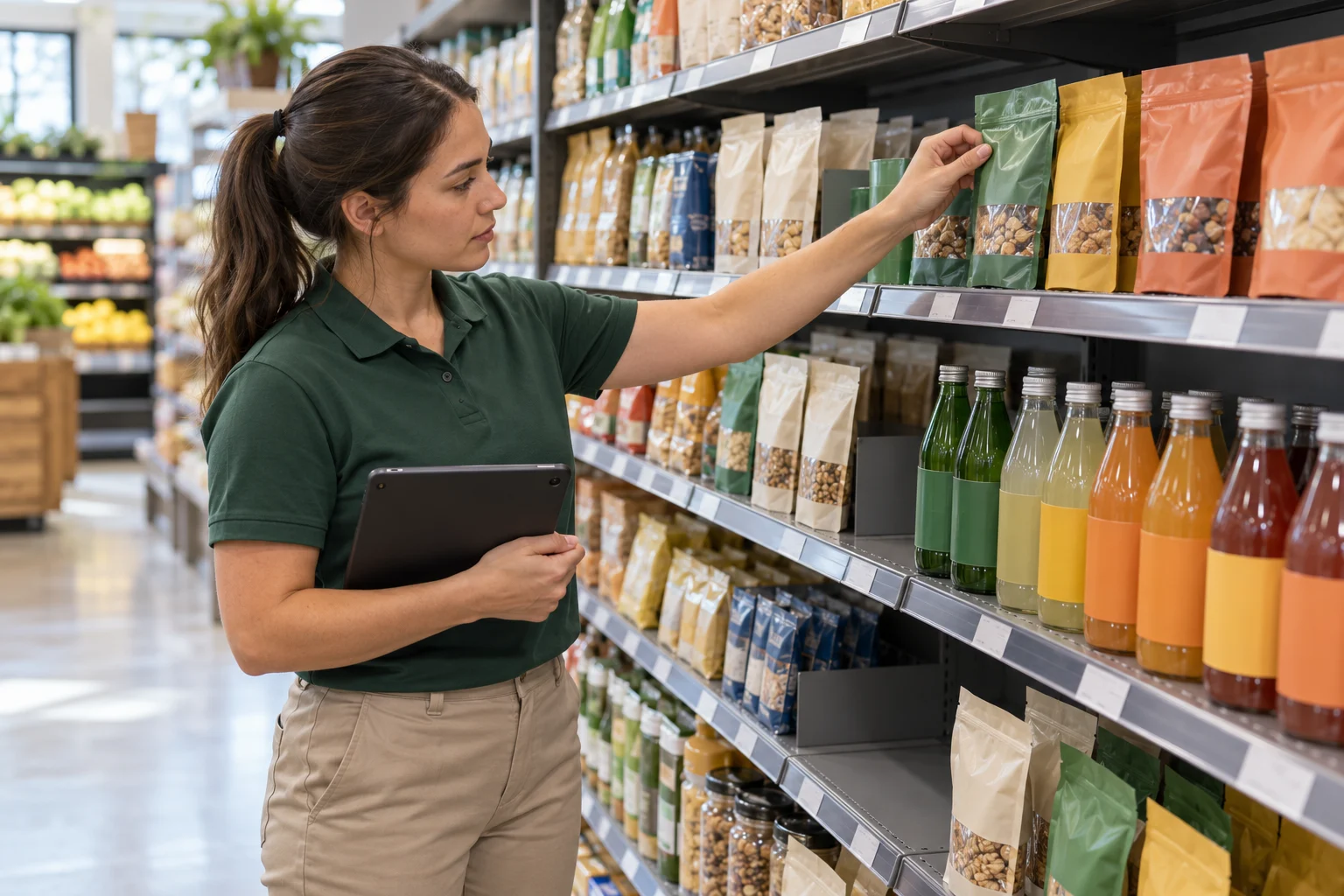
Consumer packaged goods are everyday items sold in packaging, consumed quickly, and repurchased often at relatively low unit prices. Food and drink, cleaning products, toiletries, cosmetics, over-the-counter medicine, pet food and paper goods all qualify.
The defining characteristic is replacement cycle rather than price. A shopper finishes a bottle of shampoo and buys another one, which means the manufacturer gets many chances to win or lose that customer, and the retailer treats shelf space as an asset that has to produce turns.
The CPG meaning is stable across the industry, and the acronym is used interchangeably with FMCG, or fast-moving consumer goods, which describes the same broad category. FMCG is the more common term outside North America and leans slightly harder on the speed of turnover, while CPG emphasizes the packaging and branding. In practice, treat them as synonyms. A fuller definition of the term and its boundaries lives in our CPG industry glossary entry.
CPG, Durable Goods and Everything Between
The cleanest way to place CPG is against what it is not.
| Consumer packaged goods | Durable goods | Services | |
|---|---|---|---|
| Typical unit price | Low | High | Varies |
| Replacement cycle | Days to weeks | Years | Ongoing |
| Purchase decision | Habitual, fast | Researched, considered | Contracted |
| Where it is sold | Grocery, convenience, mass, club, online | Specialty retail, dealerships | Direct |
| What drives growth | Distribution reach and velocity | Product cycles and financing | Retention |
| Inventory risk | Expiry and obsolescence | Depreciation | None |
The bottom two rows explain most of what is distinctive about working in CPG. Growth comes from being in more places selling faster, not from a better sales pitch to an individual shopper.
The expiry row is the one that bites hardest. Inventory with a date on it turns slow-moving stock from a carrying cost into a write-off, which is why the CPG supply chain network a brand builds has to move product at the speed the product actually sells.
Consumer Packaged Goods Examples
The category is broader than the grocery aisle suggests. Typical segments include:
- Food and beverage, from shelf-stable pantry items to refrigerated drinks and frozen meals
- Household care, covering cleaning products, laundry, paper goods and trash bags
- Personal care and beauty, including shampoo, skincare, oral care and cosmetics
- Over-the-counter health, such as pain relief, vitamins and first aid
- Pet care, spanning food, treats and litter
- Baby and childcare, including diapers, wipes and formula
- Tobacco, alcohol and other regulated consumables sold through the same channels
Each segment behaves differently despite sharing a definition. A refrigerated beverage needs cold-chain handling and has weeks of shelf life, while a bottle of dish soap can sit in a warehouse for a year. The operational demands diverge sharply even though both are CPG, which is why brands rarely transfer easily between segments. For a view of who leads each one, our roundup of top CPG brands covers the companies currently winning shelf space.
How Big the CPG Industry Is
CPG is frequently described as large without a number attached. There is a good one.
A PwC study conducted for the Consumer Brands Association, released in October 2024, found the industry supports 22.3 million jobs, or 10.5 percent of total U.S. employment, and contributes $2.5 trillion to U.S. GDP, close to 10 percent of the national total. The study also identifies CPG as the largest manufacturing sector by employment, and puts labor income supported at $1.5 trillion, including $195.2 billion directly.
The employment figure is the interesting one. A sector that is 10 percent of GDP but 10.5 percent of employment is labor-intensive relative to its size, which fits an industry whose product has to be physically manufactured, packed, shipped, delivered, stocked and merchandised, thousands of times a week, largely by people.
Where the Money Actually Goes
The most clarifying dataset in this industry is one CPG articles rarely cite. The USDA Economic Research Service maintains the Food Dollar Series, which traces how each dollar of U.S. food spending is divided across the supply chain.
In 2024, U.S. consumers spent $2.58 trillion on food. Of every dollar spent on domestically produced food, the farm share was 11.8 cents and the marketing share was 88.2 cents, that second figure covering processing, packaging, transport, wholesaling and retailing. Split by channel, the farm share is 18.5 cents for food eaten at home and 7.1 cents for food away from home.
Two caveats before anyone quotes that. It measures food specifically, not the household and personal care segments that also sit inside CPG. And it is a national average across all products, so a minimally processed item runs a much higher farm share than a packaged snack.
With those caveats, the point stands and it is a big one. Nearly ninety cents of every food dollar is created after the raw ingredient, in exactly the activities a CPG brand and its distribution partners perform. That is the value CPG captures, and it is also why execution in those activities, rather than the recipe, tends to decide which brands grow.
Four Routes to a Shelf
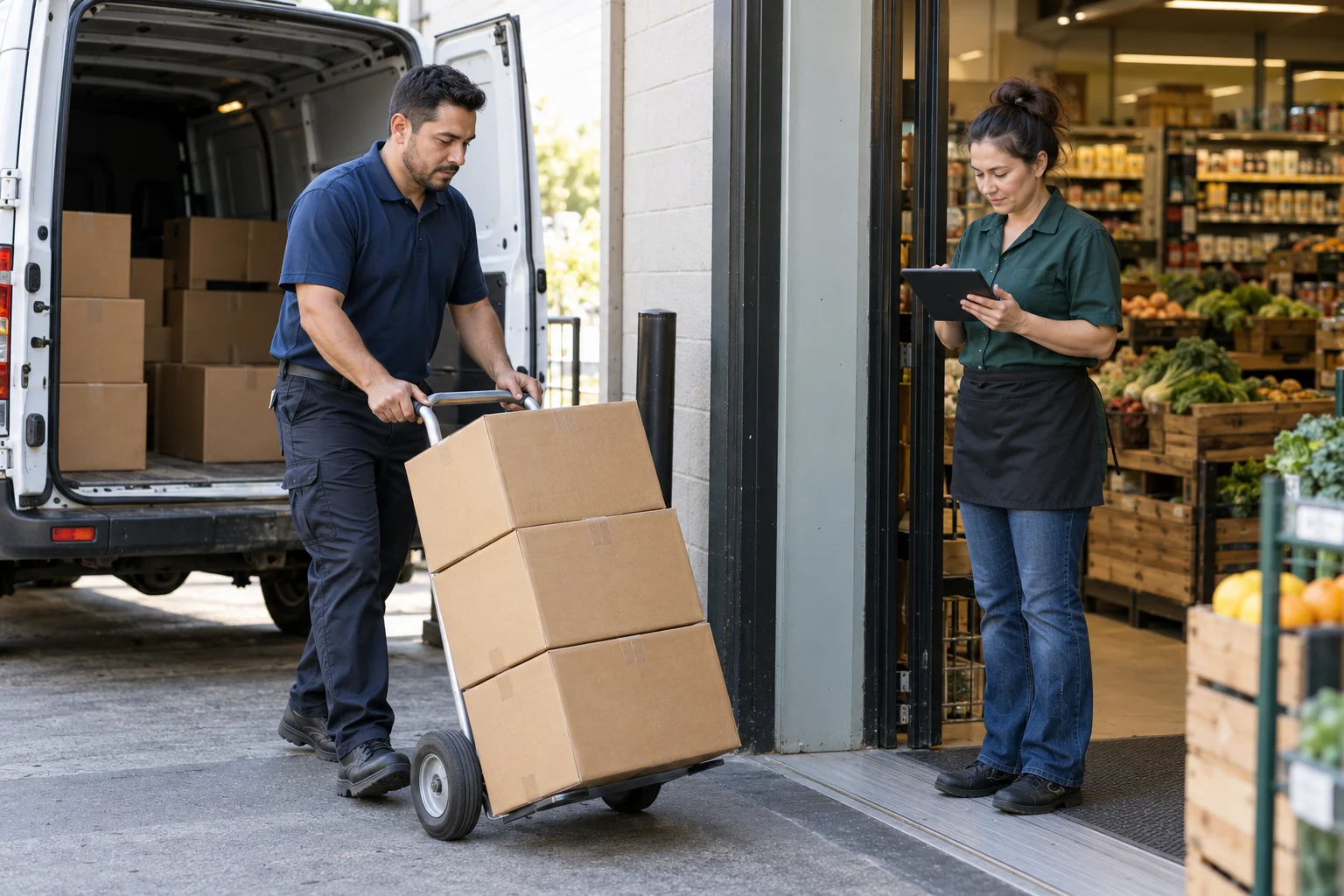
A CPG brand has to choose how its product physically reaches stores. There are four common models, and most growing brands run more than one at once.
| Route | How it works | Best for | The trade-off |
|---|---|---|---|
| Direct to retail | Brand sells and ships straight to the retailer’s warehouse | Chains with their own distribution | Retailer holds the power, payment terms stretch |
| Distributor | Brand sells to a wholesaler who sells on to stores | Broad geographic reach quickly | Margin sacrificed, and you lose visibility of the end store |
| Direct store delivery | Brand’s own reps sell and deliver to individual stores | Fresh, refrigerated and impulse items | Expensive to run, needs routes and vehicles |
| Direct to consumer | Brand sells online to shoppers | Launch, testing, high-margin niches | Does not build retail presence or scale volume |
The distributor route is the one brands misjudge most often. It buys reach fast, and it takes away the thing that lets you manage the business, because you stop seeing which stores actually carry you and how fast the product moves there.
Brands that scale well through distributors usually keep some field presence anyway, so somebody is still walking the stores. Weighing that trade against the alternatives is the central decision in product distribution, and it is rarely a one-time choice.
The Economics a CPG Brand Lives With
Three cost structures shape the business and none of them appear on a product page.
Trade spend is the money paid to retailers and distributors for promotions, discounts and display. It is often the second-largest line on a CPG brand’s income statement after cost of goods, and it is notoriously hard to measure, because the deduction arrives on an invoice months after the promotion ran.
Slotting fees are payments for shelf placement, common in larger chains, charged per SKU per store. They convert a distribution win into an upfront cash cost, which is why an underfunded brand can win a listing it cannot afford to service.
The third cost, being out of stock, does not appear anywhere at all. A shopper who reaches for your product and finds a gap buys the competitor, and often keeps buying it. Retailers track this closely and it influences whether your listing survives the next range review.
All three costs land months apart from the activity that caused them, which is the specific reason brands outgrow spreadsheets and start looking at distribution management software to hold the thread.
What Makes CPG Operationally Hard
The difficulty scales in a way that surprises founders. Selling into ten stores is a relationship business you can run from a phone. Selling into a thousand is a data business.
At ten stores the founder knows every buyer, remembers what each one ordered, and notices personally when something stops moving. At a thousand, nobody knows anything unless it was recorded, and the questions that were trivial become unanswerable: which accounts have not reordered in six weeks, which stores are missing the display they were paid for, whether the price on this invoice matches the agreed list.
That transition is where growing brands tend to break, and the account count at which it bites depends on how many stores one person can still hold in their head. The symptoms are consistent: orders re-keyed from photos of handwritten sheets, a spreadsheet per department, and a founder who finds out about a problem two weeks after it happened.
GNGR Labs, a New York wellness ginger shot brand founded in 2020 with a team of six, is a recognizable version of the moment. Its VP of Sales, Daniel Chechelnitsky, supervises reps, controls merchandising across stores, and oversees the distributor’s accounts as well. Its case study describes tracking orders, store visits and contact information in separate spreadsheets, with distributor communication living only in email, and reports the company freeing up 15 hours per week.
The pattern there is specific to CPG rather than general business advice. A brand-side sales lead in this category is running two distribution motions at once, direct field sales and a distributor relationship, and spreadsheets fail at the seam between them.
How CPG Brands Grow
Growth in packaged goods follows a fairly consistent sequence, and skipping steps tends to be expensive.
Prove velocity in a small footprint
Get into a handful of stores in one metro and measure how fast the product actually turns. Retail buyers and distributors both ask for this data, and having it is what turns a pitch into a listing.
Build repeatable execution before scale
Fix the ordering, delivery and invoicing process while the store count is small enough to correct mistakes by hand. Brands that scale on top of a broken process just make more mistakes faster.
Add channels deliberately, not opportunistically
Each new channel carries its own terms, margins and service requirements. Taking on a club retailer and a distributor network in the same quarter is how brands run out of cash while growing.
Defend the shelf you have
Reorder rate and on-shelf availability protect the base. A brand losing 10 percent of existing accounts a year needs to add that much just to stand still.
The second step is the one most commonly skipped, because process work feels like a distraction from selling. Sequencing the four correctly is most of what a CPG go-to-market strategy decides, and the order matters more than the speed.
The Operating Stack a Growing Brand Needs
Once a brand passes the point where memory works, a few capabilities become non-negotiable: a product catalog everyone works from, per-account price lists that apply themselves, order capture that works in a store, and a record of what each rep did at each account.
SimplyDepo is built for that seam. A brand’s orders, its shelf photos, its route for the day and its wholesale storefront all live in a single app, which is what stops the distributor side and the direct side drifting into separate systems.
The boundary is worth stating precisely. SimplyDepo handles the commercial and field side while your accounting system remains the book of record. It integrates with QuickBooks Online rather than standing in for it, and a brand needing full manufacturing resource planning still needs an ERP.
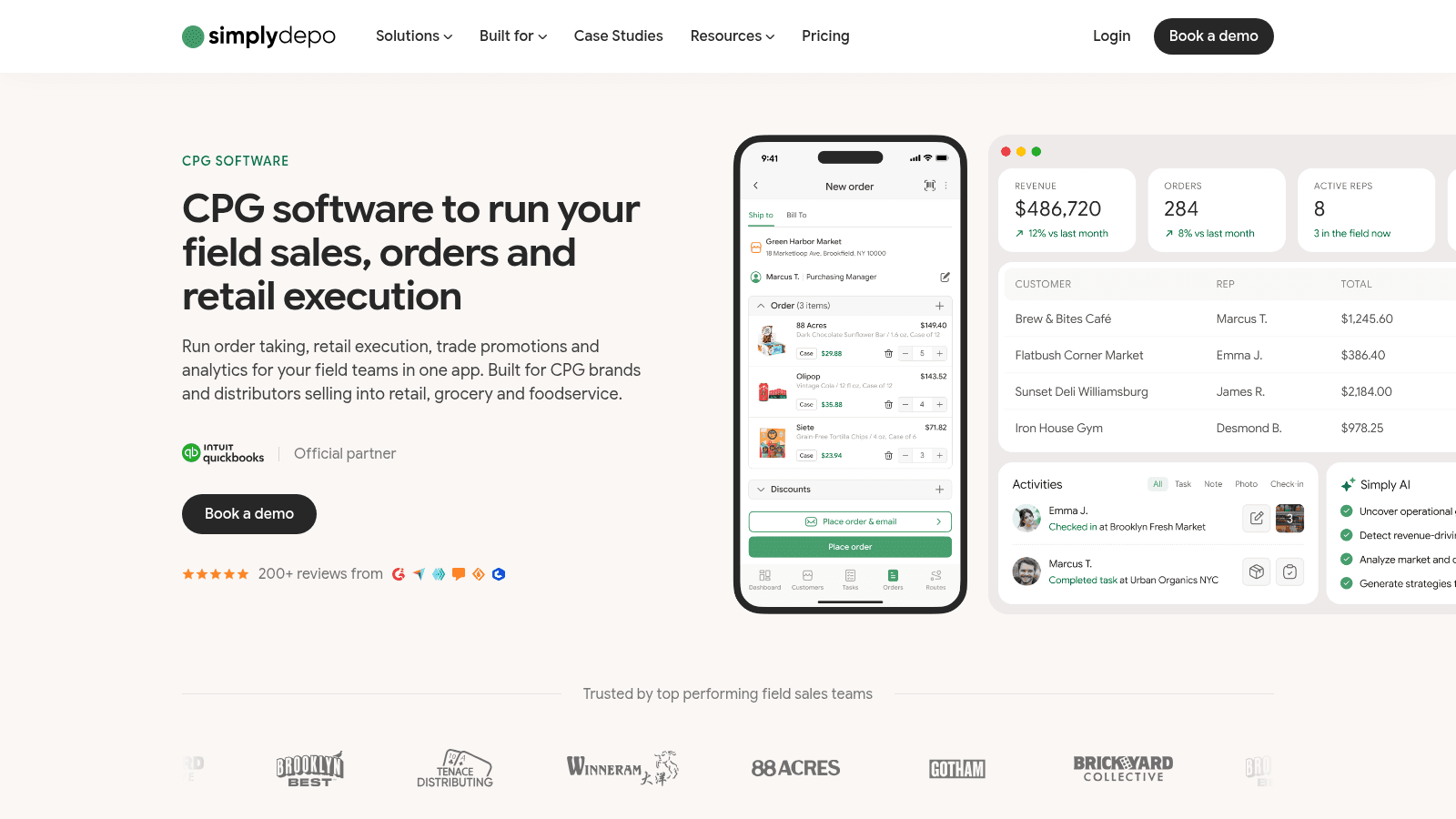
SimplyDepo’s CPG software page, simplydepo.com (September 2026).
Whichever platform a brand picks, the requirement that matters for CPG software is that a rep can complete a full store visit inside it without touching a second system.
The Numbers CPG Teams Watch
A short set of measures tells you whether a packaged goods business is working.
| Metric | What it answers | Why it matters here |
|---|---|---|
| Velocity, units per store per week | Is the product selling once it is placed | The number every buyer and distributor asks for |
| All Commodity Volume distribution | What share of the market’s sales sit in stores that carry you | Distinguishes wide but weak distribution from strong |
| On-shelf availability | Is it physically there when a shopper looks | Lost sales here never appear in any report |
| Reorder rate | Are accounts buying again | The earliest signal of sell-through as opposed to sell-in |
| Trade spend as a share of revenue | What growth is costing | Often the least controlled major line |
| Days sales outstanding | How fast retailers and distributors pay | Determines whether growth is fundable |
Velocity and distribution have to be read together. A brand in 2,000 stores selling half a unit a week per store is in a worse position than one in 300 stores selling six, because the first is about to be delisted in a lot of places at once, and current CPG industry trends have made buyers considerably quicker to act on that math.
Where to Begin
CPG is a simple idea with a demanding execution model. The products are inexpensive and familiar, the definition takes a sentence, and the whole difficulty sits in getting a physical item onto a great many shelves, keeping it there, and knowing what happened at each one.
The USDA’s food dollar figures make the point in a way arguments cannot: almost everything a consumer pays for is created after the raw material, in exactly the activities where CPG brands compete. If you are running a growing brand, the honest first question is not what your marketing looks like but whether you could name, today, which of your accounts have not ordered in six weeks.
SimplyDepo works that ground for brands and distributors across the US and Canada. New customers get a month to trial it, plus setup and training at no cost, and a booked demo is the route in.
Frequently Asked Questions
The CPG meaning is consumer packaged goods. The term describes everyday items sold in packaging that consumers use up and replace often, such as food, drinks, cleaning products, toiletries and pet food. The label is used mainly in North America; elsewhere the same category is usually called FMCG, or fast-moving consumer goods.
There is no meaningful difference in what they describe, and the terms are used interchangeably across the industry. CPG is the standard term in the United States and Canada and emphasizes packaging and branding, while FMCG is more common internationally and emphasizes how quickly the product turns over. Some analysts treat FMCG as the slightly narrower set covering only the fastest-moving items, but that distinction is not applied consistently enough to rely on.
Bottled drinks, snack foods, breakfast cereal, frozen meals, laundry detergent, dish soap, paper towels, shampoo, toothpaste, cosmetics, over-the-counter pain relief, vitamins, pet food and diapers are all consumer packaged goods. The common thread is that each is packaged, relatively inexpensive, bought regularly and used up, which is what separates them from durable goods such as appliances or furniture.
CPG companies earn a margin on each unit sold and depend on volume and repeat purchase rather than large individual transactions. Because unit margins are thin, profitability is driven by manufacturing efficiency, distribution reach and how well trade spending converts into sell-through. USDA figures show that for domestically produced food, 88.2 cents of every consumer dollar is generated after the farm gate, in processing, packaging, transport, wholesaling and retail.
It is a large and durable employer, supporting 22.3 million U.S. jobs according to the PwC study for the Consumer Brands Association, and demand stays comparatively steady because people keep buying essentials through economic cycles. The work is operationally demanding rather than glamorous, with margins that reward precision in supply chain, distribution and retail execution. Roles on the commercial side, particularly field sales and category management, tend to be the most accessible entry points.
-
 October 20, 2026
 -
 October 20, 2026
 -
 October 20, 2026