CPG Marketing: Channel Strategy for Brands


📌 Key takeaways:
- CPG brands have to market to both the channel and the shopper. Trade marketing wins distribution and shelf space, while consumer marketing creates the demand that keeps products moving.
- Pull-through demand makes distribution more sustainable. Retail media, sampling, influencer marketing, and other consumer tactics can improve velocity and give retailers a stronger reason to reorder.
- Measure marketing at the account level. Sell-through, velocity, distribution gains, and store-level performance give CPG brands a clearer picture of what’s working across distributor and retail channels.
You can run the sharpest campaign of the year and yet never watch a single person buy the thing you made.
The shopper reaches for your product on a shelf you don’t own, hands a card to a cashier you’ll never meet, and pays a retailer who never sends you the receipt.
If the purchase reaches you at all, it arrives weeks later as a line in someone else’s sell-through report.
That distance between the marketing and the money is the defining condition of selling through distributors. It shapes who a CPG brand markets to and how it proves any of that spending worked. In this guide, we’ll take that distance as the starting point and help you build the channel strategy around it.
What is CPG marketing, and why is the distributor model the hard part?
CPG marketing is the work of building awareness, trial, and repeat purchase for consumer packaged goods: the food, drinks, personal care, and household items people buy and replace on a regular cycle.
The category is crowded, switching costs are near zero, and brand loyalty is thin, so CPG marketers are always working to earn attention and hold it.
A typical consumer packaged goods brand doesn’t sell to shoppers directly. It sells through intermediaries, wholesalers and distributors who warehouse the product, and retailers who put it on a shelf. That single fact reshapes everything downstream.
Three consequences follow for you as a brand:
- You market to two audiences, not one, since the channel sits between you and the shopper, and you have to sell into it and pull demand through it
- You measure your marketing efforts through numbers that mostly belong to someone else
- You get limited first-party data, because you don’t own the transaction, which pushes brands to find their own ways to build it
Who are you really marketing to when you sell through distributors?
When you sell through distributors, you have two audiences with different motivations, and they usually need two different budgets.
1. The trade audience: Distributors, buyers, and category managers
The first audience never eats your snack or drinks your beverage.
Distributors, retail buyers, and category managers decide whether your product gets a place in the warehouse and a spot on the shelf.
They evaluate you on cold commercial terms: proven consumer demand, healthy margin, reliable supply, and velocity.
Marketing to this audience means trade marketing. It runs on sell sheets, category stories, promotional allowances, and in-store promotions negotiated account by account.
This is the demand you push into the channel, the work of convincing the people who control distribution that your product earns its space.
2. The consumer audience: The shopper who lifts it off the shelf
The second audience is the shopper. Here you’re building awareness, driving trials, and turning first-time buyers into loyal customers.
These are the tactics people picture when they think of marketing: social media, influencer partnerships, content, retail media, sampling, and coupons.
Where trade marketing pushes product into the channel, consumer marketing pulls it back out.
The two usually sit with different teams chasing different KPIs, and a channel strategy falls apart when they drift out of sync. Coordinating them is the harder, more valuable job.
What is pull-through marketing, and why does it win shelf space?
Pull-through marketing is the consumer demand you create on purpose so that shoppers walk in already wanting your product. When people ask for it by name, distributors and retailers get a reason to stock it, keep it stocked, and give it better placement.
Set that against push, the trade incentives that get products into the channel in the first place. Brands need both, but pull is what makes push sustainable.
A retailer will accept a slotting deal once. What earns the reorder is velocity, and velocity comes from shoppers buying, which is what consumer demand generation produces.
The tactics that create pull
Tactics that generate real pull tend to sit close to the purchase decision.
Retail media, advertising on a retailer’s own digital platform, reaches shoppers at the point where they’re choosing between you and the item beside you.
Social proof from user generated content, influencer marketing that seeds authentic trials, and sampling that gets product into hands all do the same job from different angles. They manufacture the demand that makes your product hard for a retailer to drop.
How should you split the budget between trade marketing and brand marketing?
Every dollar of marketing spend leans one of two ways, and the two pull against each other.
Trade spend, the promotions, discounts, and allowances that buy distribution and shelf presence, works now. It gets your product placed and keeps buyers happy.
Brand marketing, the awareness and loyalty work, pays off later by building demand that makes distribution defensible.
Lean too hard on trade and you rent shelf space you can’t hold without permanent discounting, which erodes margin and trains shoppers to wait for the deal.
On the other hand, if you lean too hard on brand, you build consumer demand for a product nobody can find, since you never invested in getting placed.
What’s important here is the stage you’re at. Earlier-stage CPG brands usually weight toward trade to earn placements and prove velocity, then shift toward brand marketing as sell-through data accumulates and gives them room to reduce promo dependence.
| Dimension | Trade marketing | Consumer (brand) marketing |
|---|---|---|
| Audience | Distributors, retail buyers, category managers | End shoppers |
| Goal | Win and defend shelf placement | Create awareness, trial, and loyalty |
| Direction | Push (into the channel) | Pull (through the channel) |
| Typical tactics | Slotting, trade promotions, co-op, sell sheets | Retail media, social, influencer, sampling |
| Primary metric | Distribution, velocity, sell-through | Awareness, trial rate, repeat purchase |
| Pays off | Now (placement) | Over time (defensible demand) |
Neither column is optional. The split just moves as the brand matures and the consumer demand becomes strong enough to carry more of the weight.
How do you measure CPG marketing when the sale happens on someone else’s shelf?
This is where CPG marketing analytics parts ways with digital marketing. There’s often no direct line from an ad to a purchase, because the retailer owns the point-of-sale data and shares it on their own terms, if at all.
So you measure through proxies and partial views.
Sell-through and velocity by account tell you how fast product moves in specific stores. Distribution gains, new doors opened and new SKUs added per door, show whether pull is translating into shelf.
Syndicated data from firms like NielsenIQ and Circana gives you category-level movement, drawing on point-of-sale feeds from a vast network of stores.
Retail media platforms hand you their own closed-loop numbers. Proxy consumer signals like branded search, social engagement, and sampling redemption hint at demand forming before it reaches a register.
Marketing creates consumer pull, that pull shows up as velocity in specific accounts, and that velocity is your case to a buyer for more shelf.
Why account-level visibility matters more than campaign dashboards
A national awareness lift means little if it doesn’t convert in the stores that carry you.
Two stores with the same SKU can post very different velocity, depending on placement, local demand, or whether the shelf was even filled that week.
Measuring at the account level turns “the campaign did well” into a specific story you can take to the next buyer meeting.
The catch: this arrives as a dense distributor report, and the account-level story (which stores are moving products and which aren’t) stays buried in it. Use an AI data analyst to read the file and pull those trends out for you.
How do you build first-party data when you sell through distributors?
Measuring through other people’s numbers has a ceiling. When the retailer owns the checkout, it owns the purchase data, and that’s the silent tax on selling through distributors.
It’s the reason CPG marketers so often plan campaigns without knowing who bought, how often, or why they stopped.
The workaround for many CPG companies has been to open a direct-to-consumer channel, not because it will ever replace retail volume, but because it produces first-party data the brand can own.
A small online store, a subscription option, or a sampling program gives you consumer insights you can feed back into your broader marketing strategies.
Even for the channels you sell through indirectly, that data sharpens your audience segmentation.
The other lever is building owned relationships that don’t depend on the retailer at all.
Email marketing, loyalty programs, and an engaged social media following let you reach loyal customers directly, learn their preferences, and test messaging before it ever runs at scale.
None of this replaces the shelf. It just gives you a set of signals you control, and it makes the rest of your marketing efforts less of a guessing game.
💡 Also read:
What marketing trends should channel-driven CPG brands watch?
Two key trends would be omnichannel marketing and value-based positioning.
Omnichannel marketing
Shoppers move between digital and physical touchpoints without thinking about it. They check a product on their phone in the aisle, see a social media ad, then buy in store a week later.
Consistent messaging across digital and traditional channels lets your brand stand out across that fragmented customer journey.
Positioning on value, not just price
Changing consumer preferences are pushing people toward brands that share their priorities on health, sustainability, or sourcing.
A clear value proposition is what separates an established brand from the private-label alternative sitting one facing over. That positioning has to survive the trip to the shelf.
Packaging ends up carrying as much of the message as any campaign, since it’s the last marketing asset a shopper sees before deciding.
These trends reward brands that connect their marketing to what happens in the store.
Did you know?
Private label sales in the US hit a record $282.8 billion in 2025, growing at nearly three times the rate of national brands.
Build a channel-aware CPG marketing engine
Selling through distributors splits your job in two: you market to the trade that controls the shelf, and to the shopper who empties it.
Pull-through demand is what ties the two together, since it’s the consumer interest that earns placement and the reorder that defends it. There’s no clean attribution line to point to, so proving it worked means reading velocity and proxy signals instead.
The brands that pull this off share one habit: they know exactly what’s selling in which account, in real time. Most channel data doesn’t offer that. It comes as reports, and the account taking off and the one stalling are both buried inside them.
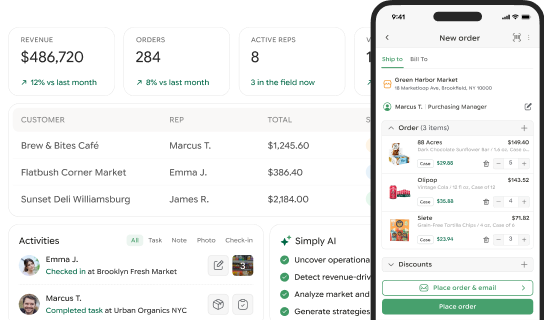
CPG software closes that gap. A platform like SimplyDepo gives CPG brands and distributors per-account pricing and trade promotion tracking to see which deals moved product, plus sell-through analytics by SKU and account pointing out what sells where.
With that store-by-store picture, marketing and trade work from the same numbers, and a campaign result becomes the velocity argument that wins the next placement.
Book a demo to see how SimplyDepo can sharpen your CPG marketing.
FAQs on CPG marketing
They market to two audiences at once. Trade marketing targets the distributors and retail buyers who control shelf space, using promotions, allowances, and category stories. Consumer marketing targets shoppers through social media, influencer partnerships, and retail media. Pull-through demand ties the two together, since consumer interest is what convinces the channel to stock and reorder the product.
Trade marketing aims at distributors, buyers, and category managers, and it’s judged on distribution and velocity. Consumer marketing aims at the shopper who buys the product, and it’s judged on awareness, trial, and repeat purchase. Trade pushes product into the channel; consumer marketing pulls demand through it. Nearly every CPG brand runs both in parallel.
Pull-through marketing is consumer demand you deliberately create so shoppers seek out your product, which gives retailers and distributors a reason to stock and reorder it. Tactics include retail media, influencer marketing, sampling, and user generated content. It’s the counterpart to push marketing, which uses trade incentives to get products onto shelves in the first place.
It depends on the stage. Early-stage brands usually weigh toward trade spend to earn placements and prove velocity, since distribution comes first. As sell-through data builds and demand strengthens, the smart move is to shift more budget toward brand marketing, which reduces dependence on constant discounting and builds loyalty that protects margin over time.
Retail media is advertising on a retailer’s own digital properties, its website, app, and sometimes in-store screens. It matters for CPG because it reaches shoppers at the point of purchase, targets using the retailer’s own consumer data, and produces measurable signals tied to specific accounts. That last part is rare in a channel where brands don’t own the customer relationship.
 Rated 4.7 on G2
Margins are tight. Visibility shouldn't be.
-
 September 16, 2026
 -
 September 15, 2026
 -
 September 15, 2026