Retail Supply Chain Management: How Brands & Distributors Sync


📌 Key takeaways:
- Effective retail supply chain management depends on brands and distributors working from the same source of truth. When data falls out of sync, stockouts and chargebacks become more common.
- Metrics such as OTIF, on-shelf availability, sell-through rate, order accuracy, and inventory turnover help teams identify where coordination gaps are affecting performance.
- Real-time visibility helps brands forecast demand more accurately and gives distributors the information needed to execute efficiently. It also supports stronger retailer compliance.
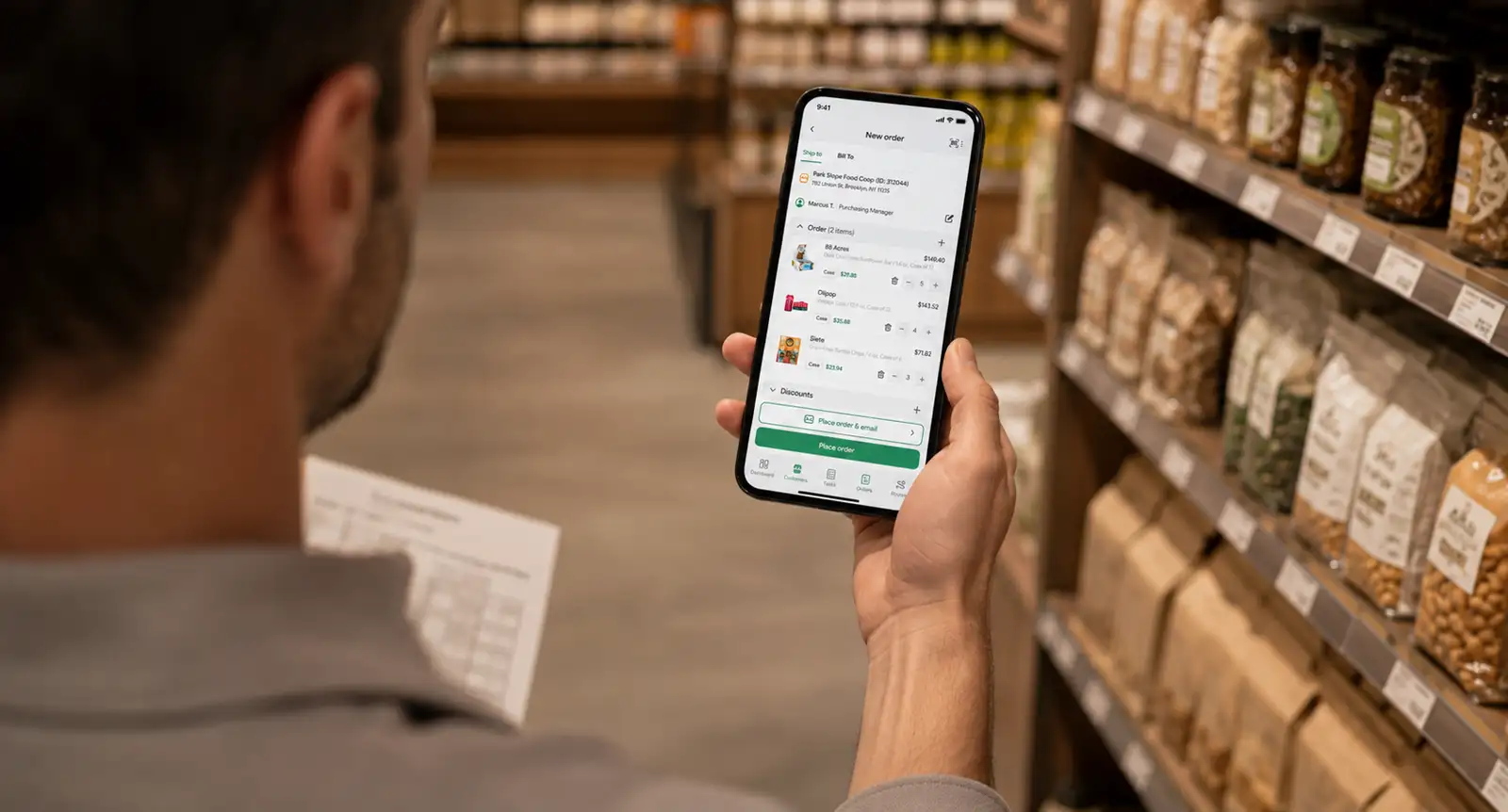
A field rep pulls up at a grocery account and places an order based on what the system shows.
But behind the scenes, the warehouse had already run out of three of those SKUs. The inventory data just had not caught up.
Two days later, the retailer gets a partial shipment, the brand takes a chargeback, and the rep fields a complaint call.
No one’s at fault; blame it on the sync failure.
That’s the core problem retail supply chain management exists to solve.
For CPG brands and distributors, it’s not enough to move product efficiently at each individual stage.
The entire supply chain has to move as one: demand signals flowing from the field to the brand, inventory data flowing from the warehouse to the rep, and fulfillment data closing the loop back to everyone.
When those connections are solid, reliable delivery becomes a genuine competitive advantage. But when they break, the costs show up as stockouts, chargebacks, and lost customer loyalty.
What does retail supply chain management cover for CPG teams?
Retail supply chain management is the coordination of every process that moves product from production into a consumer’s hands: sourcing, inventory management, warehousing, order fulfillment, and logistics operations.
The CPG-specific pressures
CPG products move in high volumes on short replenishment cycles.
Demand uncertainty can lead to stockouts or excess inventory with very little warning. A regional trade promotion can empty shelves faster than a monthly forecast accounts for.
Shelf-life constraints mean inventory costs compound quickly when the product sits too long. And the multi-tier structure of CPG distribution (brand to distributor to retailer) creates multiple handoff points where supply chain data can slow down or fragment.
Why compliance raises the stakes
Retailers face challenges managing multiple vendor relationships, and their response has been to enforce increasingly strict delivery requirements, using metrics such as OTIF (on-time, in-full).
Meeting those standards requires supply chain visibility that extends across the entire chain, not just within each party’s own systems.
This is what separates CPG retail supply chain management from a generic supply chain strategy: it is as much a coordination problem as a logistics one.
Understanding how CPG distribution channels work is the starting point; keeping brand and distributor data in sync is what drives supply chain efficiency in practice.
Where does brand-distributor sync break down?
Supply chain disruptions in CPG distribution rarely begin with a truck breakdown or a port delay.
For most brands and distributors, the breakdown starts earlier, in the information layer that connects them.
Stale inventory data leads to order errors
When field sales reps place orders using inventory data that’s hours or days old, the results are predictable: overselling product that is no longer available, or leaving money on the table because the system shows low stock when the warehouse has plenty.
Both outcomes hurt.
Overselling creates partial shipments and chargebacks. While underselling means missed revenue.
Phantom inventory compounds this. When a retailer’s system shows units in stock that are not physically on the shelf, nothing triggers a reorder and the product stays out of stock until someone catches it manually.
Inventory record inaccuracy is one of the most persistent operational problems in retail, and fixing it drives measurable improvements in sales and on-shelf availability.
Real-time inventory tracking is the operational fix. But getting that data to the rep before they place the order is the bigger challenge.
Demand signals do not flow back from the field
Distributors sit on sell-through and velocity data that brands need for accurate demand forecasting.
In most operations, that data flows back slowly in the form of weekly reports, monthly summaries, or not at all.
Brands forced to forecast off shipment data alone are looking at what they sent, not what sold.
The difference between those two numbers is where the bullwhip effect takes hold. Small fluctuations in actual retail demand trigger exaggerated inventory swings further up the chain, leading to overproduction in one cycle and shortfalls in the next.
Effective supply chain management depends on closing this loop. Accurate demand forecasting requires sell-through data from the field, not historical sales data that is already three weeks old.
Trade promotions fall apart at execution
A brand funds a trade promotion. The distributor’s field reps may not have clear visibility into which accounts are eligible, which SKUs are discounted, or when the window closes.
The result: uneven execution across accounts and a promotional lift that falls short.
Aligning promotional data before the window opens is a high-leverage sync point in the brand-distributor relationship.
Who owns what in the retail supply chain?
Sync failures in CPG retail supply chains usually happen at the handoff points, where one party needs data or direction that the other holds.
The first step toward closing the chasm is to map those handoffs clearly.
Brand vs. distributor responsibilities
| Function | CPG brand’s responsibilities | Distributor’s responsisbilities |
|---|---|---|
| Demand forecasting | Leads; uses shipment data and historical sales data | Contributes sell-through and velocity data from field |
| Inventory positioning | Sets safety stock targets and reorder triggers | Manages warehouse stock levels and replenishment to accounts |
| Order management | Issues purchase orders to distributor | Processes orders from retail accounts |
| Pricing and promotions | Sets trade terms and promotional windows | Executes at account level; applies correct pricing in the field |
| Last-mile delivery | Defines delivery windows and compliance requirements | Plans routes, executes deliveries, confirms proof of delivery |
| OTIF compliance | Tracks performance against retailer requirements | Directly accountable for on-time, in-full delivery |
| Supply chain data | Needs sell-through data for future customer demand planning | Owns field-level sales data but must share it upstream |
The sync problem lives in the right column of that table: the distributor owns execution data that the brand needs to forecast accurately, and the brand holds pricing and compliance direction that the distributor needs.
When that data does not travel between them in real time, both sides end up optimizing their own column without enough visibility into the other’s. The right metrics make those blind spots visible.
💡 Pro tip:
Review retailer deductions and chargebacks by root cause every month. Many brands track the total cost of deductions but miss the patterns behind them. Separate OTIF misses, pricing disputes, and shipment discrepancies to reveal recurring process issues that cost far more than a single failed delivery.
Which metrics reveal whether the sync is working?
These five metrics track where brand-distributor sync is working and where it’s not:
Delivery and accuracy metrics
- OTIF (on-time, in-full): A supply chain metric that measures whether an order arrives exactly when promised and contains every item and quantity requested. Retailers use OTIF to evaluate supplier performance because even small delays or short shipments can disrupt shelf availability and customer demand.
- Order accuracy rate: The percentage of orders fulfilled without errors. Errors trace almost directly to the data quality available at the moment the order was placed: inventory levels that were inaccurate, pricing that had not been updated, or promotional flags missing from the rep’s screen.
Inventory and demand metrics
- On-shelf availability (OSA): Whether products are physically on the shelf when a consumer reaches for them.
- Sell-through rate: How quickly a product moves from distributor to retailer. A low sell-through rate with adequate supply points to a field execution problem. On the other hand, a low sell-through rate with supply shortfalls points to a demand forecasting failure.
- Inventory turnover: How efficiently the supply chain is converting stock into sales. Optimized inventory management can reduce carrying costs meaningfully, but inventory turnover only improves when demand forecasting and replenishment decisions are based on real-time data rather than lagged reports.
These metrics are most useful when both brand and distributor track them from the same data source. Separate dashboards with different update cadences produce different numbers, and usually, the wrong conversations.
How do you tighten the loop between brand and distributor?
Here are three key ways you can keep CPG brands and distributors in sync:
1. Share demand signals in real time
Brands that wait for weekly or monthly sell-through reports from distributors are forecasting in arrears.
The better model is shared real-time visibility into what is selling at the account level: velocity by SKU, movement by territory, early signals of demand spikes before they become inventory problems.
This is as much a workflow change as a technology one: it requires distributors to treat field data as a shared asset, not an internal report.
When the data inputs are current, AI and ML can optimize demand forecasting and logistics planning across the supply chain.
McKinsey research on AI-enabled distribution operations points to inventory reductions of 20 to 30 percent and logistics cost reductions of 5 to 20% as achievable outcomes. Brands that build this capability report fewer overproduction cycles and lower inventory costs over time.
2. Align promotional execution before the window opens
Trade promotions are one of the most expensive coordination failures in CPG distribution.
Promotional lift only materializes when every rep knows which accounts are eligible, which SKUs are discounted, and when the window closes.
Before a promotion launches, confirm that updated pricing is live in the ordering tool and managers have briefed their reps on timing. Proof of delivery then confirms that inventory reached the right accounts on schedule.
3. Make OTIF accountability a shared metric, not a one-sided penalty
When distributors experience OTIF purely as a compliance requirement passed down from the brand, the response is reactive: expedite the shipment and absorb the chargeback.
But when both brand and distributor track OTIF together and trace each miss back to its root cause, the conversation shifts from blame to problem-solving.
Was it a route failure? An order error? Stale inventory data at the time of picking?
Each root cause has a different fix, and identifying it requires data from both sides of the relationship.
Joint OTIF scorecards and a regular operations cadence between brand supply chain teams and distributor ops managers catch problems while they are still recoverable.
Give field reps data they can act on at the account level
Field reps are the closest point in the supply chain to the retail accounts that keep the brand on shelf.
Equip them with live inventory data, account-level order history, and route-optimized schedules, and convert them from order-takers into active participants in supply chain operations.
A rep who can see that a key account is approaching reorder threshold before the next scheduled visit can act before the stockout registers as an OTIF miss.
This is where real-time data and field execution converge. According to IHL Group’s research, global retailers lose an estimated $1.7 trillion annually from inventory distortion (the combined cost of stockouts and overstocks), and a significant portion of those losses happen because no one caught the signal in time to act on it.
What does good retail supply chain management look like in practice?
When the brand-distributor sync is working, data flows in a closed loop rather than accumulating in silos at each stage.
The data flow cycle
The brand updates demand forecasts based on real-time sell-through data.
Then the distributor’s warehouse team sees updated stock targets and triggers replenishment before safety stock is breached.
Field reps receive account-specific route schedules and order screens populated with live inventory. They place orders against what is actually available.
Electronic proof of delivery closes the loop on each stop, giving both the brand and the distributor a shared record of what shipped and when.
That fulfillment data feeds back into the brand’s supply chain data layer, updating forecasting models for the next replenishment cycle.
Building resilience into the chain
Automation reduces labor costs and improves order fulfillment accuracy throughout this loop.
Modern retail supply chain management software increases flexibility and supply chain agility to adapt to market conditions faster.
Cloud-based systems improve end-to-end supply chain visibility, giving brand planners, distributor ops managers, and field reps a consistent view of the same data.
Teams that close this cycle operate with fewer stockouts, lower chargeback exposure, and stronger retailer relationships.
Keeping CPG brands and distributors in sync, at all times
Retail supply chain management for CPG brands and distributors is a coordination problem.
The sourcing, manufacturing, warehousing, and logistics operations involved in getting product to the shelf are well understood. What separates high-performing operations is not the sophistication of any individual function: it is how cleanly those functions connect to each other.
Closing the information loops between brand and distributor is what turns supply chain processes from a cost center into an advantage. It’s also what keeps customer satisfaction stable as customer demand shifts, supply chain disruptions hit, and retailers raise the bar on compliance.
Distribution management software built for CPG teams brings these functions into a single connected system.
A platform like SimplyDepo gives brands and distributors real-time inventory visibility across locations, mobile order capture for field reps with full offline support, route optimization to reduce shipping costs, automated reorder triggers, and QuickBooks integration to keep operations and finance aligned.
Everything the brand’s supply chain team needs to see, and everything the field team needs to act on, runs from the same data.
Book a demo to see how SimplyDepo can fit into your workflow.
FAQs on retail supply chain management
Retail supply chain management for CPG brands covers all supply chain processes involved in moving product from production to the retail shelf: demand forecasting, inventory management, distributor coordination, order fulfillment, and logistics operations.
In the CPG context, high-frequency replenishment cycles, short shelf lives, multi-tier distribution through distributors and retailers, and strict OTIF compliance requirements from major retail partners all define the scope.
Sync depends on real-time data flowing in both directions: sell-through and velocity data from the distributor’s field team to the brand for demand forecasting, and inventory positions, pricing, and promotional data from the brand to the distributor’s reps.
Shared OTIF tracking, joint operational reviews, and mobile sales tools that give field reps live inventory data are the practical mechanisms that keep operations aligned.
The most common causes are stale inventory data at the time of ordering, phantom inventory that hides out-of-stocks in the system, demand spikes from promotions or trends that outpace forecasts, and slow sell-through data that delays the brand’s ability to respond.
Demand uncertainty can lead to stockouts or excess inventory when the information connecting brand, distributor, and retailer is not current.
OTIF (on-time, in-full) measures whether orders arrive complete and within the required delivery window. Major retailers enforce strict compliance thresholds and apply financial penalties for misses.
For CPG distributors, OTIF performance directly affects shelf space allocation and retailer relationships. An OTIF failure almost always traces to an upstream failure in data or coordination.
Field reps generate sell-through and velocity data at the account level that reflects actual consumer demand, not just what the brand shipped to the distributor.
When that data flows back to the brand in real time, teams can base forecasting on what consumers are buying rather than on shipment volumes that may reflect distributor stock-building. This reduces the overproduction and inventory correction cycles that drive up supply chain costs.
CPG distributors use distribution management software that connects inventory management, B2B order management, route planning, and field execution in a single system.
This is distinct from traditional ERPs, which handle financial operations but usually lack the last-mile and field execution functionality that distributor teams need on the ground.
The most effective platforms provide real-time inventory tracking, mobile access for field reps, automated reorder triggers, and integration with accounting tools.
-
 October 20, 2026
 -
 October 20, 2026
 -
 October 20, 2026