Trade Marketing for CPG Brands: Strategy, Budgets, and ROI

📌 Key takeaways:
- Trade marketing helps CPG brands win distribution and shelf visibility by influencing retailers, distributors, and other channel partners before the shopper ever reaches the aisle.
- A strong trade marketing strategy ties spend to growth opportunities, sets clear guardrails before retailer negotiations, and adapts tactics to each sales channel.
- ROI depends on incremental sales rather than total promotional volume. Brands also need store-level execution data to confirm that planned promotions actually reached the shelf.
The product is a hit. Reviews are glowing, the founder is convinced the hard part is behind them.
Then the sell-through reports come in flat, and the reason has nothing to do with whether consumers want it. It comes down to whether the product sits on enough shelves, at the right price, in the store where those shoppers buy.
Brands win that fight long before a shopper reaches the aisle. It happens in a meeting with a category buyer who decides whether a new beverage gets four facings or none. It happens on a distributor’s order sheet, and in a promotion calendar negotiated with retailers account by account.
This is the work of trade marketing.
It often runs larger than the entire consumer marketing spend, yet very few brands can say with confidence whether it pays off. This guide walks through the three questions that settle it: building the strategy, setting the budget, then proving the return.
What is trade marketing, and how is it different from consumer marketing?
Trade marketing is a B2B strategy aimed at the supply chain partners that carry a product to the shelf: distributors, wholesalers, and retailers.
Rather than selling to the end consumer directly, it focuses on selling through the channel, convincing each partner to stock and promote the product.
Consumer marketing courts the person who eats the snack; trade marketing courts the buyer who decides whether the snack gets stocked at all.
The two run on separate budgets. Consumer marketing moves demand, graded on awareness and household penetration.
On the other hand, trade marketing moves availability and conversion at the point of sale, graded on distribution, shelf space, and promotional lift once you net out the spend.
It complements traditional marketing strategies rather than replacing them.
One more distinction trips up newer brands: trade marketing versus shopper marketing. Shopper marketing targets the end buyer at the moment of purchase, while trade marketing targets the partner who controls that moment. A brand can have consumers who genuinely want the product and still stall out when it reaches too few shelves.
Why is trade marketing important?
Trade marketing is important because it connects manufacturers with retailers effectively and turns a product shoppers might want into one they can find. Much of a CPG brand’s growth is won or lost at this layer, where product visibility and availability decide whether demand ever converts into sales.
It counts the most in industries with complex distribution. Trade marketing is crucial in FMCG and pharmaceuticals, where thousands of SKUs compete for finite shelf space across countless retail channels.
CPG brands like Coca Cola built their reach on relentless availability and cooler placement as much as on advertising. It’s a reminder that being wanted means little without being present.
Done well, effective trade marketing helps brands gain market share and secure shelf space, while building the partner relationships that make the next product launch easier.
It rests on a solid foundation of trust with the channel, and that trust compounds over time.
What does trade marketing include?
Think of trade marketing as an umbrella rather than a single activity.
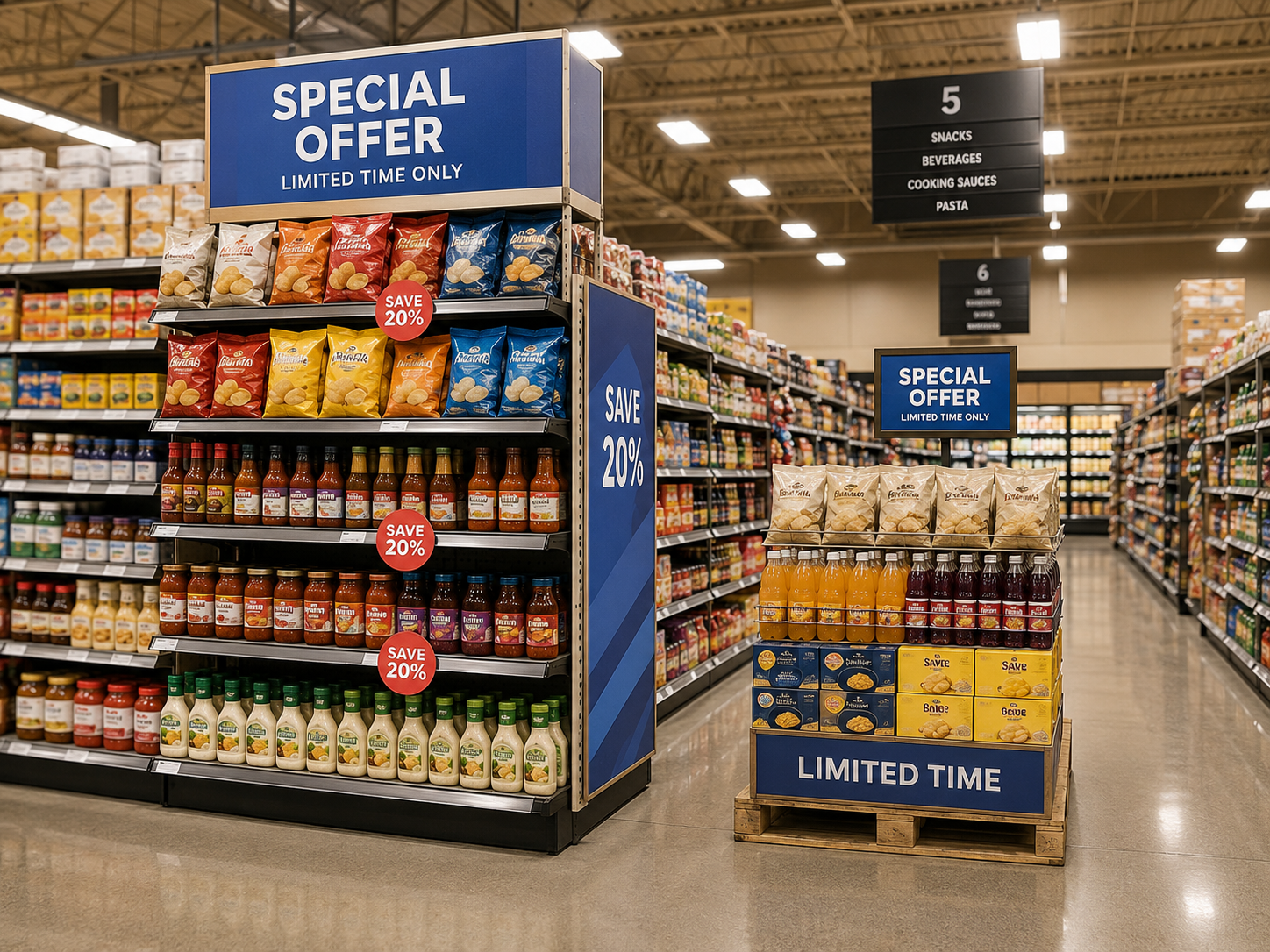
Trade promotions, the temporary price cuts and retail displays most people picture first, are one component of it.
The main categories of trade spend
Key activities of trade marketing include trade shows, in-store displays, and retailer-specific promotions.
The spend falls into a handful of categories:
- Listing and slotting fees
- Price-based promotional activities like temporary price reductions and off-invoice allowances
- Feature and display
- Co-op advertising, and
- Distributor incentive programs.
Companies also use trade shows to demonstrate products and attract new partners.
Each category is a separate negotiation with a specific retailer or distributor, and each comes back later as a deduction against the brand’s invoices.
| Tactic | What it buys | Best used for |
|---|---|---|
| Slotting/listing fees | A new SKU’s place in a retailer’s planogram | Launching into a new account or channel |
| Temporary price reductions (TPRs) | A lower shelf price for a set window | Driving short-term volume and trial |
| Off-invoice allowances | A per-case discount that funds retailer promotions | Supporting retailer-led price events |
| Feature and display | End-caps, circular ads, secondary placements | Visibility spikes around a season or launch |
| Co-op advertising | Shared advertising cost with the retailer | Building the brand within a retailer’s audience |
| Special offers and samples | Discounts, bundles, and product samples | Trial, seasonal pushes, and store associate buy-in |
How do you build a trade marketing strategy?
A promotion calendar copied from last year is not a strategy. A real trade marketing strategy answers four questions before the first promo date:
- How big is the budget?
- Where does the money go?
- What is each block of spend for?
- Where are the guardrails?
Getting there starts with market research and clarity on consumer needs and shifting CPG industry trends.
1. Allocate against goals
The common mistake is funding accounts and SKUs in proportion to their current sales share, which just entrenches wherever the brand already sits.
Allocation should follow the opportunity, directing more spend toward the accounts and products with room to grow.
Depth should track brand positioning too: a premium SKU rarely benefits from a deep discount, while a value SKU can carry price depth as part of its identity.
2. Set guardrails before the buyer meeting
Buyers negotiate for a living, and without limits set in advance, trade spend leaks away one account at a time.
Write the guardrails down beforehand: a floor price, a maximum discount depth, a cap on how often a SKU goes on sale.
Aligning brand goals with retailer needs keeps the conversation collaborative. That collaboration is the basis of a transparent relationship and the long-term partnerships trade marketing depends on.
3. Match tactics to the channel
The same tactic performs differently across distribution channels, so the plan has to fit where the product sells.
Off-premise retail rewards displays and price events tied to foot traffic, while on-premise venues lean on distributor programs and staff incentives.
A well-placed end-cap and demo can build trial that advertising struggles to match, because retail distribution is often the single largest awareness driver for a smaller brand.
How much should a CPG brand budget for trade marketing?
McKinsey estimates that CPG companies worldwide invest about 20 percent of their revenue annually in trade promotions. Broader trade spend figures commonly land in a 15 to 25% of gross sales range. The right number depends on category dynamics, growth stage, and competitive intensity.
Size it top-down and bottom-up
Good budgeting uses two methods as a cross-check.
The top-down method sets the number as a percentage of projected gross sales. The bottom-up method builds it account by account from the programs each retailer requires.
The metric that ties them together is trade rate: trade spend divided by gross revenue.
A brand expecting 10 million dollars in gross sales at a 20% target rate is planning a 2 million dollar investment. And a blended rate across the year absorbs a deep one-off event without blowing the annual plan.
How do you measure trade marketing ROI?
Trade marketing is one of the largest investments a CPG brand makes and one of the hardest to measure.
Effectiveness comes down to incremental sales, and getting past a common trap is what separates a real ROI discipline from counting sales spikes.
Clean data analysis is key here, because the numbers are the only honest verdict on whether a promotion paid off.
Why lift alone is misleading
When a promotion runs, the brand funds the markdown on every unit sold at the promoted price, not only the extra units it generated.
Some of that promoted volume would have sold anyway at full price. A promotion can post an impressive lift and still lose money once you count the markdown on baseline volume.
This is not a rare edge case. McKinsey has found that in the United States, 72% of trade promotions fail to turn a profit, while the best-run ones returned five times more than the least efficient. Data analytics is how brands move toward the profitable end of that spread.
The metrics
Real measurement starts with separating incremental sales from baseline. A cleaner working number for comparing events is the efficiency ratio: incremental retail dollars per dollar of trade spend.
A well-targeted promotion might pull two to three dollars for every dollar of trade, while a poorly targeted one returns less than a dollar.
Track that ratio by retailer and by tactic, alongside distribution and shelf space, and you learn which events to repeat and which to kill.
Why execution decides the return
None of this measurement means anything if the promotion never happened correctly at the store. Execution failures turn a well-planned promotion into pure cost, and they stay invisible until sell-through comes in short and no one can say why.
What does a trade marketing manager do?
The person who owns this work is usually a trade marketing manager, sitting between the marketing and sales departments and translating brand goals into programs a retailer will run.
The role demands constant cross-team coordination, because trade marketing only works when the marketing team and the sales teams move in the same direction.
Key responsibilities of the role
The key responsibilities center on planning promotional initiatives and discounts, managing retailer relationships as a trusted advisor, and monitoring market performance to see what works.
A trade marketing manager develops the account-level plan, supports sales teams with tools like samples and displays, and coordinates product launches through the channel.
Store associate training is also important, since the people on the floor influence which brand a shopper leaves with.
Trade marketing only works if it reaches the shelf
Strategy, budget, and measurement all converge on one dependency: the promotion has to happen at store level, and the brand has to see whether it did.
A disciplined plan still returns nothing if the display sits in a back room and the price never changes on the shelf.
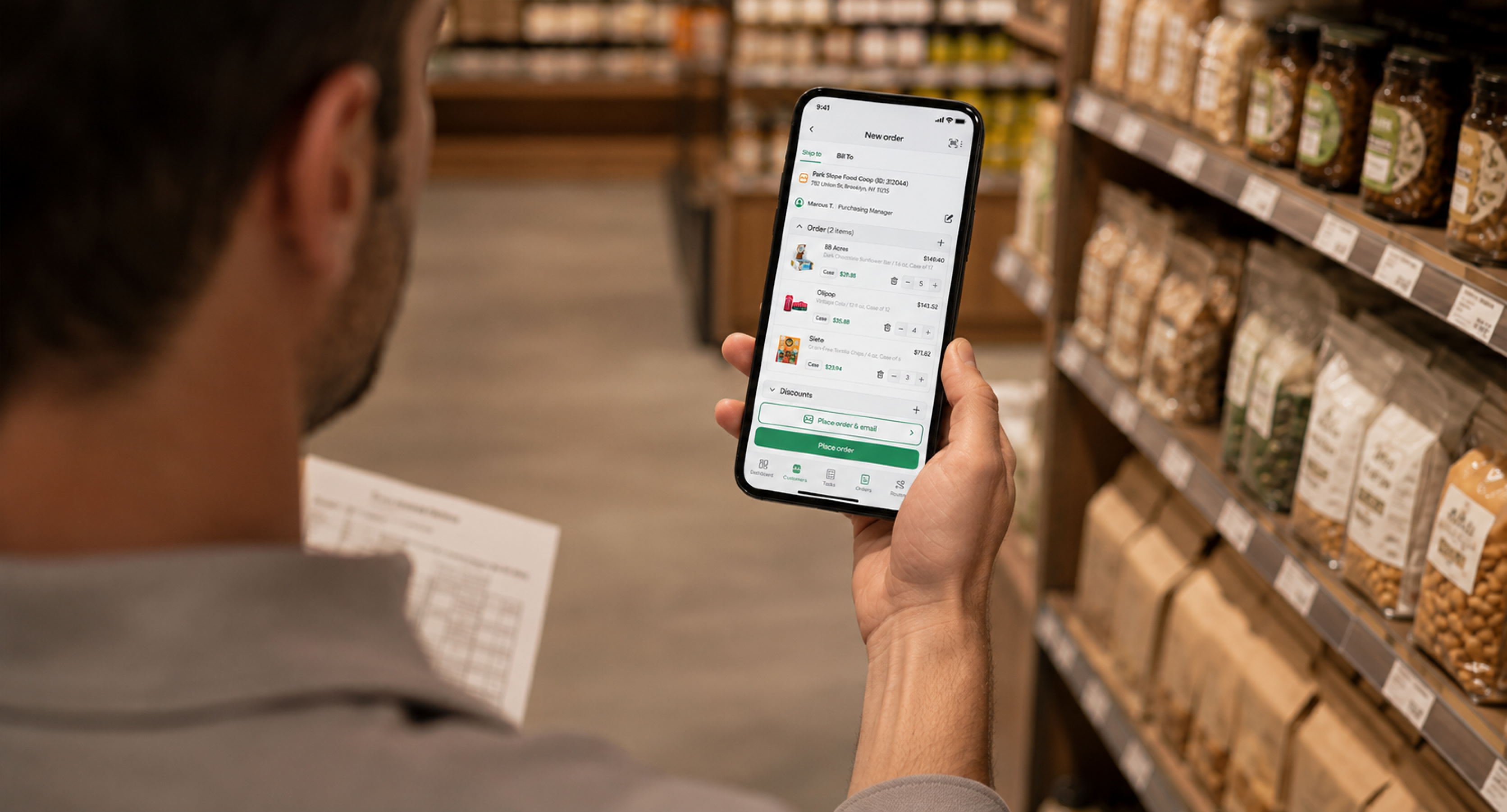
This is where retail execution software earns its place in the trade marketing stack. These tools give brands real-time visibility into whether a promotion is set up correctly. Reps capture shelf photos and compliance data on every visit, and the platform ties that in-store activity back to performance analytics.
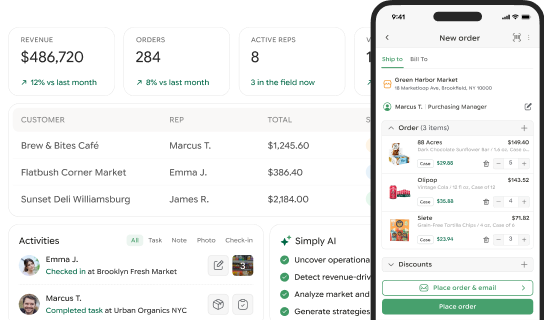
SimplyDepo brings that verification into one mobile-first platform. Reps complete store audits and capture photo proof so promotions and displays show as live and compliant. Managers get real-time dashboards covering sales activity, promotions, and in-store performance.
The analytics tie field execution to results, so brands can confirm campaigns run correctly and every account reflects the strategy. It turns trade spend from a number committed on trust into one a brand can watch reach the shelf and defend with data.
Book a free demo to see how SimplyDemo can support your trade marketing initiatives.
FAQs on trade marketing for CPG brands
Trade marketing is the full discipline of investing in supply chain partners to win distribution, shelf space, and sell-through. Trade promotion is one tactic within it: the temporary price cuts, displays, and allowances that drive short-term volume. Every trade promotion is trade marketing, but trade marketing also covers slotting, co-op advertising, and distributor programs.
Trade spend commonly runs 15 to 25% of gross sales, and McKinsey estimates around 20% of revenue goes to trade promotions specifically. It usually ranks as the second-largest line on the P&L after the cost of goods sold. The right figure depends on category, growth stage, and competitive intensity.
A useful benchmark is the efficiency ratio: incremental retail dollars generated per dollar of trade spend. Roughly two to three dollars of incremental sales per dollar of trade signals a healthy promotion, while less than one dollar means the spend is eroding margin. Measure ROI against incremental volume, never total promoted volume.
Trade marketing usually sits with a trade marketing manager or a revenue growth management function, positioned between the marketing and sales departments. Sales owns the retailer relationships, marketing owns the brand, and the trade marketing manager bridges the two while finance oversees the spend and its return.
A trade marketing manager often requires a degree in Marketing, and a specialized master’s program can strengthen your prospects. The role rewards anyone interested in both data and relationships, and strong performers can advance to senior positions like Sales Director as they take on larger accounts and budgets.
Common examples include slotting fees to get a new product listed, temporary price reductions, end-cap displays, co-op advertising, trade shows, and incentive programs that motivate a distributor’s sales team to prioritize a brand. Each one targets a channel partner rather than the end consumer.
 Rated 4.7 on G2
Blind spots on the shelf are costing you sales.
-
 September 16, 2026
 -
 September 15, 2026
 -
 September 15, 2026