What Is a Warehouse Order Selector? Role, Pay & Best Practices

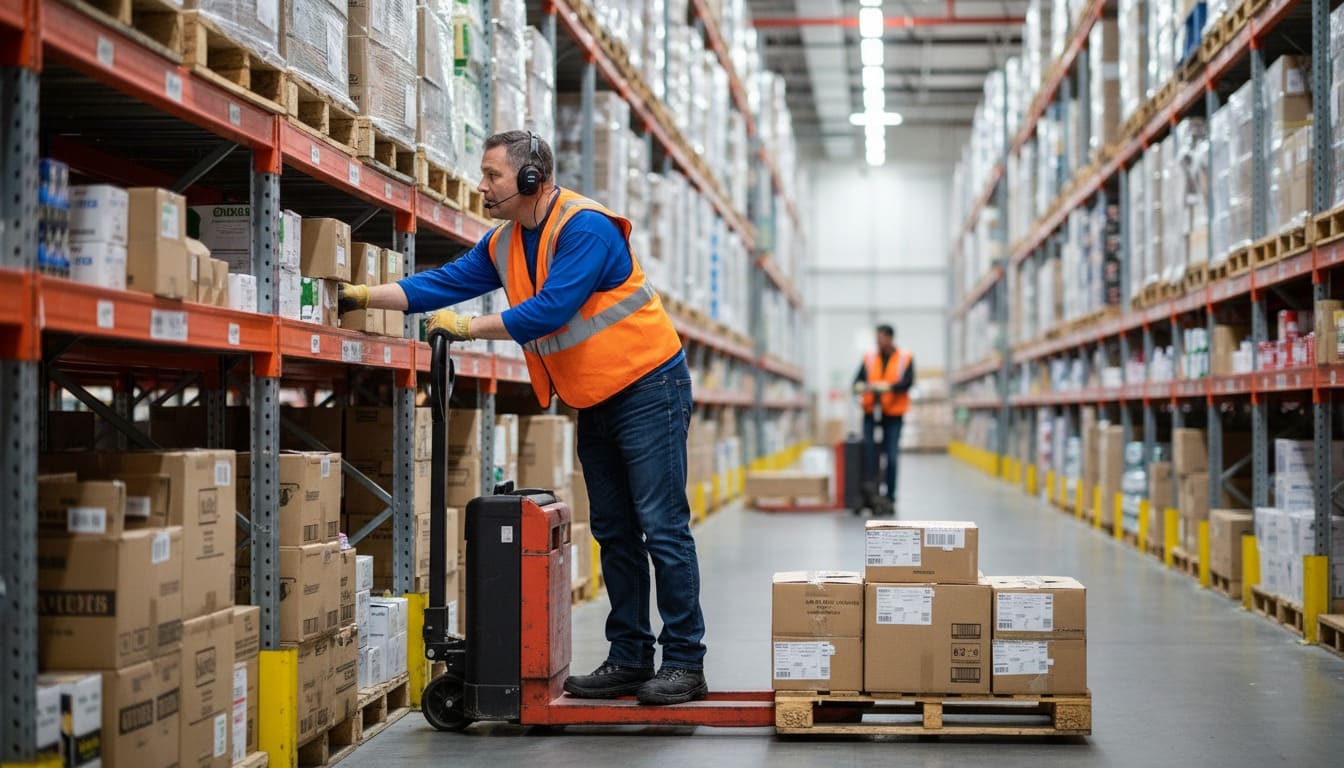
A warehouse order selector is the person who turns a customer’s order into a physical pallet. They read a pick list, travel to each location, pull the right cases in the right quantity, stack them so nothing crushes on the truck, and wrap the load for delivery.
In a food or beverage distribution operation, that job is the last point where an order can still be made right. It is also the first point where a wrong case becomes a credit, a chargeback, and a phone call from a store. For warehouse operators, distributors, and hiring managers trying to understand the role, pay, physical demands, and day-to-day standards behind the title, that makes order selecting one of the clearest drivers of customer service, labor cost, and injury risk in the building.
Job boards cover the title in about 250 words: pull stock, lift 50 pounds, high school diploma. What they skip is everything an operator needs. This guide covers what the role does, how it differs from related warehouse positions, what federal wage data says it pays, how the work gets measured, what the physical load and lifting look like in numbers rather than adjectives, where injury rates show up, and how to hire, train, and set the job up so your error rate and your injury rate both come down.
Warehouse Order Selector Job Description: What a Warehouse Order Selector Actually Does
The Bureau of Labor Statistics files order selectors under the occupation “Stockers and Order Fillers,” code 53-7065, and defines the work as receiving, storing and issuing merchandise “from stockroom, warehouse, or storage yard to fill shelves, racks, tables, or customers’ orders,” with the note that the worker “may operate power equipment to fill orders.” In practice, selectors help fill customer orders by handling different products in varying quantities.
That definition covers two different jobs, and the split matters when you write a job ad. A stocker moves product from the back of a store to the shelf. An order selector builds outbound orders for someone else to receive, so their output is judged by a customer rather than a manager.
In distribution, order selecting is almost always case-level work and part of broader warehouse operations. The selector pulls full cases off a pallet rack, and a single order for an independent grocer commonly runs a few dozen cases across dry, refrigerated and frozen zones. The role sits inside the wider order fulfillment sequence: an order arrives, a pick list is generated, the selector builds it, someone loads and delivers it. Speed and accuracy drive efficiency.
Three things separate a good selector from a warm body. They pull the right code date, not just the right SKU. They build a pallet that survives the drive. And they flag a short before the truck leaves, because attention to detail is what separates strong selectors from weak ones.
Order Selector vs Picker and the Roles Around It
“Warehouse picker order selector” is a single job posted under two names, and most operations use the terms interchangeably. Where a real distinction exists, it is about unit size: “picker” more often means each-level picking into a tote for parcel shipment, while “order selector” means case-level selection onto a pallet for route delivery.
The adjacent titles are genuinely different jobs, and conflating them in a job description is how you end up with the wrong hire.
| Role | BLS occupation | What they handle | Judged mainly on |
|---|---|---|---|
| Order selector | Stockers and Order Fillers (53-7065) | Cases onto a pallet for an outbound order | Pick accuracy, cases per hour, pallet build quality |
| Picker or packer | Packers and Packagers, Hand (53-7064) | Eaches into a tote or carton | Units packed, pack accuracy |
| Receiver or inventory clerk | Shipping, Receiving and Inventory Clerks (43-5071) | Inbound product and the paperwork against it | Receipt accuracy, put-away timing |
| Material mover or loader | Laborers and Freight, Stock and Material Movers (53-7062) | Finished pallets, trailers, staging lanes | Load sequence, dock throughput |
The confusing overlap is with the stock-record owner, who investigates why the shelf and the system disagree rather than filling orders, a separate job and pay band covered in the guide to the inventory control specialist. Keep the two budgets apart: a selector who spends half the week counting is not selecting, and your cost per case quietly doubles.
A Day on the Selection Floor
Selection runs backwards from the delivery schedule. Routes leave at a fixed time, so the pick window is fixed too, with the pace driven by customer demand and the need to close orders in a timely manner before the trucks load. Night selection is common in food distribution for that reason.
The cycle itself is short and repeats a few hundred times a shift. Reading the repeated tasks selectors perform step by step is what lets you find the seconds worth removing, which is where productivity actually comes from.
How One Pick Cycle Works
Seven steps repeat for every line on the order, and each one is a place where a control can be added or skipped.
- The selector receives the next line on the pick list, showing location, SKU and quantity.
- They travel to the slot, using pallet jacks or riding an electric rider to locate and move product and, in some operations, operating forklifts for heavy pallets.
- They confirm the slot by scanning a location barcode or speaking back a check digit.
- They pull the stated quantity, checking the code date against the rule for that product.
- They confirm the count, and the system either accepts it or flags a mismatch.
- They place the cases on the pallet in the sequence the load plan calls for.
- They move to the next line, and the pallet is wrapped and labeled when the order closes.
Step three is where most of the accuracy lives. A location check digit, a short number posted at the slot that the selector reads back, catches the most common error in the building: a selector standing one slot over from where they think they are.
Voice-directed systems put that check in a headset so the hands stay free, and scanner-based systems put it on a screen. Either way the confirmation is one of the tools used to work accurately, and skipping it to save two seconds a line is how an error rate appears that nobody can explain. Regular equipment checks and maintenance are required for safe operation.
The wider method choice, whether you pick order by order, in batches, or by zone, is a separate decision covered in order picking methods.
What a Warehouse Order Selector Gets Paid
There is no federal wage series for the job title itself, so a warehouse order selector’s pay has to be read off the wider occupation. BLS put the median for stockers and order fillers at $17.95 an hour, or $37,330 a year, in its May 2025 Occupational Employment and Wage Statistics release, with a mean of $19.01 an hour, across 2,833,810 jobs.
The spread matters more than the midpoint, because a distributor competing for selectors is competing against the top of the range, not the middle.
| Percentile | Hourly wage | Annual wage |
|---|---|---|
| 10th | $14.48 | $30,110 |
| 25th | $16.56 | $34,450 |
| 50th (median) | $17.95 | $37,330 |
| 75th | $21.47 | $44,650 |
| 90th | $23.68 | $49,260 |
Two adjustments put that in context. First, the occupation’s employment is dominated by retail: general merchandise retailers account for 871,910 of those jobs, food and beverage retailers another 655,900 and warehousing and storage 457,740, against just 87,770 in wholesale. The median is largely a retail-stocker number.
Second, wholesale pays above it. The last static industry breakout BLS published for this occupation, May 2023, showed a mean of $20.20 an hour, or $42,010 a year, against an all-industry mean of $18.27 that year, so it gives you a more relevant hourly rate for comparison.
BLS labels that row “4244 and 4248 only”, meaning grocery and beverage wholesalers specifically rather than nondurable wholesaling at large. That makes it the closest published figure to a food distributor’s own payroll. That is roughly a 10% premium for the same occupation code, and it is the figure to benchmark against if you staff a food or beverage warehouse rather than a store.
Job-board postings around New York and New Jersey currently show $18 to $23, which runs from just above the national median to near the 90th percentile. Those are advertised rates in a high-cost market, not survey data, so read them as local competition rather than a benchmark; in tight markets, both pay and benefits help attract selectors.
Why the Range Runs From $14 to Nearly $24
The gap between the 10th and 90th percentile is $9.20 an hour, and almost none of it is explained by the work being different. Four things move a selector’s rate.
Geography does the heaviest lifting, since the same job in a metro with high warehouse density pays what it has to pay to fill the shift. Shift timing comes next: selection that finishes before a 4 a.m. route departure carries a night differential in most buildings.
Temperature is third, and freezer selection is the hardest slot in any food warehouse to keep staffed. The fourth is incentive pay, where a building sets a baseline rate of cases per hour and pays above base for beating it, which pulls the top of its own range well past its posted starting wage and rewards selectors who maintain accuracy with strong attention to detail and organization skills.
If you are setting a rate, start from the 2023 wholesale figure rather than the occupation median, then add for wage growth since and for the conditions you are asking someone to work in.
The Physical Requirements and Load, in Real Numbers
Every job description reduces the physical demand to one line, “must lift up to 50 pounds,” and that line is useless for designing the job. The NIOSH Lifting Equation turns it into a figure you can check against a real slot.
The equation produces a Recommended Weight Limit for one specific lift. It starts from a load constant of 51 pounds, the most NIOSH considers acceptable under ideal conditions, then multiplies it down for everything about the lift that is not ideal.
How to Run the NIOSH Numbers on One Pick
The limit is that 51 pounds times six multipliers, each between 0 and 1:
- Horizontal, 10 divided by the reach in inches from ankles to hands. A 20-inch reach halves the limit.
- Vertical, 1 minus 0.0075 times the hands’ distance from 30 inches off the floor. Knuckle height is the free one.
- Distance, 0.82 plus 1.8 divided by the vertical travel of the lift.
- Asymmetry, 1 minus 0.0032 times the twist angle in degrees.
- Frequency, read from the manual’s Table 5 by lifts per minute and shift length.
- Coupling, 1.00 for a good handhold, down to 0.90 as the grip gets worse.
Divide the actual case weight by that limit and you get the Lifting Index. NIOSH’s design target is 1.0 or below, and above it the risk of lifting-related low back pain rises for some fraction of the workforce.
Run it on a real slot. Take a 40-pound case at floor level, reached at 20 inches, lifted about once a minute across a full shift, with a fair handhold. The multipliers come out at 0.50, 0.775, 0.88, 0.75 and 0.95, so the limit is 51 × 0.50 × 0.775 × 0.88 × 0.75 × 0.95, about 12 pounds. The Lifting Index is 40 ÷ 12, or 3.2.
Now fix the geometry. Move the same case to knuckle height and pull the reach in to 16 inches, and the limit roughly doubles to about 22 pounds. The index falls to 1.9, better and still nearly twice the target.
That is where most ergonomics advice stops, and it is the part worth understanding. At one lift a minute the frequency multiplier alone is 0.75, so the best limit available at that pace is 51 × 0.75, about 38 pounds, however perfectly the slot is built. A 40-pound case cannot reach 1.0 by re-slotting; the weight has to come down.
Which is where OSHA’s threshold comes from: at that pace a 35-pound case lands at 0.92, just inside the target.
OSHA gets to the same place with simpler thresholds in its warehousing hazards guidance, and these are the numbers to design slots around.
| Task | OSHA’s stated threshold |
|---|---|
| Case picking | Reduce case weights to 35 pounds or less |
| Cases over 35 pounds | Raise the pallet so cases are lifted between the knees and mid chest |
| Item picking | Keep items under 10 pounds, or 2 pounds with a pinch grip |
| Totes | Keep tote weights under 35 pounds |
| High-volume items | Place near standing elbow height |
OSHA also names what most productivity conversations leave out: stress and fatigue from a fast work pace and from continuous performance monitoring. If you run an incentive rate, that sentence is about your building.
What the Injury Numbers Look Like for Food Distribution
The risk is measurable and concentrated. In its 2024 survey of workplace injuries, BLS recorded 4.2 recordable cases per 100 full-time workers in grocery and related product merchant wholesalers, against 2.3 across private industry. The DART rate, cases serious enough to cause days away, restricted duty or a transfer, was 3.4 against 1.6 for wholesale trade generally.
Warehousing and storage as a whole runs higher still at 4.8 recordable and 4.1 DART. One figure cuts against intuition: refrigerated warehousing came in at 3.4, below the 4.9 recorded for general warehousing, the subset that excludes cold storage. So temperature is not what separates the highest-rate operations, even though OSHA notes that cold makes gripping and carrying harder. Case weight, reach and repetition are doing most of the work.
A grocery distribution warehouse runs at close to double the private-industry rate, and the design decisions above are what move it.
How to Measure an Order Selector’s Work
Four measures cover the job: pick accuracy, cases per hour, damage, and whether selectors complete customer orders accurately and in time for the route. Accuracy is the one that pays for itself, because every error costs twice, once in the credit and once in the trust you spend with a store that stops believing its invoices.
Worth saying plainly: there is no published national benchmark for cases per hour. No federal agency measures output for this occupation, and the industry surveys that do track picking productivity report ranges from self-selected participants rather than a standard you can hold your building to. What exists in the field are engineered standards each operation builds from its own time studies, specific to its slot layout, case mix and equipment.
So set your own baseline. Time management skills are what let selectors hit route deadlines and rate expectations consistently. Measure four weeks of actual selection by zone, take the median rather than the best week, and use that as the reference point.
Pair it with the gap between what was picked and what the store received, which tells you whether the rate is real or whether speed is being bought with errors. Damage rates and whether orders closed on a timely basis for the route come off the same records once you are capturing them. An accurate stock record is a precondition for all of it, and the practices behind that sit in warehouse inventory management.
Hiring and Training an Order Selector
BLS reports no formal educational credential and no prior work experience for the occupation, with short-term on-the-job training that typically runs from a few days to a month, usually shadowing an experienced selector. That means your training design, not your hiring bar, determines how fast a new selector becomes reliable.
For a new hire, the core responsibilities start with sustaining moderate physical work across a full shift, using a scanner or headset correctly, and stopping to flag a problem instead of guessing. A responsible candidate treats those as baseline responsibilities, not preferences, and that third point is the one that shows up in your credit memos six months later.
A structured first two weeks beats leaving the new hire with whoever is nearest.
- Certify on the pallet jack or rider before any production picking, with daily duties that include keeping the work area clean and organized.
- Pick alongside an experienced selector for the first several shifts, with the trainer confirming every location check and reinforcing communication and teamwork with loaders and other warehouse staff.
- Move to independent picking on one simple zone before rotating across the building.
- Audit every order for the first week and review each miss the same day.
- Introduce the rate expectation only once accuracy is holding.
Two weeks is a realistic ramp, and it matches what operations report when they change systems, though the closest published example is a software cutover rather than a selector ramp. The Las Vegas wholesale distributor Proglo World moved off pen and paper in roughly two weeks including rep training, then processed more than 200 orders in a single month with per-person daily capacity roughly tripling, from a handful of orders to ten or more.
The pattern holds inside the warehouse too. Throughput comes from removing re-entry and ambiguity, not from pushing people harder.
Best Practices That Cut Errors and Injuries Together
The useful thing about selection is that the changes reducing injuries are mostly the same ones reducing errors, because both come from confusion and awkward reaching.
Put your fastest-moving cases at knuckle-to-elbow height and leave the floor and the top beam for slow movers. Sequence the pick path so heavy cases land on the pallet first for accurate order assembly, which OSHA recommends and which also stops a selector restacking a finished pallet. During packing, stack boxes securely to prevent damage in transport. Cap stacked order height at shoulder level, and label slots so a check digit is readable without a second look.
Rotate people between zones so nobody spends eight hours on the identical motion, and build in warm-up time for anyone starting in a cold room. Where a case cannot come under 35 pounds, raise the pallet rather than asking for care.
None of this holds as a one-time project. It holds as a standing part of the wider warehouse management process, reviewed when your case mix changes to maintain the gains, because one new 45-pound SKU in a bottom slot undoes a year of good slotting.
Where Selection Meets the Sales Side
Most selection errors are not selection errors. They start earlier, when an order was written on paper in a store, re-keyed into an office system hours later, and reached the floor with a transposed quantity. The selector picks the list correctly and the store still gets the wrong thing.
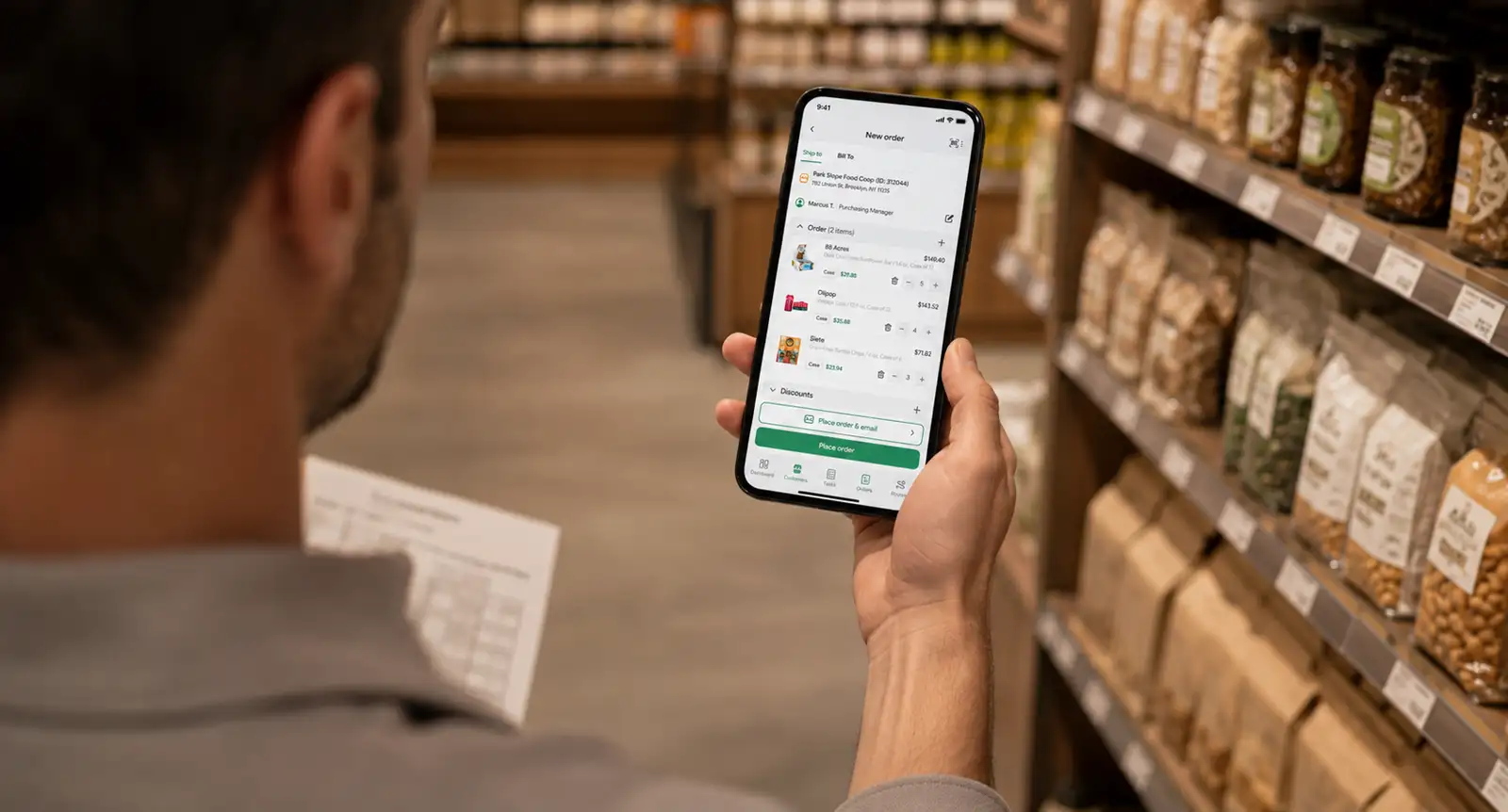
Closing that gap is mostly about where the order originates. SimplyDepo builds the selection list out of orders that are already paid and still unfulfilled, whether a rep wrote them in the field or a customer placed them through a self-service portal, then draws stock down as each one is fulfilled and pushes the result to QuickBooks Online on shipment. The effect is that the quantity on the selector’s list is the quantity the customer agreed to.
Its warehouse management scope is narrow and worth stating plainly. The platform hands you a list and keeps the stock record honest behind it; deciding the pick path, the slotting and the wave is a different category of software. Slotting optimization, wave and zone picking engines, automated pick-path routing, bin-location management, put-away and cycle counting all sit outside what it does.
Buildings that need those capabilities need a dedicated WMS. Only QuickBooks Online is supported, not the Desktop edition.
The practical reading for an operator: fix order capture first, because a clean pick list is worth more than a faster selector.
Career Path and Job Outlook
Selection is an entry point rather than a dead end. The usual progression runs from selector to lead or trainer, then to inventory control or a supervisory role, with advancement into warehouse operations leadership, including Operations Manager after 5+ years, often happening in busy distribution centers. If you’re interested in the field, it’s a real career path rather than a stopgap. Selectors who learn the stations either side of their own move fastest, because they can see the whole order fulfillment process rather than one step in it.
The demand picture is unusually strong for an entry-level occupation. BLS projects employment for stockers and order fillers to grow from 2,804,300 in 2025 to 3,055,000 in 2035, a rise of 9% and about 250,700 jobs, against 3% across all occupations.
That base figure sits slightly below the wage survey’s 2,833,810 because the projections program counts the occupation on its own methodology. It attributes the growth to orders prepared for pickup and delivery rather than picked off a shelf by a shopper.
For a distributor that is a hiring warning as much as a career note. The people you want are the people retail and e-commerce warehouses will be hiring too, which is the argument for paying the wholesale rate and designing the job well.
Order selection is a role most operations under-specify, then wonder why accuracy drifts. The pay data says what the job costs, the NIOSH and OSHA numbers say how to set it up, and the injury statistics say what getting it wrong costs, which underlines the essential role selectors play in keeping fulfillment accurate and efficient. All three are public and almost nobody uses them.
If your selectors work from lists re-keyed off paper, the biggest available improvement is not in the warehouse at all. Joining order capture to the selection list removes the re-entry step behind most shorts, though SimplyDepo stops short of the slotting and pick-path work a dedicated WMS does. To see how that fits your order flow, you can book a demo.
Frequently Asked Questions
A warehouse order selector is responsible for order selecting in a warehouse environment: reading a pick list, pulling the specified cases, and filling customer orders for stores by selecting different products in the right quantities. They stack the cases onto a pallet in a sequence that survives transport and close the order for loading. BLS files the work under stockers and order fillers, code 53-7065. In food and beverage distribution it also means checking code dates and flagging shorts before the truck leaves.
The median wage for stockers and order fillers was $17.95 an hour, or $37,330 a year, in the BLS May 2025 wage release, with the 10th percentile at $14.48 and the 90th at $23.68.
Expect to pay above the median in wholesale: when BLS last broke the occupation out by industry, in 2023, grocery and beverage wholesalers averaged $20.20 an hour while the all-industry average was $18.27. Night shifts, freezer work and incentive rates push real pay toward the upper percentiles, and some roles may offer overtime or require staff to work overtime during peak periods, depending on the shift and season.
In most job postings they are the same role, and “warehouse picker order selector” is one job with two names attached. Operations that do separate them use size as the dividing line: picking usually means single units into a tote bound for a parcel carrier, while selecting means whole cases onto a pallet bound for a delivery route.
Packer, receiving clerk and material mover are genuinely different jobs, tracked by BLS as separate occupations with their own pay bands.
It is among the more physically demanding warehouse roles. BLS put the 2024 injury and illness rate for grocery wholesaling at 4.2 recordable cases for every 100 full-time workers, roughly double the 2.3 recorded across private industry. The drivers are case weight, reach distance and repetition rather than temperature, which is why OSHA’s guidance recommends keeping cases at 35 pounds or less and raising the pallet for anything heavier.
No formal credential is required, and BLS reports short-term on-the-job training of a few days to a month. What matters is stamina across a full shift, accuracy under a pace target, comfort with a scanner or voice headset, and the discipline to confirm a check digit every time instead of working from memory. Employers usually provide the equipment certification.
-
 October 20, 2026
 -
 October 20, 2026
 -
 October 20, 2026