What Is B2B Sales? How It Works and What It Takes to Win

📌 Key takeaways:
- Selling B2B means selling to an organization rather than a person, which makes the buying decision a group process with several people who each get a say.
- U.S. merchant wholesalers sold $794.1 billion of goods in June 2026 alone, according to the Census Bureau, which is the scale of the repeat, resupply trade that the software-shaped version of B2B sales leaves out.
- Funnel, pipeline and cycle are three different things: the funnel is the shape of demand, the pipeline is your live deal list, and the cycle is elapsed time from first contact to signature.
- The stage where wholesale deals actually die is not the close, it is the second order, when a buyer who said yes never reorders because nobody went back.
B2B sales gets explained almost entirely through the lens of software. Read the top results for the term and you will find discovery calls, product demos, digital sales rooms and proposal tools, all of which assume a scheduled video call with a procurement committee.
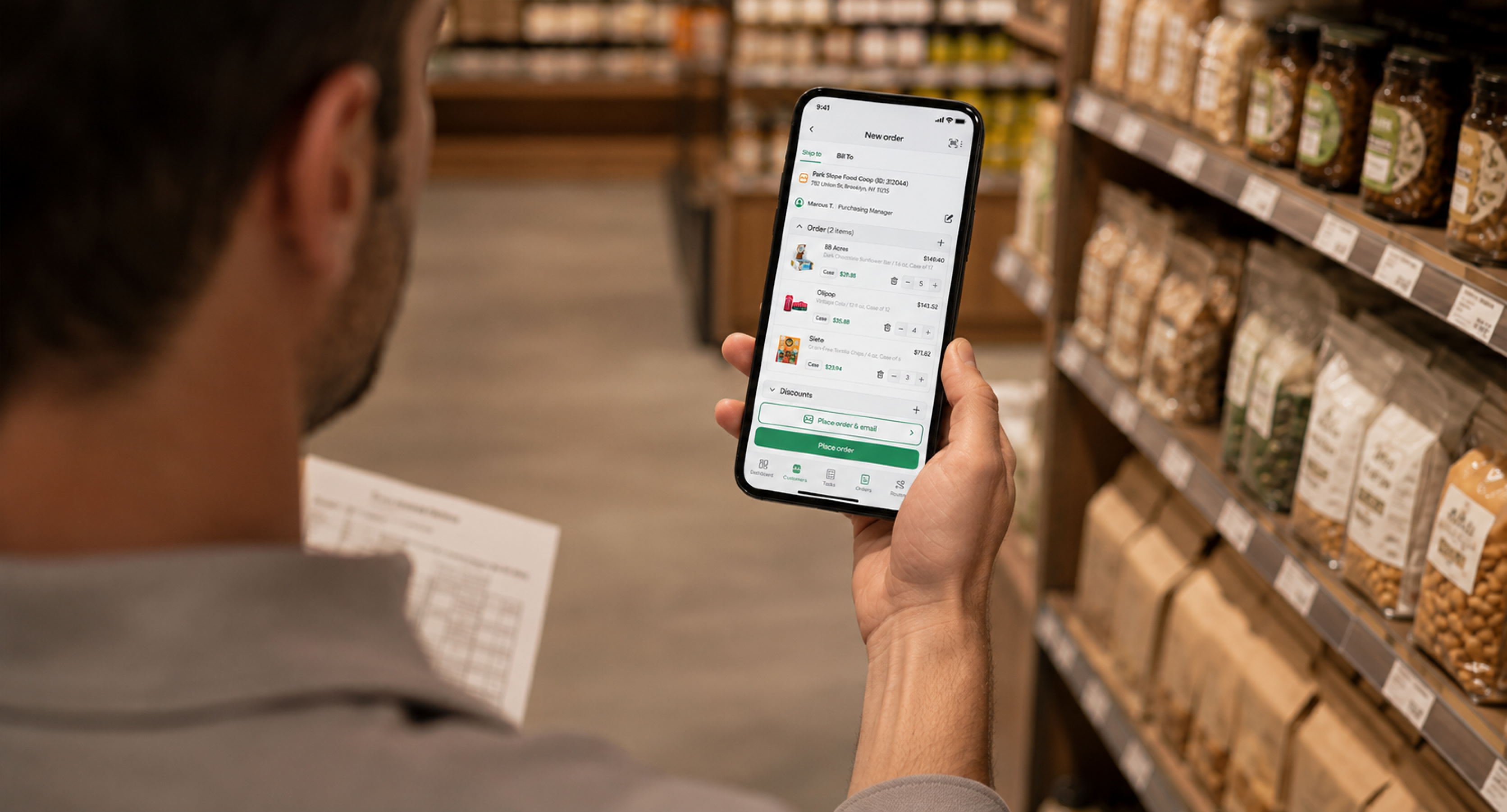
That is one real version of the job. It is not the version a beverage brand’s rep lives, walking into a bodega at 8:40 in the morning to find the owner restocking a cooler and willing to give them four minutes.
This guide covers both. It defines the term, walks the process stage by stage, separates the three words people use interchangeably, and spends real time on the part most guides skip: what B2B selling looks like when the same customer buys from you every two weeks and the whole relationship rides on whether the last delivery was right.
What Is B2B Sales?
B2B sales is the sale of products or services from one business to another business, rather than to an individual consumer. The buyer is an organization, the money is company money, and the purchase has to be justified to somebody other than the person you are talking to.
That last clause is the whole difference. A shopper who buys a case of sparkling water answers to nobody. A grocery buyer who takes on a new SKU has committed shelf space that has to earn its keep, and will be asked about it if it does not.
The term covers a wide range of transactions. A software company selling annual licenses to an enterprise is doing exactly that. So is a snack manufacturer selling pallets to a regional distributor, a distributor selling cases to 300 convenience stores, and a packaging supplier selling film to that manufacturer. The deal sizes, cycle lengths and sales motions differ enormously, but the structure holds: an organization is buying, and the purchase has to make business sense.
B2B Sales vs. B2C Sales
The two are often contrasted on deal size, which is the least useful difference. What actually changes how you sell is who decides, how long it takes, and whether the sale repeats.
| Dimension | B2C sales | B2B sales |
|---|---|---|
| Who decides | One person, often on impulse | Several people, each with a different concern |
| What justifies it | Personal want or need | A business case someone else will review |
| Cycle length | Seconds to days | Days to many months |
| Relationship after purchase | Often none | The point of the whole exercise |
| Pricing | Published and uniform | Negotiated, per-account, tiered by volume |
| Volume per buyer | Low, occasional | High, recurring |
The repeat column is the one that reshapes everything else. In consumer sales the transaction is the goal. In most B2B categories the first order is closer to an audition, and the revenue that matters arrives on the fourth, tenth and fortieth orders. That is also why the split between inside and outside sales matters more here, and why the two models suit different products, a distinction worth understanding before you staff a team.
Why B2B Buying Is a Group Decision
The most durable idea in B2B selling is over fifty years old. Writing in the Journal of Marketing in 1972, Frederick Webster and Yoram Wind proposed modeling industrial and institutional buying as an organizational decision-making process rather than an individual choice. The paper defines the dimensions of that model and draws out what it means for marketing strategy.
Framed that way, the person you are talking to is one input among several. Someone will use the product, someone controls the budget, someone else can veto on a technicality, and someone decides whether you get in the door at all. Those roles can sit with four people or with one, and they are worth identifying either way.
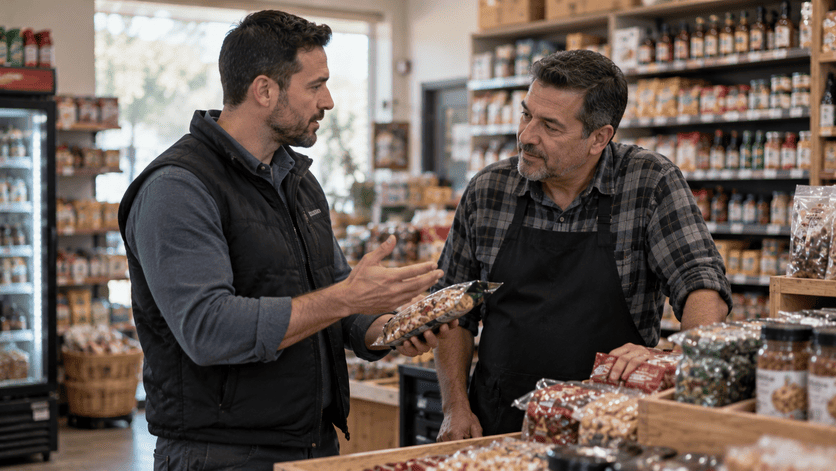
At an independent grocery store the whole set often belongs to the owner, who is also working the register. At a regional chain they scatter: a category buyer decides on the SKU, a receiving manager decides whether your delivery is workable, and an accounts payable clerk decides how quickly you get paid. Selling only to the buyer and ignoring receiving is how brands win a listing and then quietly lose it over rejected pallets.
The practical move is to ask, early, who else touches this decision. Many buyers will simply tell you, and knowing the answer changes what you bring to the second meeting, which is exactly what a well-built pitch to a retail buyer is designed to anticipate.
How Big B2B Trade Actually Is
B2B is not a niche adjacent to consumer retail. It is most of the economy’s plumbing, and the wholesale layer alone is enormous.
The Census Bureau’s Monthly Wholesale Trade Report put June 2026 sales by merchant wholesalers at $794.1 billion, up 14.1 percent on June 2025. Inventories stood at $944.7 billion at the end of the month, giving an inventories-to-sales ratio of 1.19, down from 1.30 a year earlier.
That ratio is worth pausing on, because it is a sales metric disguised as an economics statistic. It says wholesalers were holding roughly 1.19 months of stock against their selling rate, and holding less of it than the year before.
For a distributor, a falling ratio means goods are moving faster relative to what is on the floor. For a brand selling into distributors, it means your buyer is under pressure to stock what actually sells, and a slow SKU is a liability they can measure.
The B2B Sales Process, Stage by Stage
Most published sales processes run to seven or eight stages. The stage names vary; the sequence rarely does. What follows is the common spine, with the wholesale version noted where it diverges.
1. Prospecting
Build a list of organizations that plausibly need what you sell. In field and wholesale sales this is geographic as much as demographic: which stores in this ZIP code carry the category, and which of them are not carrying you.
2. Qualification
Establish whether they can buy, will buy, and are worth the drive. Qualification in wholesale is unusually concrete, because a store either has shelf space in your category or it does not, and you can see that from the aisle.
3. Discovery
Find out what the buyer is actually trying to fix. Margin, turns, a gap in the set, a competitor who keeps shorting them.
4. The pitch
Present what you sell against what they told you in discovery, not against your feature list.
5. Objection handling
Price, shelf space, and payment terms account for most of it. Answer with numbers, not reassurance.
6. Close
Get the first order written. In wholesale this is often small on purpose, a few cases to test movement.
7. Fulfillment and reorder
Deliver accurately, invoice correctly, and come back. This stage does not exist in most published processes, and in wholesale it is where the revenue lives. Getting the mechanics right here is largely a question of how disciplined your order management process is once the handshake is over.
Funnel, Pipeline and Cycle Are Not the Same Thing
Funnel, pipeline and cycle get swapped freely, and each measures a genuinely different thing. Mixing them up produces forecasts nobody can act on.
| Term | What it describes | What it is measured in | What it tells you |
|---|---|---|---|
| B2B sales funnel | The shape of demand as prospects narrow toward customers | Counts and conversion rates per stage | Where you are losing people |
| B2B sales pipeline | The live set of specific open deals and their stages | Dollar value and stage of each deal | What is likely to close and when |
| B2B sales cycle | Elapsed time from first contact to closed order | Days or months | How long cash takes to arrive |
A funnel is a model of the population. A pipeline is a list of real accounts with names on them. A cycle is a clock.
You can have a healthy funnel and an empty pipeline, which means marketing is working and nobody is following up. You can have a full pipeline and a lengthening cycle, which means deals are stalling rather than dying, and the fix is different in each case. Choosing between the various sales forecasting methods starts with being clear about which of the three you are modeling.
What Wholesale B2B Sales Really Looks Like
Here is where the standard guide stops being useful. In wholesale and direct store delivery, the sale is not an event. It is a cadence.
A rep covering 100 accounts is not running 100 deals. They are running a route, seeing a dozen or so stores a day, and at each stop they check the shelf, count what moved, write the next order, and go.
The close happened months ago. What the rep is doing now is protecting a recurring order against three things that quietly kill it: the product being out of stock when the shopper looks, the invoice being wrong, and nobody coming back for six weeks.
Ola Mate, an NYC functional beverage brand, is a clean example of the shape. Its founder AJ Scordio runs a hands-on model where reps visit stores daily, take orders on the spot, and manage merchandising displays. On its case study page the company reports its order correction rate falling from 25 percent to 5 percent, new store onboarding dropping from 7-10 days to 2-3 days, and payment reconciliation moving from 2-3 days to same-day sync.
Read those three numbers together and they describe one thing, which is the friction between saying yes and actually being supplied. That is the real problem in this category, and it is an operations problem at least as much as a persuasion problem. Persuasion opens an account; accuracy is what keeps it.
Building a B2B Sales Strategy
A strategy here means a small number of decisions made deliberately, not a document. Five of them do most of the work.
- Define the account you actually want, in terms you can check from outside: category, store count, geography, whether they already stock an adjacent product.
- Decide coverage before headcount, because how often each account tier gets visited determines how many reps you need, not the other way round.
- Set your price list architecture up front, including volume breaks and promotional allowances, so reps are not inventing terms at the shelf.
- Choose what a rep must capture at every visit, and keep the list short enough that it survives a busy morning.
- Pick the two or three numbers you will manage against, and ignore the rest for a quarter.
The third decision is the one teams most often postpone, and it is the most expensive to fix later. Once different accounts are paying different prices for reasons nobody wrote down, every invoice dispute becomes archaeology.
Keeping per-account price lists where they apply themselves to the order, rather than in a spreadsheet a rep consults from memory, is the practical reason teams adopt B2B order management software at all.
The Metrics That Show Whether It Is Working
Sales teams measure too much and act on too little. For a B2B team selling into retail or distribution, a short list covers the ground.
| Metric | How to read it | Trouble sign |
|---|---|---|
| Active accounts | Accounts that ordered in the period | Flat while new accounts rise, meaning churn is hiding growth |
| Reorder rate | Share of accounts placing a second order | Below your category norm, meaning you sell in but do not sell through |
| Average order value | Revenue divided by orders | Falling while order count rises, meaning reps are writing small safe orders |
| Order accuracy | Orders needing correction after submission | Anything you would not want read aloud to a buyer |
| Days to collect | Invoice date to cash | Drifting up quietly, which is usually a paperwork problem, not a credit problem |
| Visit-to-order rate | Visits producing an order | Low, meaning routes are running but selling is not happening |
Reorder rate is the one to watch first. It is the earliest honest signal that the product moves off the shelf rather than just onto it, and it is the number a distributor will ask you about. A fuller treatment of what to track and how sits in our guide to B2B sales KPIs, which goes deeper on targets by team size.
Where B2B Deals Break
Deals rarely collapse at the moment of decision. They leak at predictable seams.
- The buyer says yes and nobody schedules the follow-up, so the first order never gets written.
- The first delivery is short or late, and the account quietly stops answering.
- Prices differ between the rep’s quote and the invoice, so the buyer stops trusting the paperwork before they stop trusting the product.
- The rep who owned the relationship leaves, taking the account history with them because it lived in their phone.
- Nobody notices an account has not ordered in two months, because no report is built to surface silence.
The last one is the most common and the least visible. Growth reports show what happened; almost nothing shows what stopped happening. Building a review that lists accounts with no order in a defined window is a small piece of work that pays for itself the first time it catches a lapsed account before the competitor does.
What It Takes to Win
The reps who compound over years tend to share three habits, none of which are personality traits.
Strong reps know what is on the shelf before they walk in, because they looked at the last visit’s photo and the last order. They ask about the buyer’s business rather than presenting their own, which surfaces the objection early enough to answer it. And they treat the paperwork as part of the relationship, because the invoice is a message from you to the customer, and a wrong one says you are not paying attention.
Tooling matters here in one specific way. It decides whether that history is available at the moment the rep is standing in the store.
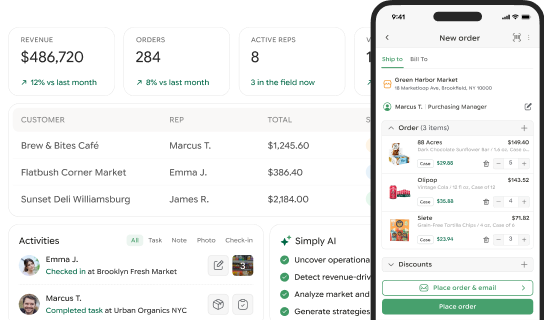
SimplyDepo keeps account history, order records, notes and visit photos in a mobile app built for that moment. The app works offline and syncs when the signal returns, so a basement stockroom or a rural route does not cost the rep the record.
The boundary is worth naming: this is field sales and retail execution tooling, not an ERP, and the books stay in your accounting system. A QuickBooks Online sync keeps the invoice a rep generates aligned with them.
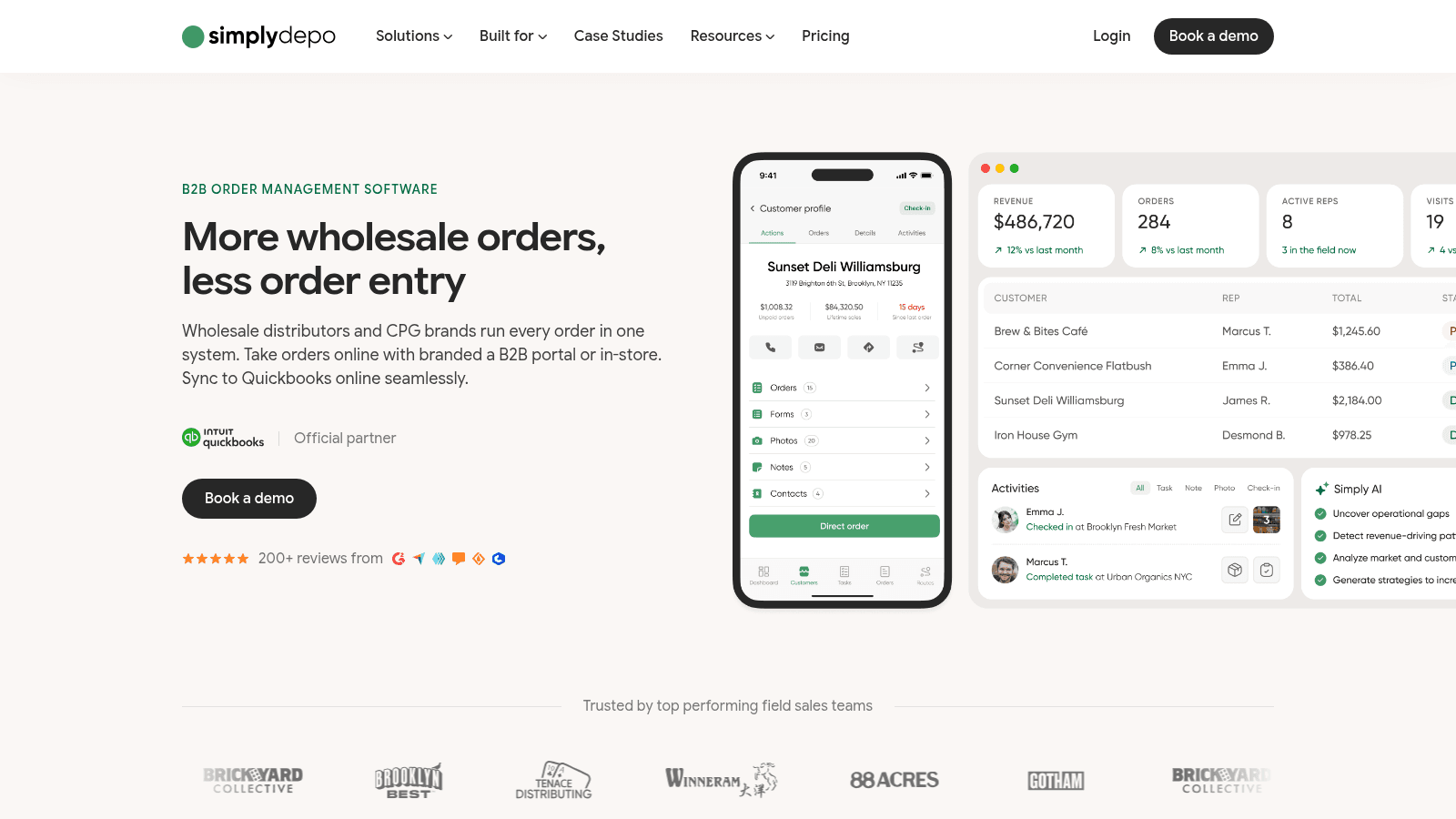
SimplyDepo’s B2B order management page, simplydepo.com (September 2026).
For teams running sales execution software for the first time, the honest test is whether a rep can complete a full visit without opening a second app.
Getting Started
The work rewards patience applied systematically. The definition is simple enough, an organization buying from an organization, but the practice turns on a handful of things the category’s own literature underweights: that several people share the decision, that the second order matters more than the first, and that operational accuracy is a selling skill.
If you sell into retail or distribution, start by measuring your reorder rate and your order accuracy for one quarter. Those two numbers will tell you more about the health of the business than any pipeline review. SimplyDepo serves operations running anywhere from one rep to a hundred, across the US and Canada. Onboarding and team training cost nothing, the trial runs 30 days, and the way in is a booked demo rather than a signup form.
Frequently Asked Questions
B2B sales is one business selling to another business rather than to an individual shopper. The practical consequences are that the money is company money, the decision usually involves more than one person, and the purchase has to be defensible to someone who was not in the room. That is why these cycles run longer than consumer purchases and why the relationship continues after the sale.
The funnel describes the shape of demand in aggregate, measured as counts and conversion rates between stages, and it tells you where prospects are dropping out. The pipeline is the concrete list of open deals with account names, values and stages attached, and it tells you what is likely to close. A funnel is a model; a pipeline is an inventory of real opportunities. Teams that treat them as synonyms usually end up forecasting from the wrong one.
Cycle length varies far too much by category for a single number to be meaningful, ranging from a same-day order at a store visit to a procurement process lasting several quarters.
The useful approach is to measure your own cycle from first contact to first order, segment it by account type, and watch the trend rather than the absolute figure. A lengthening cycle within one segment is worth acting on; a comparison against someone else’s average is not.
A workable B2B sales strategy answers a few questions explicitly: which accounts you are targeting and how you will recognize them, how often each tier gets contacted, what your pricing and promotional structure is before reps start quoting, what data must be captured at every interaction, and which two or three metrics you will manage against. Most failed strategies are not wrong about the market, they simply leave pricing architecture and visit cadence undefined until the problems surface.
No. Wholesale is one form of B2B sales, specifically selling goods in bulk to businesses that will resell them. The category also covers software licensing, professional services, raw materials and equipment, none of which are wholesale. The distinction matters because wholesale carries characteristics the broader category does not, particularly recurring reorder cycles, per-account price lists and physical delivery, all of which shape how the sales team has to work.
 Rated 4.7 on G2
Your reps are in the field. Do you know what's happening?
-
 September 16, 2026
 -
 September 15, 2026
 -
 September 15, 2026