Order Processing: The Complete Workflow for Distributors


📌 Key takeaways:
- Order processing covers the entire workflow from order placement to delivery and payment, while order fulfillment is the physical subset that sits inside it.
- A single order passes through multiple departments. Sales captures it, finance clears credit, the warehouse fulfills it, and IT owns the integrations that carry it between departments.
- Order processing can be manual, semi-automated, or fully automated, and the right mode depends on order volume and pricing complexity rather than on company size.
- Measure by stage instead of by one composite score, because order accuracy rate, order cycle time, and order fill rate each point to a different part of the workflow.
For distributors, order processing starts well before the warehouse touches an order and continues after the customer receives it.
Before fulfillment begins, the team checks pricing rules and payment terms. Operations confirms that enough stock exists to support the promise made to the customer. After delivery, finance uses the confirmed quantity to create the invoice and collect payment.
A mistake at any handoff can delay the order or create a discrepancy that surfaces days later.
For distributors, order processing goes far beyond warehouse fulfillment.
In this guide, we’ll follow the complete order processing workflow from order capture to payment. You’ll see who owns each stage and what has to happen before the order moves forward.
Where does order processing start and end?
Order processing starts when a customer places an order and ends when the invoice is paid and the cash is applied. It encompasses the entire workflow from order placement to delivery, plus the administrative work on either side of it.
Order fulfillment is only a part of that workflow. Fulfillment focuses on physically preparing and delivering products to customers, which covers picking, packing, loading, and dropping off at the store.
But order processing covers a whole lot more, including tasks beyond fulfillment. It verifies payment terms, checks stock availability before a commitment is made, applies customer-specific pricing, and issues the invoice afterward.
That range is why order processing is a multi-department process. Sales captures the order, sales ops validates it, finance clears credit and invoices, the warehouse fulfills, and IT owns the integrations that carry the order between them.
Sitting above all of this is order management, the wider function that tracks every open order, exception, and performance trend across the business.
What are the stages of the order processing workflow?
The most popular version of this workflow includes five main steps: placement, picking, sorting, packing, and shipping. This sequence fits an e-commerce operation well.
But a wholesale order is a different beast. It passes through eight, because pricing, credit, and invoicing wrap around that physical core. What counts at each boundary is who owns the order next and which event pushes it to them.
| Stage | Who owns it | What moves it forward | What goes wrong here |
|---|---|---|---|
| 1. Order placement and capture | Field rep, buyer, or EDI | Order submitted to the system | Wrong SKU, wrong unit of measure, missing PO number |
| 2. Pricing and validation | Sales ops | Order clears price book and rule checks | Stale price book, expired promo |
| 3. Credit and payment terms | Finance | Account cleared or hold released | Silent payment holds nobody chases |
| 4. Allocation | Inventory or operations | Stock reserved against available-to-promise | Overselling, wrong lot, or date code |
| 5. Picking and packing | Warehouse | Pick complete and loaded to the route | Short picks recorded nowhere |
| 6. Shipping and delivery | Driver | Proof of delivery captured | Rejections at the door with no evidence |
| 7. Invoicing | Finance | Invoice issued against delivered quantity | Invoice built from the ordered quantity |
| 8. Returns and post-purchase support | Customer service | Credit memo issued | Deductions taken without a matching credit |
How does an order get captured?
Where customer orders come from
Orders arrive from a rep’s mobile app, a buyer’s self-service portal, an emailed purchase order, an EDI connection, or even a phone call that you note down.
Coverage is more important than elegance here. A back room or a walk-in cooler will kill a signal, and offline capture is what stops an order being rebuilt from memory in the parking lot.
But when capture is digital, order details are recorded automatically on submission, removing the re-keying step where transcription errors enter. Channel strategy is a subject of its own, and multi-channel order management covers it properly.
What a wholesale order line has to carry
A retail order line needs a SKU, a quantity, and a customer’s address. But a wholesale line carries considerably more:
- The customer-specific price drawn from that account’s assigned price book
- A deal or promotion reference, with its own start and end dates
- Case pack and unit of measure, since a buyer who says “twelve” may mean cases, layers, or eaches
- Minimum order quantity and any pallet rounding rule
- Lot or date code requirements for dated goods
- The requested delivery window or route day
- The retailer’s PO number, which their accounts payable team will match against your invoice later
Each of those fields is either captured correctly at the point of sale or corrected expensively somewhere downstream.
What happens during validation and credit checks?
Two separate checks run at this stage, and teams that treat them as one spend more time chasing the wrong person for answers.
Pricing and rule validation
Sales ops owns this one. The system checks the order against the assigned price book, promotion eligibility and its date window, the approved SKU list for the account, minimum order quantities, and rounding rules.
When the orders check out, they’re released automatically, so only exceptions reach a human.
During this phase, you should treat a price override as a signal rather than as a fix. One override is a favor for a customer, while a pattern of overrides on the same account usually means the price book is wrong, and correcting the record fixes the issue.
Verifying payment and credit terms
Finance owns this one. The check covers open balance against credit limit, aged receivables, and the terms on the account, whether those are net 30, COD, or prepayment.
A credit hold with no named owner and no expected resolution time is the easiest way to lose an order. Since no one flags it, the rep assumes it cleared, and the buyer finds out on delivery day.
💡 Pro tip:
Set a standing rule that any credit hold older than 24 hours goes to the rep who owns the account, not just to finance. The person with the customer relationship is the one who can resolve it or kill the order.
How does allocation reserve stock against a promise?
Confirming an order means committing stock, and that has to run against available-to-promise rather than on hand.
On-hand quantities include units already reserved for other orders, so a team that commits against them will sell the same pallet twice in one morning.
The simplest way to verify the numbers is with real-time synchronization between the order system and inventory. With real-time inventory management in place, you reduce the risk of both stockouts and overstocking. Cloud-based inventory management takes care of how that sync works.
The real decision comes when there isn’t enough stock to fill the order. You have four ways to handle the shortfall:
- Substitute a comparable SKU, which works when the buyer approves substitutions in advance
- Backorder the balance, which suits an account on a weekly route and complicates one that ordered for a weekend promotion
- Short ship and close the line, which is cleanest for the warehouse, and has to be visible on the invoice
- Split into two deliveries, which serves the customer and costs a second trip
The rep who owns the account should make that call before pick release. For dated goods, this stage also selects lot codes, usually first-expired-first-out, unless a retailer’s minimum shelf life requirement overrides it.
How do warehouse teams handle picking and packing?
Warehouse staff pick and pack items according to the specifications on the order, and the method depends on volume and layout. Piece picking handles one order at a time, zone picking assigns each picker an area, and batch picking collects several orders in a single pass.
You can reduce picking errors with mobile picking and barcode scanning. This way, a wrong scan stops the pick instead of surfacing at a store two days later.
By standardizing the packing process, you keep handling consistent, especially for case and pallet volumes. Shipping packaging follows the product, since chilled goods and mixed pallets each need their own rule.
Then the distribution specifics take over. A distributor builds to a route rather than to a carrier, so loading runs in reverse stop order and the first delivery sits at the tailgate. This is one of the operational differences that makes direct store delivery its own discipline.
Short picks belong on the order record immediately. The warehouse learns about a shortfall first, and if that number isn’t passed on, the invoice and the delivery won’t match.
What happens between delivery and payment?
The order is not finished when the truck leaves.
Proof of delivery closes the physical handoff. If there’s ever a disputed invoice, a signature or photo captured at the stop, timestamped and tied to the order record, is the evidence you need. Automated notifications keep the buyer updated on order status along the way, which cuts down on calls asking for updates.
You should also watch out for delivered quantities that can change at the door. A receiver might reject damaged cases, refuse an over-shipment, or take the order short because the back room is full. In those cases, the driver has to record the adjustment on the spot. Capturing those changes is part of why closing a route properly takes more than an empty truck.
The invoice then has to be built from the delivered quantity instead of the ordered quantity.
Deductions close the loop. Retailers short-pay invoices for shortages or compliance misses, and each deduction has to be matched back to a specific order to be disputed or written off. Post-purchase support handles what remains, including order tracking, returns, and exchanges.
When does an order stop being editable?
Every order reaches a point where a change costs more than it saves, and publishing those points is what stops sales and the warehouse arguing over it every week.
Four cutoffs cover most operations:
- Price and quantity lock when validation clears
- Line-level changes lock at pick release
- The delivery date locks at route cutoff
- Quantity is final at proof of delivery
A change requested after its cutoff is a new transaction rather than a simple edit. You should handle it as a second order or a credit memo. A re-picked order that no longer matches the paperwork on the truck creates work for your driver and for accounting.
Is your order processing manual, semi-automated, or fully automated?
Order processing can be manual, semi-automated, or fully automated, and operations rarely sit in one mode for so long.
- Manual processing means orders arrive by phone or email and someone enters them into a system. It works at low volume, where the constraint is labor cost per order rather than technology.
- Semi-automated processing covers digital capture that feeds manual validation, or automated validation that feeds a warehouse still running on printed sheets. This is the most common state, and it is worth pointing out, because teams tend to assume they are further along than they are.
- Just-in-time processing triggers replenishment as orders arrive, which minimizes excess stock and suits short shelf life categories where holding inventory is the larger risk.
- Real-time processing updates continuously, so a buyer checking order status and a picker reading a task list see the same information at the same moment.
An integrated order management system is what moves an operation between these modes. By automating repetitive tasks, you remove the handoffs where errors enter, and automated order processing reduces both the manual effort and the error rate.
How do you measure order processing performance?
Perfect order rate is the metric everyone quotes, and on its own it tells you something broke without telling you where. Measuring by stage fixes that.
Entry-stage metrics
- Touchless order rate: The share of orders that clear validation with no human edit
- Order accuracy rate: The percentage of error-free orders at entry
- Credit hold rate and average hold duration: How often orders go on credit hold and how long they stay there
- Time from submission to confirmation: How long it takes to validate and confirm an order after the customer submits it
Fulfillment-stage metrics
- Order fill rate: The percentage of orders filled completely from available stock
- Order cycle time: The average elapsed time from order placement to delivery
- On-time delivery rate: The percentage of orders delivered within the promised delivery window
- Return rate: The share of orders that customers send back
- Perfect order rate: The composite that sits on top, which combines accurate orders, on-time delivery, undamaged goods, and correct invoicing
Watch the perfect order rate first. When it moves, check the stage metrics to find which one changed.
What breaks first as order volume grows?
Each stage reaches its breaking point at a different time.
- Capture breaks first, since volume multiplies transcription work directly, and no version of manual entry gets faster with practice.
- Allocation breaks second, when several reps commit against the same stock inside a batch update window and nobody finds out until the pick.
- Invoicing and deductions break last and hurt the most, because the damage surfaces 30 to 60 days later. At that point reconstructing what was delivered depends on paperwork that wasn’t kept properly.
What accelerates the disruption is seasonality. If you have a sales forecasting system in place, your teams can plan staffing for peak weeks in advance.
💡 Interesting to note:
McKinsey’s 2024 B2B Pulse Survey found that B2B customers now use an average of ten interaction channels across their buying journey, up from five in 2016. Every channel you accept orders through is another entry point that has to connect to the same queue.
Bring the whole workflow into one record
Eight stages, seven owners, one order. What costs distributors margin is not one slow stage. It is the order being reconstructed at each handoff, from a rep’s notes into a spreadsheet, and from a spreadsheet into a pick sheet.
B2B order management software exists to hold all of it in one record. The tool covers order capture and validation, pricing rules, inventory availability, order status, fulfillment, and reporting, so the same order moves through every stage without being re-entered.
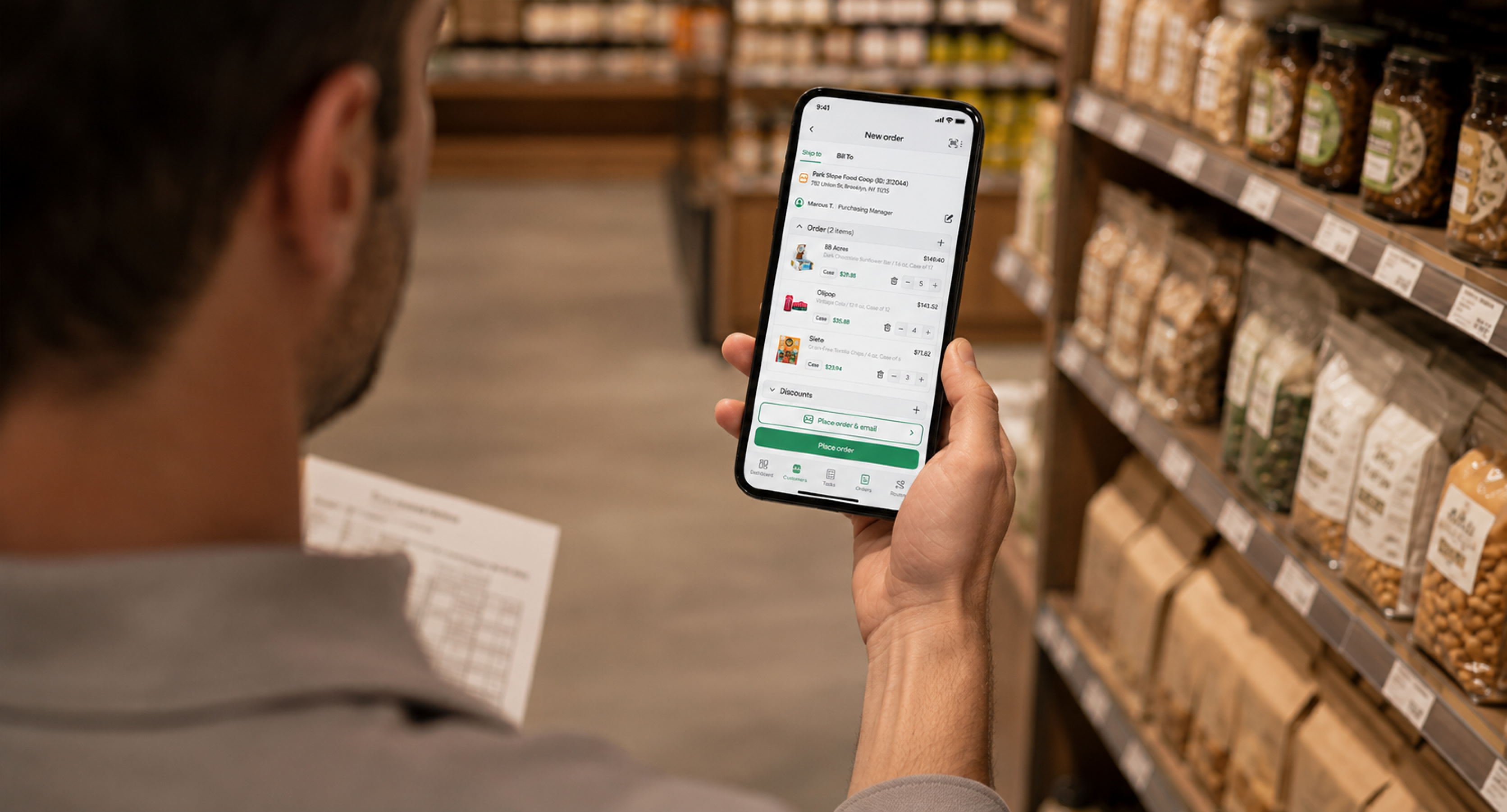
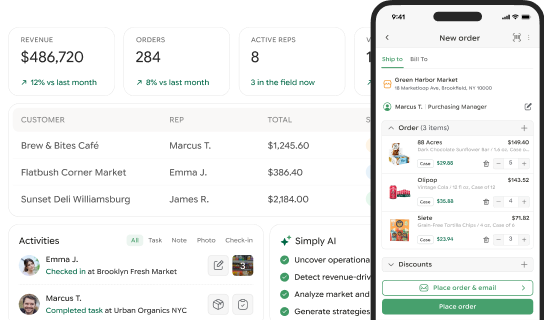
SimplyDepo is built around that model for CPG brands and wholesale distributors. Reps capture and update orders, notes, and pricing on a mobile app with offline support and real-time sync. So if they take an order in a back room with no signal, it lands in the queue once the device reconnects.
Features like customer profiles, order history, and pricing agreements are available in one place, which gives reps full context before a visit. Orders and invoices sync natively with QuickBooks Online, removing the manual reconciliation step between operations and accounting. For route-based operations, order data flows into route planning and delivery, and proof of delivery is captured at the stop.
That Tuesday morning order goes in once and comes out paid. Book a demo to see how SimplyDepo helps you with order processing.
FAQs on order processing
Order processing means moving a customer order from the moment it is placed to the moment it is paid. The entire order processing workflow covers capture, pricing validation, payment terms, inventory allocation, picking, delivery, and invoicing.
Accurate order processing begins at capture rather than in the warehouse, since a wrong unit of measure or a stale price follows the order through the entire process. When a buyer sees an order marked as processing, it has been captured and is moving through validation and allocation, and it has not yet been picked.
A rep takes an order for twelve cases at a convenience store. The system checks that account’s price book and promotion dates, finance confirms the credit terms, and the warehouse reserves stock against available inventory.
The widely popular model of sales order processing lists five steps from there: order placement, picking orders, sorting, packing, and shipping. A distributor adds a credit check before fulfillment and payment processing afterward, since fulfilling customer orders on wholesale terms means the invoice follows delivery rather than checkout.
An order processing job is any role responsible for processing orders through part of a workflow. Titles vary, and in distribution centers you will find order entry clerks, order processing specialists, inventory controllers, and warehouse associates who pick and pack.
Sales ops validates pricing, finance clears credit and issues invoices, and drivers close out the delivery.
Manual order processing roles carry the most exposure to human error, because re-keying an order by hand is where wrong quantities and wrong prices enter the record.
The order fulfillment process is the physical half: picking, packing, loading, and delivering products to customers. Order processing surrounds it and adds verifying payment terms, checking inventory levels, applying customer-specific pricing, and invoicing against what was delivered.
Fulfillment is a subset, and the distinction is a key element in deciding where to fix a problem.
A late delivery is a fulfillment issue, while an order that sat three days on an uncleared credit hold never reached fulfillment at all.
Order processing software holds capture, pricing, allocation, fulfillment, and invoicing in one order record. Order processing systems overlap with two other tools.
Order management software adds visibility across every open order, while a warehouse management system governs storage, inventory tracking, and pick paths inside the building. And automated order processing solutions layer rules on top, so compliant orders are released without a human touch.
Same-day confirmation is a reasonable target for orders that clear validation without a human edit. Total cycle time depends more on route day and order cutoff than on system speed, since an order confirmed Tuesday for a Thursday route will not arrive sooner.
Measure your existing processes for a month before setting a target, because supply chain performance varies by category and route density. Efficient order processing does more than save money on labor, because delivering when you said you would is what will improve customer satisfaction on repeat accounts.
 Rated 4.7 on G2
Still re-entering orders manually?
-
 September 16, 2026
 -
 September 15, 2026
 -
 September 15, 2026